# BitLab Full Content
## Page: https://bitlab.co/about
# About BitLab
BitLab is a Toronto-based venture studio and fractional CTO service founded in 2013 by Shoukri Kattan, focused on healthtech and fintech startups.
## Key Facts
- Founded: 2013
- Headquarters: Toronto, Ontario, Canada (1200 Bay Street, Suite 1201)
- Founder and CEO: Shoukri Kattan (former Ericsson Director of Engineering, 20+ years experience)
- Team: 50+ (40+ senior engineers, 0 junior developers)
- Products shipped: 50+ in regulated industries
- Capital raised by clients: $100M+
- Compliance audit failures: 0
- Internal product: Caesar Health (7-agent AI platform for medical clinics)
## What We Do
- Fractional CTO for healthtech and fintech startups
- Compliance-native architecture (HIPAA, PCI-DSS, SOC2, HITRUST)
- EHR/EMR integration (Epic, Oracle Cerner, athenahealth, eClinicalWorks, ModMed, 40+ others)
- AI/ML development for healthcare
- Project rescue and codebase remediation
- Go-to-market strategy for regulated industries
## Anti-Agency Philosophy
We turn vision into product by understanding the business, not delivering specifications. We focus exclusively on regulated verticals where compliance is built into our architecture from sprint one.
## Contact
- Email: hello@bitlab.co
- Phone: (877) 899-0333
- Website: https://bitlab.co
## Page: https://bitlab.co/case-studies
# BitLab Case Studies
How BitLab helps healthtech and fintech startups ship products, rescue failed projects, and pass compliance audits.
## Featured Outcomes
- Genoplex: shipped in 60 days
- Caesar Health: 7-agent AI platform built and operating in HIPAA-compliant clinics
- MONMEDX: McGill University partnership, live in clinics across the US and Canada with full EMR integration
- 50+ products shipped across healthtech and fintech
- 15+ projects rescued after other teams failed
- 0 compliance audit failures
## Verticals We Serve
- HealthTech: HIPAA-compliant platforms, EHR integration, healthcare AI agents
- FinTech: PCI-DSS architecture, payment infrastructure, regulated data handling
- IoT: Industrial-grade IoT for medical and non-medical applications
## How To Engage
Apply for a free 48-hour codebase + team audit at https://bitlab.co/fractional-cto/apply.
## Page: https://bitlab.co/contact
# Contact BitLab
Book a discovery call or apply for a free 48-hour codebase + team audit.
## Contact Information
- Email: hello@bitlab.co
- Phone: (877) 899-0333
- Headquarters: 1200 Bay Street, Suite 1201, Toronto, Ontario, Canada, M5R 2A5
## Book a Discovery Call
https://calendly.com/d/ct29-46r-77g/discovery-call-with-bitlab-team-round-robin
## Apply for the Free Audit
https://bitlab.co/fractional-cto/apply
We accept 5 new audits per month. The audit is free for qualified seed-stage healthtech and fintech startups.
## Page: https://bitlab.co/fractional-cto/fintech
# Fractional CTO for FinTech Startups
BitLab provides fractional CTO services for fintech startups, starting at $2,000/month.
## What's Included
- Senior CTO with 20+ years experience
- Senior-only engineering team (no juniors)
- PCI-DSS, SOC2 compliant architecture from sprint one
- Payment infrastructure design
- Banking partner integration
- 90-day delivery methodology
## Free 48-Hour Audit
Every engagement starts with a free 48-hour codebase + team audit:
1. Architecture review and structural risk map
2. PCI-DSS compliance assessment
3. Technical debt and risk inventory
4. 90-day prioritized roadmap and 60-minute strategy call with our CTO
## Pricing Tiers
- Advisory: $2,000/month
- Build: $4,000/month
- Embedded CTO: $12,000/month
Apply at https://bitlab.co/fractional-cto/apply
## Page: https://bitlab.co/fractional-cto
# Fractional CTO Services
BitLab offers fractional CTO services for healthtech and fintech startups starting at $2,000/month.
## What You Get
- A senior CTO with 20+ years of experience
- A senior-only engineering team (no juniors)
- Compliance-native architecture (HIPAA, PCI-DSS, SOC2, HITRUST)
- 90-day delivery methodology
- Free 48-hour codebase + team audit included with every engagement
## Pricing
- Advisory: $2,000/month (weekly strategy calls, architecture review, technology roadmap)
- Build: $4,000/month (hands-on development leadership, compliance architecture)
- Embedded CTO: $12,000/month (full technical leadership, investor meetings, hiring support)
## Verticals
- HealthTech: https://bitlab.co/fractional-cto/healthtech
- FinTech: https://bitlab.co/fractional-cto/fintech
Apply at https://bitlab.co/fractional-cto/apply
## Page: https://bitlab.co/fractional-cto/healthtech
# Fractional CTO for HealthTech Startups
BitLab provides fractional CTO services for healthtech startups, starting at $2,000/month.
## What's Included
- Senior CTO with 20+ years experience
- Senior-only engineering team (no juniors)
- HIPAA-compliant architecture from sprint one
- EHR/EMR integration capability (Epic, Oracle Cerner, athenahealth, eClinicalWorks, ModMed, 40+ others)
- Healthcare AI / agentic workflow design
- 90-day delivery methodology
## Free 48-Hour Audit
Every engagement starts with a free 48-hour codebase + team audit:
1. Architecture review and structural risk map
2. HIPAA compliance assessment
3. Technical debt and risk inventory
4. 90-day prioritized roadmap and 60-minute strategy call with our CTO
The report is yours to keep whether you hire us or not. No credit card required.
## Pricing Tiers
- Advisory: $2,000/month
- Build: $4,000/month
- Embedded CTO: $12,000/month
## Track Record
- 50+ healthtech and fintech products shipped
- 0 compliance failures
- 15+ projects rescued
- $100M+ raised by clients
Apply at https://bitlab.co/fractional-cto/apply
## Page: https://bitlab.co/methodology
# Build, Launch, Grow Methodology
BitLab's three-phase delivery methodology for healthtech and fintech startups, designed to ship products in 90 days.
## Build
- Compliance-native architecture from sprint one (HIPAA, PCI-DSS, SOC2)
- Senior-only engineering team
- Architecture decisions documented and reviewed
- EHR / payment / regulated data integration scoped early
## Launch
- 90-day MVP delivery cadence
- Production-grade infrastructure (no demoware)
- Compliance audit readiness on launch day
- Investor-ready technical due diligence package
## Grow
- Scaling architecture for 10x and 100x load
- Team augmentation with senior-only engineers
- Continuous compliance posture review
- Product iteration based on user feedback and clinical / financial metrics
## Outcomes
- 50+ products shipped
- 0 compliance failures
- 15+ rescues delivered
- $100M+ raised by clients
Learn more or apply at https://bitlab.co/fractional-cto/apply
## Page: https://bitlab.co/partnerships
# Partner with BitLab
BitLab partners with technology vendors, channels, and strategic builders to accelerate healthtech and fintech outcomes.
## Partner Tracks
- Technology partnerships: integrations with EHR/EMR, payment, and compliance platforms
- Channel and referral: agencies, accelerators, and advisors who refer qualified startups
- Strategic co-build: jointly designed and delivered products in regulated verticals
- Compliance partnerships: legal, audit, and certification firms for HIPAA, PCI-DSS, SOC2
## Why Partner
- 50+ shipped products and 0 compliance failures
- Senior-only engineering team
- 90-day delivery methodology
- Toronto headquarters with global delivery
Contact partnerships at hello@bitlab.co
## Page: https://bitlab.co/emr-integration
Title: EMR integration services for healthtech teams
Updated: 2026-10-11
EMR integration connects your product to the electronic medical record a clinic already runs, so data moves both ways without anyone retyping it. BitLab designs, builds and rescues those integrations for healthtech companies. We run them in production on athenahealth, ModMed and EZDERM through our sister product, Caesar Health, and our founder tracks about 200 EMRs and has spoken with around 100 of them.
The build is rarely the hard part. Getting in is. Every vendor has its own door, its own review, and its own idea of what a third party may touch.
## There are three ways into an EMR
**1. Open developer program.** You register, get sandbox credentials, build against published APIs, and the vendor reviews your app before a practice can switch it on. eClinicalWorks works roughly this way for its certified FHIR APIs.
**2. Marketplace or partner program.** You apply, sign the partner terms, build, pass the vendor's validation, and get listed where its customers shop. athenahealth's Marketplace and ModMed's partner program are the examples most teams meet first. Validation and paperwork take more calendar time than the code.
**3. Enterprise, customer-sponsored access.** The big hospital-grade systems, Epic and Oracle Health above all, open most doors only when a customer organization sponsors and configures your app. Your sales cycle and your integration timeline become the same thing.
**When there's no door for the job.** Plenty of EMRs publish nothing for the workflow you need. The options are a vendor-built interface (often HL7 v2, often paid), the practice's own data export, or a browser agent the practice authorizes to work the EMR as a named user. Read the vendor's terms before choosing the last one. Some forbid automated access, and the practice owns that decision.
## What FHIR gets you, and what it doesn't
Every certified US EHR has to offer a standardized FHIR API for patient data (the ONC (g)(10) criterion). That makes clinical **read** reasonably consistent: demographics, problems, medications, allergies, results, documents.
What it doesn't standardize is where clinic operations live:
- **Scheduling.** Booking, rescheduling and appointment types are rarely writable through the certified API. Some vendors expose them in a proprietary or partner API. Many don't.
- **Writing back.** Filing a note, a document or an order into the chart usually needs a vendor-specific API, partner status, or both.
- **Practice management.** Billing, eligibility and claims sit in a separate module with its own access rules.
Scope those three on day one. They decide your real timeline.
## Where integrations actually stall
- **Access, not code.** App review, partner applications and the customer switching your app on all run on someone else's calendar.
- **The closed half.** Teams scope the integration against the open API, promise the workflow, and find in month four that scheduling or write-back isn't exposed.
- **Fees nobody budgeted.** Partner programs and vendor interfaces can carry per-practice or per-call costs. Ask before you price your product.
- **A partner badge isn't distribution.** A listing gets you into the catalog. It doesn't sell for you, and the platform can change its terms.
- **Variants.** The same vendor name can mean different products, versions and hosting. Confirm which one each customer runs.
## How we run an EMR integration
1. **Map the workflow to the door.** For each job (read the chart, book, file a document, write a note) we confirm which access path covers it on that EMR, from the vendor's own documentation.
2. **Scope the closed half first.** If a step has no published API, we decide the fallback before anyone commits a date.
3. **Build once per EMR, not once per customer.** One adapter, configured per practice, tested against the vendor sandbox and a real workflow.
4. **Plan the paperwork in parallel.** Partner applications, validation and security reviews start the week the build does.
5. **Monitor in production.** Vendors change screens, versions and rate limits. Integrations need an owner after launch.
If your integration has already stalled, [here's how we unstick it](/fractional-cto/healthtech/integration-stall).
## FAQ
### What is EMR integration?
EMR integration connects a healthcare product to the electronic medical record a clinic uses, so patient data, appointments and documents move between the two systems without manual re-entry. It usually combines a standard FHIR API for clinical data with vendor-specific APIs or interfaces for scheduling and write-back.
### How long does an EMR integration take?
The engineering on a well-documented API is usually measured in weeks. Access is what stretches it: app review, partner validation and the customer's activation can add months, especially on marketplace and enterprise programs. Scope the access path before committing to a date.
### Is a FHIR API enough to integrate with an EMR?
For reading clinical data, often yes. For scheduling, filing documents or writing notes back into the chart, usually not. Those jobs typically need a vendor-specific API, partner status or another route.
### Can you integrate with an EMR that has no public API?
Usually, with trade-offs. Options include a vendor-built HL7 interface, the practice's own data export, or a browser agent the practice authorizes to operate the EMR as a named user. Check the vendor's terms before automating access; the practice decides.
### Do we need to join an EMR marketplace?
Only if the workflow needs access the marketplace controls, or if the vendor's customers buy through it. A listing adds validation work and sometimes fees, so it's a commercial decision as much as a technical one.
### Which EMRs does BitLab work with?
We run production integrations on athenahealth, ModMed and EZDERM, and we've scoped integrations across most of the EMRs in the table above, including Epic, Oracle Health, eClinicalWorks, NextGen and Veradigm.
## Page: https://bitlab.co/emr-integration/eclinicalworks
Title: eClinicalWorks (eCW) API integration guide: versions, healow and FHIR
Updated: 2026-10-11
## The short answer
eClinicalWorks (eCW) publishes **certified FHIR APIs** that any developer can register for, free "at this time" per eCW. Each practice then switches the APIs on and opts your app in. The published surface is **read**: clinical data out, not appointments or notes in. Plan scheduling and write-back as a separate problem from day one.
## The eCW flavors to tell apart
"We're on eCW" covers several different setups. Ask which one before you scope.
| Flavor | What it means for an integration |
|---|---|
| **V11** (certified build 11.52.305C) | Runs in Chrome as the web version, and eCW's disclosure says it's also available as a desktop executable. Older installs are common. |
| **V12** (certified builds 12.0.1 to 12.0.3) | Announced Oct 2022 as the browser and cloud format. Whether a desktop client remains is not stated in eCW's public material. |
| **Licensed, customer-hosted** | Upfront licence; the practice (or its IT provider) runs the servers. eCW lets these customers pay eCW to host instead. |
| **eCW cloud subscription** | eCW hosts; hosting is included. eCW also sells an RCM-with-cloud bundle. |
| **healow** | eCW's patient-facing family: the healow app and portal, healow Open Access (self-scheduling), healow Genie (AI contact center) and more. Patient-facing API apps register on the healow portal. |
| **eCW's own add-ons** | Sunoh.ai (ambient scribe, developed by healow), PRISMA (outside-records search), plus RCM services. If your product overlaps one, expect the practice to compare you with it. |
Two things to confirm on every eCW deal: the **version** and **who hosts**. eCW doesn't publish whether API activation differs by hosting model, so ask the practice's eCW admin early.
## How access works
1. **Pick the portal.** Provider-facing, SMART EHR-launch and backend or bulk apps register on the **eCW FHIR portal** (fhir.eclinicalworks.com). Patient-facing apps register on the **healow developer portal** (connect4.healow.com).
2. **Register and test.** Sign-up is self-service. Build against the shared sandbox; eCW reviews registered apps before they reach production.
3. **The practice activates.** Each practice enables the FHIR APIs through eCW's Product Activation / On-Demand Activation, then opts your app in. Budget calendar time for both gates.
4. **Respect the rate limit.** eCW's Nov 2025 certification disclosure states no more than **25 calls per minute per base URL** on the FHIR, authorize and token endpoints, with HTTP 429 beyond that.
## What the APIs cover
| Job | Path on eCW |
|---|---|
| Patient and clinical read | Certified FHIR R4 read APIs (USCDI v1 and v3 resource sets), SMART on FHIR |
| Population export | Bulk FHIR (multi-patient) for backend apps |
| Full record export | EHI Export, documented at ehi.eclinicalworks.com |
| Book or change appointments | No public write API. healow Open Access is eCW's own self-scheduling product |
| File a note or document into the chart | No public write API |
| Auth | OAuth 2.0 / SMART App Launch; private-key JWT preferred, PKCE (S256) |
## What it costs
eCW states its certified FHIR APIs are free to third-party developers and customers at this time, and that it will give at least 30 days' notice before adding licensing or usage fees. It may sell value-added services separately.
## Our take
eCW is one of the easiest EMRs to read from and one of the hardest to write into. For the read side, use the certified APIs and design around 25 calls a minute: cache, batch, and use bulk export for anything population-wide. For scheduling and chart actions, the pattern we've seen work is **APIs plus an agent**: the certified APIs for data, and for the actions they don't cover, an automation running under the practice's own named eCW user, with scoped permissions and a full audit trail. Read eCW's terms and the practice's agreement first; that decision belongs to the practice. And price in the version and hosting conversation, because it changes timelines more than the code does.
## FAQ
### Does eClinicalWorks have an API?
Yes. eCW publishes certified FHIR R4 APIs on two portals: fhir.eclinicalworks.com for provider and backend apps, and connect4.healow.com for patient apps.
### Can you book appointments in eClinicalWorks through the API?
Not through a published public API. eCW's documented FHIR surface is read-only, and its own self-scheduling product is healow Open Access.
### What's the difference between eCW V11 and V12?
V12 is eCW's browser and cloud-format release, announced in 2022. V11 runs in Chrome too, and its certified build is also available as a desktop executable. Confirm which one each practice runs.
### Is the eClinicalWorks API free?
eCW states its certified FHIR APIs are free at this time, with 30 days' notice before any fees.
## Sources
Public pages, accessed 11 Oct 2026: [eCW certified EHR technology](https://www.eclinicalworks.com/resources/certified-ehr-technology/) · [eCW ONC certification and costs disclosure, Nov 2025 (PDF)](https://www.eclinicalworks.com/wp-content/uploads/2025/12/ecw-onc-health-it-certification-details-and-additional-costs-disclosures-nov-2025.pdf) · [eCW FHIR developer portal](https://fhir.eclinicalworks.com/ecwopendev/documentation) · [healow developer portal](https://connect4.healow.com/) · [eCW interoperability](https://www.eclinicalworks.com/products-services/interoperability/) · [healow Open Access](https://www.eclinicalworks.com/products-services/patient-engagement/open-access/) · [eCW V12 announcement](https://www.eclinicalworks.com/eclinicalworks-announces-v12-a-multi-dimensional-ehr-and-new-healow-products/)
## Page: https://bitlab.co/emr-integration/epic
Title: Epic API integration guide: open.epic, Showroom and per-customer approval
Updated: 2026-10-11
## The short answer
Epic's APIs are free and well documented, but you never integrate with "Epic". You integrate with **each Epic customer**. You register your app once, then every health system decides whether to turn it on in its own environment. The commercial work is winning those customers, not getting past Epic.
## The flavors to tell apart
- **A health system's own Epic instance.** Most Epic customers run their own environment, so your app is approved per organization.
- **Community Connect.** A larger health system hosts Epic for affiliated practices. The practice usually depends on the host organization to authorize apps, so the host's IT team is your real counterparty.
- **FHIR versions.** R4 is primary. Epic still exposes STU3 and DSTU2 for some resources, which matters for scheduling (below).
## How access works
1. **Create an Epic on FHIR account** and register your app. You get non-production and production client IDs.
2. **Build against the public sandbox**, then mark the app ready for production.
3. **Each customer approves.** The health system signs Epic's open.epic API subscription agreement once, then downloads and approves your app. Confidential clients, refresh tokens and backend OAuth need per-customer keys you provision.
4. **Optional: Vendor Services.** A membership with extra support, an expanded sandbox and more documentation. Epic doesn't require it to use open.epic APIs.
Epic states it doesn't endorse or verify developers or their software. Approval is the customer's call.
## Showroom and listings
Epic's **Showroom** replaced the old App Orchard. A **Connection Hub** listing is optional and self-attested, and typically follows your first live customer connection. **Toolbox** designation covers selected product categories at Epic's discretion, and requesting it requires Vendor Services. Epic reported over 1,000 apps in Showroom in April 2026.
## What the APIs cover
| Job | Path on Epic |
|---|---|
| Clinical read | FHIR R4 (US Core / USCDI v3), SMART on FHIR patient and provider launch |
| Backend and population | Backend OAuth 2.0, Bulk FHIR |
| Decision support in workflow | CDS Hooks |
| Scheduling | Epic's resource list shows Appointment $find and $book on **STU3**, with R4 Appointment as read and search |
| Everything else | Epic states 750+ APIs and interfaces are available on open.epic at no cost |
## What it costs
Epic states open.epic APIs are free to app developers. Epic doesn't publish Vendor Services pricing on the pages we read.
## Our take
Treat Epic as an enterprise sale with a free API attached. Pick your first health system before you pick your endpoints, because its analysts, security review and build calendar set your timeline. Build scheduling against what Epic documents today ($book on STU3) and confirm with the customer what they'll enable. For ambulatory practices on Community Connect, get the host organization in the room early.
## FAQ
### Is the Epic API free?
Epic states its open.epic APIs are free to app developers. Optional Vendor Services membership is separate.
### Do I need Epic's approval to go live?
You need each customer's approval. The health system signs Epic's API agreement once and then approves your app in its own environment.
### Can you book appointments in Epic through FHIR?
Epic documents Appointment $find and $book on its STU3 FHIR API. On R4, Appointment is listed as read and search.
## Sources
Public pages, accessed 11 Oct 2026: [Epic on FHIR](https://fhir.epic.com/) · [Epic on FHIR documentation](https://fhir.epic.com/Documentation?docId=epiconfhir) · [open.epic](https://open.epic.com/) · [Epic Vendor Services](https://vendorservices.epic.com/) · [Epic launches Connection Hub](https://epic.com/epic/post/epic-launches-connection-hub) · [Open@Epic 2026](https://www.epic.com/epic/post/openepic-to-return-in-2026-as-healthcare-data-sharing-accelerates/)
## Page: https://bitlab.co/emr-integration/athenahealth
Title: athenahealth API integration guide: athenaOne, Marketplace and FHIR
Updated: 2026-10-11
## The short answer
athenahealth runs two API layers on **athenaOne**: a certified **FHIR R4** API and a large **proprietary REST API** where most operational work happens, including scheduling and documents. Serious products go through the **athenahealth Marketplace** partner program, and each practice authorizes your app.
## The flavors to tell apart
| Flavor | What it means for an integration |
|---|---|
| **athenaOne** | Cloud, single-instance platform (clinicals, collector, communicator). One global API surface: proprietary REST plus FHIR R4. This is what most practices mean by "athena". |
| **athenaOne for Hospitals & Health Systems** | The hospital variant of the same network platform. |
| **athenaPractice / athenaFlow** | Centricity lineage, deployed on customer servers. Separate FHIR server and developer portal (mydata.athenahealth.com); each practice registers your app in its own install, on its own domain. |
If a prospect says "athena", ask whether it's athenaOne. The Centricity-lineage products are a different integration.
## How access works
1. **Sign up on the developer portal** for preview (sandbox) access.
2. **Choose your auth.** OAuth 2.0 client credentials for backend apps; authorization code with PKCE for SMART apps.
3. **Production and the proprietary API** route through the **Marketplace** partner program. athenahealth describes partners as vetted for security, HIPAA compliance and integration quality.
4. **Each practice authorizes** your app for its practice ID.
## What the APIs cover
| Job | Path on athenaOne |
|---|---|
| Certified clinical read | FHIR R4, US Core / USCDI, SMART on FHIR, at api.platform.athenahealth.com/fhir/r4 |
| Scheduling, documents, most write workflows | athenaOne proprietary REST API (athenahealth cites 800+ endpoints) |
| Event notifications | FHIR Subscriptions, in limited alpha per athenahealth's public GitHub |
## Our take
athenaOne is one of the better EMRs to build on: a single cloud platform, a real write API, and a marketplace practices actually shop. Budget for the partner process, not just the code: security review, commercial terms and a practice-by-practice rollout. Design for the proprietary API from the start if you need to book or file anything; FHIR alone won't get you there.
## FAQ
### Does athenahealth have an open API?
It has a certified FHIR R4 API and a proprietary athenaOne API. Production access to the proprietary API goes through the athenahealth Marketplace partner program.
### Can you schedule appointments in athenahealth by API?
Scheduling runs through the athenaOne proprietary API, not the certified FHIR API.
### Is athenaPractice the same as athenaOne?
No. athenaPractice and athenaFlow come from the Centricity line, run on customer servers, and have their own FHIR server and developer portal.
## Sources
Public pages, accessed 11 Oct 2026: [athenahealth developer portal](https://www.athenahealth.com/developer-portal) · [athenaOne FHIR base URLs](https://docs.athenahealth.com/api/guides/base-fhir-urls) · [athenaPractice / athenaFlow APIs](https://mydata.athenahealth.com/access-the-apis) · [athenaOne FHIR Subscriptions (GitHub)](https://github.com/athenahealth/aone-fhir-subscriptions) · [athenahealth Marketplace partners](https://www.athenahealth.com/solutions/marketplace-partners)
## Page: https://bitlab.co/emr-integration/modmed
Title: ModMed API integration guide: EMA, synapSYS and certified FHIR
Updated: 2026-10-11
## The short answer
ModMed has two lanes. The **certified FHIR API** is self-service and read-only. The **EMA Proprietary API** reads and writes across EMA and ModMed Practice Management (patients, appointments, encounters, clinical data, charges, tasks) but you apply for it through ModMed's **synapSYS** partner program and pass a technical review.
## The flavors to tell apart
| Flavor | What it means for an integration |
|---|---|
| **EMA + ModMed PM** | The specialty EHR and practice management for dermatology, ophthalmology, orthopedics and others. Covered by both the proprietary API and certified FHIR. |
| **gGastro + gPM** | ModMed's gastroenterology line. Covered by certified FHIR and HL7, not the EMA Proprietary API per ModMed's docs. |
| **ModMed Pay, ModMed Scribe** | ModMed's own payments and ambient scribe. If you sell either, the practice will compare you with them. |
## How access works
**Certified FHIR (self-service):**
1. Find the practice's public FHIR endpoint (ModMed publishes them).
2. Register a client ID and request scopes.
3. The practice authorizes your app.
**EMA Proprietary API (partners):**
1. Apply through the synapSYS Marketplace.
2. Get a backend sandbox and agree resource access with synapSYS.
3. Pass a demo and technical review.
4. Receive production keys for each customer that connects.
## What the APIs cover
| Job | Certified FHIR | EMA Proprietary API |
|---|---|---|
| Read patients and clinical data | Yes (US Core, Bulk FHIR, SMART) | Yes |
| Create and update appointments, documents, tasks, charges | No | Yes, per ModMed's portal |
| HL7 v2 interfaces | | Through synapSYS (EMA, PM, gGastro) |
| Auth | SMART / client credentials | OAuth 2.0 client credentials (password grant being phased out) |
## Our take
ModMed is a good EMR to build serious products on, if you do the partner work. Certified FHIR gets you reading in days; anything that books, files or bills needs synapSYS, so start that application early and budget for the review cycle. Scope your build to the specialty line your customers run: EMA and gGastro aren't the same integration.
## FAQ
### Does ModMed have a public API?
Yes. A self-service certified FHIR API (read-only) and an EMA Proprietary API for approved synapSYS partners.
### Can you write appointments into ModMed EMA?
Through the EMA Proprietary API, which supports creating and updating resources including appointments. You need synapSYS partner access.
### What is synapSYS?
ModMed's partner and developer program for third-party apps that integrate with its proprietary API.
## Sources
Public pages, accessed 11 Oct 2026: [ModMed API portal](https://portal.api.modmed.com/) · [Getting started](https://portal.api.modmed.com/docs/getting-started) · [EMA Proprietary API](https://portal.api.modmed.com/docs/ema-proprietary-api) · [ModMed synapSYS announcement](https://www.modmed.com/press-release/modmed-synapsys-healthcare-interoperability/)
## Page: https://bitlab.co/emr-integration/oracle-health
Title: Oracle Health (Cerner) API integration guide: Millennium FHIR and tenants
Updated: 2026-10-11
## The short answer
Oracle Health (formerly Cerner) lets you register free and build in a sandbox. For provider and system apps, production is **per customer**: each health system asks Oracle to provision your app against its **tenant**. Oracle's Millennium FHIR R4 docs list **Appointment create and patch**, which is more scheduling write than most large EHRs document.
## The flavors to tell apart
- **Millennium, Cerner-hosted.** The customer's tenant ID comes from Cerner Central.
- **Millennium, remote-hosted and global.** Tenant IDs come from Oracle Health Hosting, with regional production hosts (APAC, Canada, UK).
- **Shared-domain products** (CommunityWorks, PowerWorks, Continuum) sit outside the standard provisioning flow except by exception.
- **Soarian Clinicals** is covered by the consumer FHIR registration path.
- **DSTU2 is retired.** Build on R4.
## How access works
**Consumer (patient) apps:** accept the API terms, register in the Developer Program console, test in the sandbox, and Oracle provisions you to active consumer FHIR endpoints.
**Provider and system apps:**
1. Accept terms, document a gap analysis, register in the console and build a working sandbox demo.
2. Your app becomes available for Developer Program customers to consider.
3. A customer files service requests asking Oracle to provision your client ID on its tenant, then completes its own setup.
4. Custom scopes need a contract with Oracle Health.
**Oracle PartnerNetwork (OPN)** offers optional validation and value-added services. Oracle says you can connect without it.
## What the APIs cover
| Job | Path on Oracle Health |
|---|---|
| Clinical read | FHIR R4 (about 45 resources), SMART on FHIR |
| Population export | FHIR Bulk Data |
| Scheduling | Appointment POST and PATCH; Slot GET and PATCH; Schedule read |
| Other writes | POST listed on Condition, Encounter, Observation, DocumentReference and more |
| Non-FHIR | Millennium "EHR APIs" (allergies, messages, personnel and others) |
## What it costs
Oracle's API terms say the APIs are free in the developer sandbox; production fees, if any, are set in a separate written agreement. OPN membership and its services carry published fees that Oracle says are not required to develop or deploy.
## Our take
Oracle Health's documented write surface is better than its reputation. Its access model is enterprise: no customer, no production. Line up the health system's IT and Oracle service request process before you build, and confirm which scopes and resources that tenant will actually grant.
## FAQ
### Is Cerner the same as Oracle Health?
Yes. Oracle completed its acquisition of Cerner in June 2022 and renamed the EHR business Oracle Health. Many developer tools still carry Cerner names.
### Can you book appointments in Oracle Health through FHIR?
Oracle's Millennium R4 docs list Appointment POST and PATCH. Availability depends on the scopes each customer grants.
### Do I need to join Oracle PartnerNetwork?
No. Oracle says developers can connect without OPN validation; OPN adds value-added services and marketplace listing.
## Sources
Public pages, accessed 11 Oct 2026: [Millennium Platform APIs](https://docs.oracle.com/en/industries/health/millennium-platform-apis/apis.html) · [FHIR app provisioning](https://docs.oracle.com/en/industries/health/millennium-platform-apis/fhir-app-provisioning) · [Millennium R4 REST endpoints](https://docs.oracle.com/en/industries/health/millennium-platform-apis/mfrap/rest-endpoints.html) · [Oracle Health Developer Program](https://www.oracle.com/health/developer/program/) · [Oracle completes Cerner acquisition](https://www.oracle.com/news/announcement/oracle-completes-acquisition-of-cerner-2022-06-07/)
## Page: https://bitlab.co/emr-integration/nextgen
Title: NextGen API integration guide: Enterprise vs Office, and the three programs
Updated: 2026-10-11
## The short answer
NextGen sells two different EHRs, and an app built for one won't automatically work on the other. Its FHIR APIs are read-only. Read-write work on **NextGen Enterprise** goes through proprietary APIs under the **API Distributor** program, with fees that depend on scope.
## The flavors to tell apart
| Flavor | What it means for an integration |
|---|---|
| **NextGen Enterprise (NGE)** | Ambulatory EHR and PM for larger groups. Patient Access FHIR APIs plus proprietary Enterprise APIs (NGE 5.9.0+). |
| **NextGen Office** | Cloud EHR for smaller practices (5.0+). FHIR R4 with SMART App Launch and Bulk FHIR. |
## How access works
NextGen runs three programs:
1. **Patient Access API Program.** Self-register on the developer portal for FHIR credentials.
2. **Open Access Developer Program.** For NextGen clients building apps for their own use. No fees to develop or deploy.
3. **API Distributor Program.** For third-party vendors. Submit the onboarding form, sign the API terms with distributor terms, build in the sandbox, then contact NextGen's API partners team before production. Clients grant and manage access to adopted apps in NextGen's API Client Portal.
Deeper Enterprise documentation sits behind onboarding.
## What the APIs cover
| Job | Path on NextGen |
|---|---|
| Patient clinical read | FHIR R4 (DSTU2 on older Enterprise), read-only |
| SMART launch and bulk export | NextGen Office |
| Read and write on Enterprise | Proprietary Enterprise APIs (NextGen cites 800+ routes) |
| Scheduling write | Not confirmed in NextGen's public pages; confirm during onboarding |
## What it costs
NextGen states no charge to develop or use sandboxes under the Distributor program. Fees may apply by data scope, version, data categories and read vs read-write, with payment not expected until general release. NextGen states no charge for GET routes on certified technology.
## Our take
Ask "Enterprise or Office?" in the first call; it decides your whole plan. For Enterprise, start the Distributor paperwork early and get read-write pricing in writing before you commit to a write-heavy product.
## FAQ
### Does NextGen have a FHIR API?
Yes. NextGen Enterprise and NextGen Office both expose FHIR R4 APIs for patient access, which are read-only.
### Can an app built for NextGen Office run on NextGen Enterprise?
Not automatically. They're different products with different API surfaces.
### Does NextGen charge for API access?
Under the Distributor program, fees may apply depending on scope and read vs read-write. NextGen states GET routes on certified technology are free.
## Sources
Public pages, accessed 11 Oct 2026: [NextGen APIs](https://nextgen.com/api) · [NextGen developer program](https://www.nextgen.com/developer-program) · [NextGen Enterprise regulatory API information](https://www.nextgen.com/api/regulatory-nge) · [NextGen API terms](https://nextgen.com/api/terms-of-service)
## Page: https://bitlab.co/emr-integration/veradigm
Title: Veradigm (Allscripts) API integration guide: Connect, FHIR and Unity
Updated: 2026-10-11
## The short answer
Veradigm splits access in two. **Open** membership is free: anyone can build on its read-only FHIR APIs. **Integrator** membership is paid and unlocks the proprietary **Unity API**, which reads and writes, including appointments in Veradigm Practice Management. Unity integrations are tested and certified by Veradigm before they reach clients.
## The flavors to tell apart
| Flavor | What it means for an integration |
|---|---|
| **Veradigm EHR** (formerly Allscripts Professional) | FHIR R4 through Veradigm Connect. SSO for FHIR R4 needs version 24.5 or later. |
| **Veradigm Practice Management** | Unity API required to read or write demographics, appointments and financial data. |
| **Practice Fusion** | Veradigm-owned, with its own partner portal. See our [Practice Fusion guide](/emr-integration/practice-fusion). |
| **Altera Digital Health** (TouchWorks, Sunrise, Paragon) | Former Allscripts products now under Altera. Confirm which developer path applies. |
## How access works
1. **Create a developer account** on Veradigm Connect and accept the user agreement.
2. **Register your app** (patient, provider or system), with JWKS and redirect URLs, purpose of use and scopes.
3. **Test in the sandbox**, then request production. Veradigm reviews and approves.
4. **Each client activates your app** in its own License Management Portal. Developers can't license apps for clients.
5. **For Unity:** join an Integrator tier, build, and pass Veradigm's certification. Certified apps are published on **App Expo**.
## What the APIs cover
| Job | Path on Veradigm |
|---|---|
| Clinical read | FHIR R4 (US Core / USCDI), SMART App Launch 2.0, read-only |
| Write-back, appointments, PM data | Unity API (Integrator membership) |
| Marketplace | App Expo, for certified Integrator apps |
DSTU2 support ended June 1, 2025.
## Our take
Use Open for reads. If your product needs to write, price an Integrator tier and Veradigm's certification cycle into the plan; Veradigm doesn't publish tier prices on its developer pages. Also confirm whether your customer is on Veradigm or on a former Allscripts product now owned by Altera.
## FAQ
### Is Veradigm the same as Allscripts?
Allscripts renamed itself Veradigm. Several former Allscripts hospital and health system products (TouchWorks, Sunrise, Paragon) now belong to Altera Digital Health.
### Is the Veradigm FHIR API free?
Open membership is free and covers the FHIR APIs. Integrator membership, for the Unity API, is paid.
### Can you write appointments into Veradigm by API?
Through the Unity API. Veradigm's FHIR API is read-only.
## Sources
Public pages, accessed 11 Oct 2026: [Veradigm Connect FHIR process overview](https://developer.veradigm.com/Fhir/ProcessOverview) · [Veradigm FHIR introduction](https://developer.veradigm.com/Fhir/Introduction) · [Veradigm Connect memberships](https://developer.veradigm.com/Home/LearnMore) · [Veradigm Connect](https://veradigm.com/veradigm-connect) · [Veradigm App Expo](https://expo.veradigm.com/)
## Page: https://bitlab.co/emr-integration/meditech
Title: MEDITECH API integration guide: Expanse, Greenfield and the Alliance
Updated: 2026-10-11
## The short answer
MEDITECH is a hospital EHR with no open self-serve portal. You apply to **Greenfield Workspace**, a test environment against a real MEDITECH system, and production happens when an **Expanse** customer adopts your app. Vendors with live customer integrations can apply to the **MEDITECH Alliance**.
## The flavors to tell apart
- **Expanse.** MEDITECH's current web-based platform (acute, ambulatory, patient portal). This is where the FHIR APIs live.
- **Legacy platforms** (MAGIC, Client/Server, 6.x). Older, proprietary, and still running in some hospitals. Confirm the platform first.
- **Hosting.** On-site, or MEDITECH as a Service (MaaS), MEDITECH's hosted option.
## How access works
1. **Apply to Greenfield Workspace** through MEDITECH's intake form. You get a test environment with interactive API documentation.
2. **Win an Expanse customer.** Production use requires a MEDITECH customer to adopt and enable your app.
3. **MEDITECH Alliance** is for vendors with existing customer integrations. MEDITECH describes it as selective, with tiers ranging from MEDITECH reselling your product to customers licensing directly from you.
MEDITECH doesn't publish fees for either program on the pages we read.
## What the APIs cover
| Job | Path on MEDITECH Expanse |
|---|---|
| Clinical read | US Core FHIR R4 (patient-authorized, USCDI) |
| Online scheduling | FHIR scheduling APIs, user and patient workflows, Expanse customers only |
| Partner directory | MEDITECH Alliance Solutions |
## Our take
MEDITECH sells to hospitals, so expect a hospital sales cycle: a sponsoring customer, its IT team, and Greenfield as your test bed. The scheduling APIs are a real advantage for patient-access products. Get your first hospital lined up before you invest in the build.
## FAQ
### Does MEDITECH have a public API?
MEDITECH offers FHIR APIs on Expanse, accessed through its Greenfield Workspace program rather than an open self-serve portal.
### Can you schedule appointments in MEDITECH by API?
MEDITECH documents FHIR scheduling APIs for online scheduling, available to Expanse customers.
### What is the MEDITECH Alliance?
MEDITECH's partner program for vendors with existing customer integrations, with a directory of approved solutions.
## Sources
Public pages, accessed 11 Oct 2026: [MEDITECH Greenfield](https://ehr.meditech.com/ehr-solutions/meditech-greenfield) · [MEDITECH Alliance](https://ehr.meditech.com/ehr-solutions/meditech-alliance) · [MEDITECH Alliance solutions](https://ehr.meditech.com/meditech-alliance-solutions) · [Greenfield expansion announcement](https://www.businesswire.com/news/home/20221006005555/en/MEDITECH-Greenfield-Expands-to-Include-New-Collaborative-Environments)
## Page: https://bitlab.co/emr-integration/greenway
Title: Greenway Health API integration guide: Intergy, Prime Suite, FHIR and GAPI
Updated: 2026-10-11
## The short answer
Greenway publishes **read-only FHIR R4** docs with no login, and lets developers register and submit SMART on FHIR apps to its **App Gallery** after review. Read-write work goes through **GAPI**, Greenway's proprietary API, available to Marketplace partners and clients; its terms and fees aren't public.
## The flavors to tell apart
- **Intergy.** EHR and practice management.
- **Prime Suite.** EHR and practice management, Greenway's other ambulatory line.
- **Patient Portal and SmartHub.** Patient-facing products where FHIR and SMART can be activated.
- **Version gates.** Greenway lists minimum product versions for FHIR and SMART, and the minimum moves each year. Practices check theirs on MyGreenway.
## How access works
1. **Register** on the developer platform.
2. **Create your SMART app**: description, audience, launch type (standalone, EHR-embedded or backend), auth and scopes. PKCE is mandatory.
3. **Switch to production and submit.** Greenway reviews technical details and documentation; approved apps appear in the App Gallery.
4. **Practices opt in** to FHIR services themselves.
5. **For GAPI**, work through Greenway's Marketplace partner process.
## What the APIs cover
| Job | Path on Greenway |
|---|---|
| Clinical read | FHIR R4 (Cures subset, read-only), SMART on FHIR |
| Read and write across clinical and financial data | GAPI, separate calls per product |
| Scheduling write | Not documented publicly; confirm GAPI coverage with Greenway |
## Our take
FHIR on Greenway gets you reading quickly. Anything operational means a GAPI conversation, so open it early, and check each practice's product and version before you promise a go-live date.
## FAQ
### Does Greenway Health have a FHIR API?
Yes, a read-only FHIR R4 API with public documentation and a SMART on FHIR App Gallery.
### What is Greenway GAPI?
Greenway's proprietary API for reading and writing clinical and financial data, available to Marketplace partners and clients.
### Do all Greenway practices support FHIR?
They need a supported product version and must opt in. Greenway publishes minimum version requirements that change annually.
## Sources
Public pages, accessed 11 Oct 2026: [Greenway API overview](https://developers.greenwayhealth.com/developer-platform/docs/api-an-overview) · [Create and publish SMART on FHIR apps](https://developers.greenwayhealth.com/developer-platform/docs/how-to-create-and-publish-smart-on-fhir-apps) · [Minimum product requirements](https://developers.greenwayhealth.com/developer-platform/reference/minimum-product-requirements) · [Greenway on AWS HealthLake](https://aws.amazon.com/solutions/case-studies/latest-greenway-aws-healthlake-case-study/)
## Page: https://bitlab.co/emr-integration/ezderm
Title: EZDERM API integration guide: a closed API opening to preferred partners
Updated: 2026-10-11
## The short answer
EZDERM, the dermatology-focused EHR, has **no public developer program**. Its FAQ describes a closed API. In March 2026 it announced it's opening that API to **preferred technology partners**, starting with Medsender for fax and referral routing, as a first step toward a broader open API.
## The flavors to tell apart
EZDERM is one all-in-one platform: the EHR (iPad-first, also usable on desktop), practice management and billing, plus Ezportal (patient portal), Ezlink (digital intake), Ezcheck-in and Ezpay. Its certified builds include EZDERM 3.0 and 4.0.
## How access works
1. **There's no self-serve path.** Partner inquiries go to EZDERM directly.
2. **Preferred partners only**, invited by EZDERM. Medsender was first, for beta customers.
3. **Certified data access.** EZDERM's ONC materials cover application-access criteria and C-CDA export. We found no public FHIR documentation.
## What the APIs cover
| Job | Path on EZDERM |
|---|---|
| Patient data export | Certified application access and C-CDA (per EZDERM's certification materials) |
| Partner integration | Closed partner API, by invitation |
| Scheduling and write-back | Not published |
## Our take
EZDERM is a closed door with a crack in it. If dermatology is your market, talk to EZDERM about its partner program now, while it's choosing partners. Until then, the realistic options are certified data export or an automation the practice authorizes, under the practice's own user and within EZDERM's terms.
## FAQ
### Does EZDERM have an API?
Not a public one. EZDERM announced in March 2026 that it's opening its closed API to preferred technology partners.
### Does EZDERM integrate with other EHRs?
EZDERM's FAQ describes it as an all-in-one platform that doesn't integrate with other EHR or PM systems.
### How do you become an EZDERM integration partner?
Contact EZDERM directly. Partners are invited; there's no public application process.
## Sources
Public pages, accessed 11 Oct 2026: [EZDERM FAQs](https://www.ezderm.com/faqs) · [EZDERM certification](https://www.ezderm.com/fully-certified) · [EZDERM Real World Testing plan 2025 (PDF)](https://www.ezderm.com/hubfs/Certifications/EZDERM-Real-World-Testing-Plan-2025.pdf) · [Medsender announces EZDERM integration](https://medsender.com/press/medsender-announces-ezderm-integration)
## Page: https://bitlab.co/emr-integration/tebra
Title: Tebra API integration guide: SOAP, FHIR and the partner program
Updated: 2026-10-11
## The short answer
Tebra has two APIs that do opposite jobs. The **SOAP Web Services API** (inherited from Kareo) is where you create, update and cancel appointments and work with practice-management data. The **FHIR API** is read-only clinical data. Most real integrations need the SOAP API, a practice-issued customer key, and Tebra's API partner terms.
## The flavors to tell apart
- **Tebra EHR** (the clinical side) and **Tebra Practice Management** (the former Kareo PM and billing). The SOAP API and much of its documentation still live on Kareo-era hosts.
- **Patient engagement and marketing**, the former PatientPop.
- **Billing-company accounts**, which have their own partner path.
Confirm which modules a practice actually runs before you scope. A practice on Tebra PM only has nothing for a clinical read to find.
## How access works
1. **SOAP API.** Each practice's system administrator generates a customer key and grants your API user the permissions you need. Commercial use as an integrator runs under Tebra's API Partner terms.
2. **FHIR API.** Self-service developer account and sandbox on Tebra's FHIR portal, app review by Tebra's FHIR team, then the practice asks Tebra Customer Care to activate FHIR for production.
3. **Partner program.** You apply, get approved, and get a partner portal login. Tebra's published API terms grant a revocable, non-transferable licence and don't allow reselling API access.
## What the APIs cover
| Job | Path on Tebra |
|---|---|
| Read demographics, problems, meds, results | FHIR API (read-only, USCDI v1) or SOAP |
| Book, reschedule, cancel appointments | SOAP API (create, update, delete appointment calls are documented) |
| Patient and practice-management data | SOAP API |
| Push events to your system | None documented. Plan to poll. |
| HL7 v2 messaging | Not supported, per Tebra's API FAQ |
The SOAP guide publishes rate limits per call (appointment create, update and delete at roughly one call every half second), so build queues, not bursts.
## What it costs
Tebra publishes API partner fees: a **$3,000 per year developer platform fee**, then per-call usage tiers (free under 10,000 calls a month, rising to $0.01 per call above a million), with a 10 GB data-usage limit. Patient-facing FHIR read of USCDI v1 is free; clinician-facing and bulk FHIR apps need an agreement with the practice and may carry extra fees. Figures are as published on Tebra's partner terms page, accessed 11 Oct 2026, and can change.
## Our take
Tebra is one of the more workable mid-market EMRs because scheduling write is actually documented. The work goes into the SOAP envelope details, per-practice keys and permissions, and polling instead of webhooks. Budget the partner fee into your unit economics before you price per practice.
## FAQ
### Does Tebra have an API?
Yes, two. A SOAP Web Services API for practice-management data and appointment create, update and delete, and a read-only FHIR R4 API for clinical data.
### Can you book appointments in Tebra through the API?
Yes. Tebra's SOAP API technical guide documents create, update and delete appointment calls, with per-call rate limits.
### How much does the Tebra API cost?
Tebra's published partner terms list a $3,000 yearly developer platform fee plus per-call usage tiers above 10,000 calls a month. Check the current terms before you commit.
### Is Kareo's API the same as Tebra's?
Largely. Tebra's SOAP API descends from Kareo's, and older Kareo documentation links now redirect to Tebra's help center.
## Sources
Public pages, accessed 11 Oct 2026: [Tebra partners](https://www.tebra.com/partners) · [Tebra partner terms](https://www.tebra.com/tebra-partner-terms-and-conditions) · [Tebra API terms of use](https://www.tebra.com/api-terms-of-use/) · [Tebra FHIR API user guide (PDF)](https://www.tebra.com/wp-content/uploads/2025/05/Tebra-FHIR-API-User-Guide.pdf) · [Tebra API/integration help](https://helpme.tebra.com/API%2F%2FIntegration)
## Page: https://bitlab.co/emr-integration/advancedmd
Title: AdvancedMD API integration guide: Connect APIs, FHIR and the partner marketplace
Updated: 2026-10-11
## The short answer
AdvancedMD is partner-gated. You request a developer licence, sign its developer agreement, build against its **Connect APIs** in a sandbox, demonstrate the integration to AdvancedMD's interoperability team, and only then get production credentials. Its certified **FHIR API** runs on a separate portal and is read-only.
## How access works
1. **Request a developer licence** through AdvancedMD's API connection request page, describing your product and the provider types you serve.
2. **Sign the developer agreement.** Full API documentation sits behind it, and AdvancedMD states licensing and support fees apply (amounts aren't published).
3. **Build in the sandbox, then demo** the integration to AdvancedMD's interoperability team.
4. **Get production credentials**, including a unique application name.
5. **Marketplace listing is a separate step** that needs an active developer licence and a certified integration.
## What the APIs cover
| Job | Path on AdvancedMD |
|---|---|
| Read clinical data for certified use cases | FHIR R4 API, read-only (GET only) |
| Scheduling, PM, billing, charting actions | Connect APIs, which AdvancedMD describes as covering most of what the UI does |
| Bulk reporting | Read-only data access and data-warehouse offerings mentioned on its request page |
Because the Connect documentation is under agreement, we don't publish its endpoints. Confirm scheduling write against the docs you receive before you commit a date.
## Our take
AdvancedMD rewards teams that plan the paperwork. The code is rarely the long pole; the licence, agreement and certification demo are. Start them the same week you start building, and have the practice ready to enable your integration on its side.
## FAQ
### Does AdvancedMD have an open API?
Not an open one. Its Connect APIs require a developer licence and agreement. Its certified FHIR API has its own developer portal and is read-only.
### Can I list my app in the AdvancedMD marketplace?
Yes, after you hold an active developer licence and a certified integration, through AdvancedMD's partner marketplace request.
### Is the AdvancedMD FHIR API enough to book appointments?
No. The FHIR API is read-only. Write actions go through the Connect APIs.
## Sources
Public pages, accessed 11 Oct 2026: [AdvancedMD API connection request](https://www.advancedmd.com/api-connection-request/) · [AdvancedMD developer solutions](https://www.advancedmd.com/group-practice/developer-solutions/) · [AdvancedMD partner marketplace](https://www.advancedmd.com/partner-marketplace/) · [Join the marketplace](https://www.advancedmd.com/join-marketplace/)
## Page: https://bitlab.co/emr-integration/elation-health
Title: Elation Health API integration guide: API 2.0, FHIR and Partner Hub
Updated: 2026-10-11
## The short answer
Elation is one of the friendlier primary-care EMRs to build on. You request a free sandbox, build against its **REST API 2.0** (scheduling, orders, documents, visit notes, webhooks) or its **FHIR R4** API, then clear Elation's production requirements. Production access for the practice comes through a paid **Core Developer** subscription.
## How access works
1. **Request a sandbox** through Elation's form. Customers and prospective partners both qualify.
2. **Create API credentials** in the sandbox and choose API 2.0 or FHIR R4 per key. That choice can't be changed later.
3. **Clear Elation's production requirements**, then get fresh production credentials. Sandbox keys don't carry over.
4. **For FHIR**, sign the API terms, register your client, and get written consent from the practice whose data you'll use.
5. **Partner Hub** is a separate, curated listing for API partners.
## What the APIs cover
| Job | Path on Elation |
|---|---|
| Book and manage appointments | API 2.0 scheduling endpoints (public OpenAPI spec) |
| Orders, documents, visit notes, messaging, billing | API 2.0 |
| Real-time events | Event Subscription API (signed webhooks with retries) |
| Certified clinical read | FHIR R4 API |
| Analytics | Hosted Database (Snowflake share) |
Rate limits are published: under 3 calls per second and 150,000 calls per 24 hours per credential.
## What it costs
Elation publishes the structure, not the numbers: Core Developer is a per-provider add-on on top of the EHR plan, with a one-time implementation fee and no per-call or overage charges. Quotes come from Elation.
## Our take
Public OpenAPI specs and real webhooks make Elation fast to build on. The planning items are the per-provider subscription, which the practice pays, and the production requirements you clear with Elation before credentials are issued.
## FAQ
### Does Elation Health have an API?
Yes. A REST API 2.0 used by most integrations and a FHIR R4 standardized API, both available in a free sandbox.
### Can I write appointments into Elation?
Yes. Elation publishes scheduling endpoints in its API 2.0 OpenAPI specification.
### Does Elation support webhooks?
Yes, through its Event Subscription API, with signed payloads and documented retries.
## Sources
Public pages, accessed 11 Oct 2026: [Core Developer access](https://help.elationhealth.com/core-developer-access.md) · [Core Developer quickstart](https://help.elationhealth.com/core-developer-quickstart.md) · [Core Developer pricing](https://help.elationhealth.com/core-developer-pricing.md) · [FHIR standardized API](https://help.elationhealth.com/articles/fhir/getting-started-with-standardized-api.md) · [Scheduling API spec](https://help.elationhealth.com/openapi/scheduling-api.yaml) · [Partner Hub](https://www.elationhealth.com/resources/elation-health-ehr/partner-hub)
## Page: https://bitlab.co/emr-integration/healthie
Title: Healthie API integration guide: GraphQL, webhooks and Healthie Harbor
Updated: 2026-10-11
## The short answer
Healthie is API-first. Its **GraphQL API** covers appointments, clients, charting and billing, with signed **webhooks** for events. Third parties build through the **Healthie Harbor** partner program, and each customer typically requests its own API key to switch your integration on. A certified **FHIR R4** API exists as an add-on for Enterprise customers.
## How access works
1. **Apply to Healthie Harbor**: who you are, mutual customers, what you integrate, prior EHR integrations, and HIPAA and SOC 2 status. Healthie prioritizes partners with existing customer overlap.
2. **Pass a security review and sign the partnership agreement.** Fees are defined in the agreement, not published.
3. **Get documentation and sandbox credentials, build, then pass a technical review.**
4. **Customers activate you** by requesting an API key from Healthie for your integration.
## What the APIs cover
| Job | Path on Healthie |
|---|---|
| Book, update, cancel appointments | GraphQL appointment mutations |
| Clients, forms, charting, billing | GraphQL |
| Events | Webhooks (HMAC-signed, retries up to 3 days, IP allowlist) |
| Certified FHIR read | FHIR R4 add-on, Enterprise only, typical setup 4–6 weeks |
| Data export | ONC EHI export |
## Our take
GraphQL plus webhooks makes Healthie quick to build on once you're in. The gate is commercial: Harbor favors partners whose customers already ask for them. If you're early, lead with a design-partner customer on Healthie.
## FAQ
### Does Healthie have an API?
Yes, a versioned GraphQL API with queries, mutations, subscriptions and webhooks.
### How do I become a Healthie integration partner?
Apply to Healthie Harbor, pass a security and technical review, and sign the partnership agreement. Customers then request an API key to enable your integration.
### Does Healthie support FHIR?
Yes, as a certified FHIR R4 add-on for Enterprise customers, with a typical setup of 4–6 weeks.
## Sources
Public pages, accessed 11 Oct 2026: [Healthie API docs](https://docs.gethealthie.com/) · [Become a partner](https://www.gethealthie.com/become-a-partner) · [Healthie Harbor](https://www.gethealthie.com/healthie-harbor) · [Webhooks guide](https://docs.gethealthie.com/guides/webhooks/) · [Activating a marketplace partner](https://help.gethealthie.com/article/1205-how-can-i-activate-a-marketplace-partners-integration) · [FHIR API add-on](https://www.gethealthie.com/plus/catalog/fhir-api)
## Page: https://bitlab.co/emr-integration/drchrono
Title: DrChrono API integration guide: REST API, webhooks and SMART on FHIR
Updated: 2026-10-11
## The short answer
DrChrono lets you start building without asking: any account can create an API application (OAuth 2.0 authorization code) and test it. Each practice authorizes your app. Listing in the **DrChrono Marketplace** needs DrChrono's review. Certified **FHIR** access runs through a separate, questionnaire-gated path.
## How access works
1. **Create an API application** in a DrChrono account and build in test mode.
2. **The practice authorizes** each connection through OAuth.
3. **Marketplace distribution** goes through DrChrono's partner review.
4. **FHIR and SMART apps** go through DrChrono's questionnaire; DrChrono registers the app and the practice's admin enables it in the app directory. DrChrono's certification page notes developer setup and monthly fees may apply for this path.
## What the APIs cover
| Job | Path on DrChrono |
|---|---|
| Appointments, patients, clinical, billing | REST API v4 |
| Events | Webhooks, configured per API application |
| Certified clinical read, SMART launch | FHIR R4 path (with bulk export) |
DrChrono's live API reference renders in the browser, so test against the sandbox rather than relying on static copies of the spec.
## Our take
Easy to start, real scheduling endpoints, webhooks: DrChrono is a good EMR for a first integration. Plan for the marketplace review if you want distribution, and keep the FHIR path separate in your scope.
## FAQ
### Does DrChrono have an API?
Yes, a REST API (v4) with OAuth 2.0, covering appointments, patients, clinical data and billing, plus webhooks.
### Do I need DrChrono's approval to use the API?
Not to build and test. Each practice authorizes your app, and marketplace listing requires DrChrono's review.
### Does DrChrono support SMART on FHIR?
Yes, through a separate registration path run by DrChrono, after which practices enable the app in their app directory.
## Sources
Public pages, accessed 11 Oct 2026: [DrChrono API](https://www.drchrono.com/api/) · [DrChrono API docs v4](https://app.drchrono.com/api-docs/v4/) · [DrChrono certification and API disclosures](https://www.drchrono.com/meaningful-use-ehr) · [DrChrono Marketplace](https://partners.drchrono.com/)
## Page: https://bitlab.co/emr-integration/canvas-medical
Title: Canvas Medical API integration guide: FHIR with write, SDK and plugins
Updated: 2026-10-11
## The short answer
Canvas is the most developer-friendly EMR in this list. Its certified **FHIR R4** API supports writes on many resources, including creating and updating **Appointments**. Developer access is free, with identity-only verification. For deeper work, its **Python plugin SDK** runs your code inside a customer's Canvas instance.
## How access works
1. **Email Canvas's developer-access team** with your organization, app description, access model and technical contact.
2. **Identity verification** within 10 business days, then **production enablement** within 5 business days after, per Canvas's published process. Canvas states no fees to register, verify or enable.
3. **Patient-directed access** needs only patient consent. **Population and bulk access** is authorized by the practice that holds the data.
4. **Plugins** deploy into a specific customer instance, sandbox first.
## What the APIs cover
| Job | Path on Canvas |
|---|---|
| Clinical read and write | FHIR R4 (41 resources, 21 with write support, per Canvas's docs) |
| Book and update appointments | FHIR Appointment create and update |
| Events | Webhooks, and SDK events and effects |
| Custom workflows inside the EMR | Python plugin SDK |
| Bulk export | Standardized FHIR bulk export |
## Our take
If your product needs to write into the chart, Canvas is where you can do it cleanly and on the record. The constraint is market share, not access: check your customers actually run Canvas before you prioritize it.
## FAQ
### Does Canvas Medical have a FHIR API with write access?
Yes. Canvas documents write support on a large share of its FHIR R4 resources, including Appointment create and update.
### Does it cost anything to get Canvas API access?
Canvas states there's no fee to register, verify or enable third-party developer access.
### What is the Canvas SDK?
A Python plugin framework that runs inside a customer's Canvas instance, reacting to events and changing data or workflows.
## Sources
Public pages, accessed 11 Oct 2026: [Canvas developer docs](https://docs.canvasmedical.com/) · [Third-party developer access](https://docs.canvasmedical.com/api/developer-access/) · [Appointment resource](https://docs.canvasmedical.com/api/appointment/) · [Canvas SDK](https://docs.canvasmedical.com/sdk/) · [Canvas partners](https://www.canvasmedical.com/partners)
## Page: https://bitlab.co/emr-integration/curemd
Title: CureMD API integration guide: FHIR registration and what's read-only
Updated: 2026-10-11
## The short answer
CureMD has no self-serve developer portal. You register a FHIR app by sending CureMD a registration packet, and CureMD issues credentials. The published **FHIR R4** API is largely read-only, including Appointment. Clinician-facing and backend apps need a business agreement with the practice first.
## How access works
1. **Email the registration packet** described in CureMD's FHIR documentation: app name, URLs, redirect and launch URLs, patient or provider type, SMART scopes, platforms and attestation.
2. **CureMD support issues credentials.**
3. **Patient-facing apps** reading USCDI v1 are free, per CureMD's disclosures. **Clinician and backend apps** need an agreement with the practice and may carry one-time and recurring costs (amounts not published).
4. **Commercial partnerships** go through CureMD's partner contact.
## What the APIs cover
| Job | Path on CureMD |
|---|---|
| Certified clinical read | FHIR R4 with SMART App Launch v2 |
| Appointments | Search and read only in the public FHIR documentation |
| Bulk export | Supported; CureMD advises polling no more than every 15 minutes |
| Rate limit | 20 requests per minute per client |
## Our take
Treat CureMD as a read integration unless the vendor confirms more in writing. For scheduling or write-back, plan a partner conversation with CureMD or a practice-authorized alternative, and price the data refresh cadence into your product.
## FAQ
### Does CureMD have a public API?
It publishes a FHIR R4 API with registration by email. There's no public self-serve developer portal or sandbox described in its documentation.
### Can you book appointments in CureMD through the API?
Not through the published FHIR API, where Appointment is search and read only.
### What are CureMD's API rate limits?
CureMD's FHIR documentation states 20 requests per minute per client.
## Sources
Public pages, accessed 11 Oct 2026: [CureMD FHIR API documentation (PDF)](https://www.curemd.com/developer/fhir-apis.pdf) · [CureMD mandatory disclosures (PDF)](https://www.curemd.com/mandatory-disclosures-additional-costs.pdf) · [CureMD partners](https://www.curemd.com/partners.asp)
## Page: https://bitlab.co/emr-integration/nextech
Title: Nextech API integration guide: Select API, FHIR and connection requests
Updated: 2026-10-11
## The short answer
Nextech is vendor-gated. You submit a connection request through its developers portal, Nextech screens your app, and a Nextech representative issues partner API credentials. Its published getting-started material describes broad **read** access (demographics, appointments, clinical data) with very narrow **write** access.
## The flavors to tell apart
Nextech sells several specialty lines: **Select / NexCloud** (dermatology, ophthalmology, plastics, orthopedics, med spa), **IntelleChartPRO**, **Practice+** for practice management, and **SRSPro** for orthopedics. Confirm which one each customer runs, since the APIs and base URLs differ.
## How access works
1. **Submit the connection request** on Nextech's developers portal.
2. **Nextech screens your app's security.**
3. **Credentials come from a Nextech representative.** Use is governed by Nextech's API terms, which state no connection fees for the APIs required under certified-EHR rules at this time.
4. **Patient apps** connect through the patient portal login after Nextech's screen.
## What the APIs cover
| Job | Path on Nextech |
|---|---|
| Read patients, appointments, clinical data | Partner API, FHIR R4 (R4 recommended for new projects) |
| Write a clinical note | Not in the published API |
| Scheduling write | Nextech's getting-started document lists only an appointment-confirmed flag; confirm current scope with Nextech |
| Volume | That document states a daily call cap per client. Confirm the current limit |
## Our take
Scope Nextech as read-first. If your product needs to book or file into the chart, get the current write scope from Nextech in writing before you commit, and plan the fallback.
## FAQ
### Does Nextech have an API?
Yes. Nextech offers patient APIs and a partner API, with FHIR R4 recommended for new projects, after a connection request and security screen.
### Can you write appointments into Nextech?
Nextech's published getting-started material documents only marking an appointment confirmed. Confirm the current scope with Nextech.
### Does Nextech charge for API access?
Its API terms state no connection fees for the certified-EHR APIs at this time. Other commercial terms come from Nextech.
## Sources
Public pages, accessed 11 Oct 2026: [Nextech developers portal](https://www.nextech.com/developers-portal) · [Nextech API getting started (PDF)](https://www.nextech.com/hubfs/Developers%20Portal/Nextech%20API%20Getting%20Started%20Document%20-%20Published.pdf) · [Nextech API terms (PDF)](https://www.nextech.com/hubfs/Orthopedics_EHR/Nextech%20API%20Terms%20and%20Conditions%20Agreement%202022.pdf)
## Page: https://bitlab.co/emr-integration/emedicalpractice
Title: eMedicalPractice API integration guide: FHIR registration and limits
Updated: 2026-10-11
## The short answer
eMedicalPractice (eMedPractice LLC, not to be confused with eMDs, now CGM Aprima) publishes a certified **FHIR R4** API with online app registration. Patient apps are approved quickly; system-level and bulk access gets a manual review. Most resources are read-only, and scheduling isn't exposed.
## How access works
1. **Create a developer account and register your app** online, declaring usage and accepting the API terms.
2. **eMedicalPractice approves the app** and issues a practice code used in your endpoint URLs.
3. **System and bulk scopes** need manual approval, and can require a business justification, data-flow diagram and security documentation.
4. **Practices can require manual approval** for every app.
## What the APIs cover
| Job | Path on eMedicalPractice |
|---|---|
| Certified clinical read | FHIR R4, US Core 6.1.0 / USCDI v3 |
| Bulk export | System, patient and group level |
| Writes | Limited (documents and diagnostic reports, plus a few administrative resources) |
| Scheduling | Not exposed in the published API |
| Rate limit | Default 5 requests per minute per client |
## Our take
Good for reading the chart and filing documents. For booking, plan the alternative from day one: a vendor conversation or a practice-authorized route that respects eMedicalPractice's terms.
## FAQ
### Does eMedicalPractice have a FHIR API?
Yes, certified to the ONC standardized API criteria, with online registration and vendor approval.
### Is eMedicalPractice the same as eMDs?
No. eMedicalPractice is eMedPractice LLC. eMDs was acquired by CompuGroup Medical and is sold as CGM Aprima.
### Can you schedule appointments in eMedicalPractice by API?
Not through the published FHIR API.
## Sources
Public pages, accessed 11 Oct 2026: [eMedicalPractice FHIR API help](https://emedpractice.com/fhir/api_helpdoc.html) · [eMedicalPractice certification and costs](https://emedpractice.com/ehr-certification-and-costs/) · [CGM acquires eMDs](https://www.healthcareittoday.com/2020/11/25/compugroup-medical-acquires-emds/)
## Page: https://bitlab.co/emr-integration/practice-fusion
Title: Practice Fusion API integration guide: PDS partner registration and FHIR
Updated: 2026-10-11
## The short answer
Practice Fusion, owned by Veradigm, offers a **read-only FHIR R4** API through its Patient Data Sharing (PDS) partner registration. Practices control which apps can see their data. There's no published write or scheduling API for Practice Fusion; Veradigm's read-write Unity API belongs to its other EHR family.
## How access works
1. **Complete the PDS API partner registration** and accept the terms.
2. **After approval, log in to the PDS portal** and submit your app: type (patient, provider or system/bulk), JWKS URL, redirect and launch URLs, scopes.
3. **Receive credentials.** Practices then allow or deny your app in the EHR.
## What the APIs cover
| Job | Path on Practice Fusion |
|---|---|
| Certified clinical read | FHIR R4, US Core 6.1.0 / USCDI v3, SMART App Launch v2 |
| Bulk export | FHIR Bulk Data Access |
| Write-back, scheduling | Not available through the FHIR API |
## What it costs
Practice Fusion's published fee schedule states no API fees for development, deployment or usage at this time, and a no-cost FHIR licence (schedule last updated May 2024, accessed 11 Oct 2026; may change with notice).
## Our take
Practice Fusion is cheap to read from and closed to write into. If your product needs to book or file, plan a practice-authorized alternative that respects Veradigm's terms, or prioritize EMRs with documented write.
## FAQ
### Does Practice Fusion have an API?
Yes, a read-only FHIR R4 API available through its PDS partner registration.
### Can you write data into Practice Fusion by API?
Not through the FHIR API, which Practice Fusion describes as read-only.
### Is the Practice Fusion API free?
Its published fee schedule states no API fees at this time.
## Sources
Public pages, accessed 11 Oct 2026: [Practice Fusion FHIR: get started](https://www.practicefusion.com/fhir/get-started/) · [Practice Fusion FHIR](https://practicefusion.com/fhir/) · [API fee schedule (XLSX)](https://www.practicefusion.com/assets/misc/API-Fees-ONC-Cert-Criteria-for-Health-IT_May-2024.xlsx) · [Veradigm developer portal](https://developer.veradigm.com/)
## Article: https://bitlab.co/blog/ehr-integration-best-practices-for-health-systems
Title: EHR integration best practices for health systems
Published: 2026-10-10
Author: BitLab
Category: Healthcare Technology & Innovation
## The best practices health systems should use for EHR integration
Adopt a read-first FHIR rollout, add evented reads with provenance, then enable constrained writeback after proving idempotency. Translate ONC's 2025 SAFER System Management Guide into configuration, validation, and API safety checklists, and instrument logs to support CMS Patient Access API metrics (as of 2026-09-01) for unique and repeat patient-directed transfers.
For how each vendor lets developers in (Epic, athenahealth, eClinicalWorks, ModMed and more), see our [EMR integration guides](/emr-integration).
## Key takeaways
- Sequence delivery: read-only, then evented reads with provenance, then constrained writeback to control outage and audit risk.
- Turn ONC's 2025 SAFER System Management Guide into preflight, validation, and change-control checklists for every integration.
- Log counts of unique and repeat patient-directed transfers to align with CMS Patient Access API metrics named on 2026-09-01.
- Build idempotency and conflict handling before widening write scope to avoid duplication after retries.
- Model consent early so expansion to new sites does not trigger rework or re-consent.
## What changed in 2025, 2026 that affects EHR integrations?
Two updates now shape integration work. In 2025, ONC's SAFER System Management Guide identified recommended safety practices for EHR configuration, validation, and maintenance, including for system-to-system APIs. That gives teams a named source to convert into build-time and run-time controls. [Source: ONC SAFER Guides, 2025]
As of 2026-09-01, CMS's Patient Access API FAQ names two specific metrics: the total number of unique patients whose data are transferred to a patient-designated app, and the total number of unique patients transferred more than once. That pushes teams to log patient-directed flows with enough fidelity to count first and repeat transfers. [Source: CMS Patient Access API FAQ, 2026-09-01]
Together, they shift integrations toward verifiable API safety and measurable data movement.
## A build sequence that survives rollout and audits
Start read-only, add evented reads with provenance, and only then enable constrained writeback once idempotency and reconciliation are proven.
Read-first lets you deliver value while isolating risk to ingestion. Evented reads, via subscriptions or polling with resume tokens, let you recover from missed events. Provenance on every stored resource explains who wrote what and when. Constrained writeback limits impact until conflict detection and runbooks are in place.

Milestones you can validate:
- Read-only FHIR: Fetch a small set of resources with tested rate limiting, backoff, and non-prod to prod parity checks.
- Evented reads: Persist last-seen change markers, prove rehydration after outages, and prevent duplication through de-dup keys.
- Constrained writeback: Gate narrow write operations behind idempotency keys, explicit error handling, and human reconciliation steps.
## Consent and patient-directed access without surprises
Treat patient-directed data flows as first-class and log them distinctly so you can count unique and repeat transfers.
As of 2026-09-01, CMS names metrics about unique patients whose data are transferred to a patient-designated app, and unique patients transferred more than once. Even though the FAQ speaks to payers, the shapes of these counts are useful targets for providers so integrations can demonstrate data movement without inferring patient volume. [Source: CMS Patient Access API FAQ, 2026-09-01]
What to implement:
- Consent object: Bind patient identity, scopes, expiry, revocation, and the app identifier to tokens used at the API layer.
- Transfer logs: Record patient ID, app ID, scope, timestamp, and a dedup key per flow so first and repeat transfers can be counted reliably.
- Revocation path: On revoke, invalidate tokens and produce a clear audit line explaining which flows were halted.
## Turning SAFER into day-one build checklists
Use ONC's 2025 SAFER System Management Guide to define preflight checks, change controls, and validation gates for APIs.
The guide names recommended safety practices for configuration, validation, and maintenance of EHR hardware, software, and system-to-system APIs. Concretely, convert those practices into artifacts your rollout depends on instead of guidance that sits in a binder. [Source: ONC SAFER Guides, 2025]
Practical conversions:
- Configuration baselines: Version-controlled environment variables, endpoint allowlists, auth scopes, and retry policies.
- Validation runs: Repeatable non-prod and blue-green checks that must pass before enabling or widening a feed.
- Change management: A runbook for rolling keys, rotating secrets, and disabling integrations without data loss.
## The buyer's checklist for an EHR integration that scales
Insist on read-first delivery, event replay with provenance, consent-bound tokens, and logs that produce CMS-style unique and repeat transfer counts.
Then probe how each candidate handles failure, change control, and rollout. Ask for evidence, not assertions.
- Read-first plan: One department or site, clear FHIR resource scope, documented rate limits, and backoff policy.
- Event replay: Proof of last-seen tokens, de-dup logic, and a simulation showing recovery after 24 hours of downtime.
- Provenance: Stored author, source system, and timestamps on every ingested record with queryable audit trails.
- Writeback gating: Idempotency keys, conflict detection, and a stop mechanism that does not corrupt state.
- Consent model: Token scopes tied to consent objects with expiry and revocation flows.
- Logging for metrics: Ability to count unique and repeat patient-directed transfers in line with CMS's named metrics (2026-09-01).
- SAFER alignment: Build and runbook artifacts that map to the System Management Guide practices (2025).
## Approaches compared: value, risk, and rollout
Three common approaches carry different trade-offs. Choose the one that matches your risk appetite and timeline, then widen scope only after meeting clear gates.
| Approach | Speed to value | Audit and safety risk | Downtime recovery | Rollout complexity |
|-------------------------|----------------|-----------------------|-------------------|--------------------|
| Read-only FHIR | Fast | Low | Strong with event logs | Low |
| Evented reads + provenance | Moderate | Low to moderate | Strong if tokens stored | Moderate |
| Direct writeback early | Variable | High | Weak without idempotency | High |
Sequencing matters. Teams that jump to broad writeback before they can reassemble history after outages invite duplication and reconciliation debt that repeats at every new site.
## When and how to widen write scope
Enable writeback when you can prove idempotency, conflict detection, and rollback for a narrow set of operations.
Pick high-value, low-blast-radius writes first. Appointment confirmations and acknowledgments are better starters than medication changes. Require:
- Idempotency: A deterministic key so retries do not duplicate records.
- Conflict handling: Compare-and-set writes or ETag checks with clear user-facing errors.
- Rollback: A defined reversal or compensating action with audit entries.
Only expand to additional write operations after your logs show clean retries and no duplication during scheduled failovers.
## Vendor differences without vendor bashing
Different EHRs expose different subscription models, batch windows, and throttles. Plan for heterogeneity.
Design an abstraction that normalizes auth, pagination, and event markers. Keep vendor-specific logic behind adaptors and maintain conformance tests that exercise each adaptor against non-prod and production-like datasets. This reduces the friction of adding a second site that runs the same EHR but with different settings.
## How to prove resilience before the first go-live
Verification is not a trust exercise. Make resilience visible.
- Simulate missed events by pausing your consumer for a day. Confirm catch-up without duplicates.
- Rotate credentials. Confirm a clean re-auth without losing position or widening scope.
- Throttle yourself. Validate backoff and queueing behavior at configured vendor limits.
- Kill writes mid-flight. Demonstrate idempotent retries and human-readable alerts.
Record the results as artifacts that map back to your SAFER-derived checklist and keep them with your runbooks.
## Recovering a stalled integration
If your current build is stuck, isolate the failure mode first, then pick the smallest change that restarts flow.
Common stalls:
- Credentialing gap: No environment to exercise real endpoints. Remedy with a non-prod agreement and smoke tests that do not touch PHI.
- Scope creep: Too-broad writes with no idempotency. Narrow to read-first and a single writeback path after proving logs and conflict handling.
- Missing auditability: No way to produce counts of unique and repeat transfers. Add consent-bound tokens and flow logs to enable later attribution.
If the stall is at an EHR boundary, a phased recovery plan like the one outlined in our guide to [getting stalled EHR integrations unstuck](https://bitlab.co/fractional-cto/healthtech/integration-stall) can help teams re-enter on read-first terms while preserving future write options.
## Coordination with security and compliance
Security and compliance need concrete artifacts, not reassurances.
Provide:
- Data flow diagrams that include consent-bound tokens and where transfer counts are logged.
- Key and secret rotation runbooks with change windows and a tested rollback.
- An audit query pack that can answer who accessed which records, when, and under what consent.
This converts architecture decisions into evidence that can be reviewed before any PHI touches the integration.
## Statistics and policy notes that shape engineering
All items in this block are taken verbatim or directly summarized from the named sources and dated.
- ONC SAFER Guides (2025): The System Management Guide identifies recommended safety practices associated with the configuration, validation, and maintenance of EHR hardware, software, and system-to-system APIs. [Source: ONC SAFER Guides, 2025]
- CMS Patient Access API (as of 2026-09-01): The FAQ names two metrics to be reported by payers: 1) the total number of unique patients whose data are transferred via the Patient Access API to a health app designated by the patient, and 2) the total number of unique patients whose data are transferred more than once via the Patient Access API to a health app designated by the patient (89 FR 8784). [Source: CMS Patient Access API FAQ, 2026-09-01]
These are not vendor features. They are policy-aligned targets your logging and validation should be able to satisfy or emulate.
## Our take
We think most teams move to writeback too early and pay for it at the second site. The right gating is not a feature checklist. It is evidence that you can replay events, avoid duplicates, and explain provenance under audit before any writes occur. ONC's 2025 SAFER System Management Guide is a useful forcing function because it identifies configuration, validation, and maintenance as recommended safety practices. When you translate that into preflight checks and change controls, you get a concrete gate rather than a hunch.
We also think teams underinvest in logging for patient-directed flows. As of 2026-09-01, CMS's Patient Access API FAQ defines counts of unique and repeat transfers. Even if you are a provider, those shapes are the easiest way to prove you know how data moves. Build the consent-bound tokens and logs to support those counts from day one. Then add writes.
## FAQ
### What is the safest starting point for EHR integration?
A read-only FHIR integration is the safest start. It delivers early value and limits risk to data ingestion. Add evented reads so you can catch up after downtime, with provenance on every resource to explain source and timing. Only then enable constrained writeback after idempotency and conflict handling are proven through tests and drills.
### How should we prepare for audits tied to integration work?
Translate ONC's 2025 SAFER System Management Guide into preflight and validation artifacts. Maintain configuration baselines, change logs, and audit queries that show who accessed which records and under what consent. Keep event replay simulations and credential rotation drills as evidence. These materials let auditors trace decisions to controls.
### Do CMS Patient Access API metrics apply to providers?
The CMS FAQ (as of 2026-09-01) addresses payers, naming counts of unique and repeat patient-directed transfers. Providers can still align logging to those shapes. Doing so makes it straightforward to demonstrate how patient-directed flows occur and to distinguish first from repeat transfers without inventing new metrics or inferring volumes.
### How do we avoid duplicated data after outages?
Persist last-seen change tokens, use de-duplication keys on ingest, and make writes idempotent. Test recovery by pausing consumers, then resuming and verifying no duplicates. Add provenance so every record explains its source and timestamp. Only expand write scope after you can repeat these tests without manual cleanup.
### What if different sites on the same EHR behave differently?
Abstract vendor differences with adaptors that normalize auth, pagination, and event markers. Keep per-site configuration in version control and run conformance tests against each adaptor. Expect variation in throttles and subscription models. A read-first rollout with the same tests at every site reduces drift.
## What to do next
Confirm your sequence and gates. Write down your read-first scope, event replay plan, provenance fields, and the exact logs that will produce counts of unique and repeat patient-directed transfers. Map each to a SAFER-derived checklist item, then schedule drills that prove them before you ask for broader writeback. For deeper architectural patterns, this primer pairs well with our post on [EMR integration strategies for healthcare platforms](https://bitlab.co/blog/emr-integration-strategies-for-healthcare-platforms).
## Article: https://bitlab.co/blog/emr-integration-strategies-for-healthcare-platforms
Title: EMR integration strategies for healthcare platforms
Published: 2026-08-18
Author: BitLab
Category: Healthcare Technology & Innovation
## The short answer
EMR integration strategies now hinge on three moves: design FHIR-first while planning non-FHIR fallbacks, route cross-network retrievals through TEFCA Facilitated FHIR where it fits your data-sharing agreements, and embed payer-facing prior authorization loops that meet the current CMS decision timelines. Wrap this in consent-aware access controls and event-driven synchronization.
For how each vendor lets developers in (Epic, athenahealth, eClinicalWorks, ModMed and more), see our [EMR integration guides](/emr-integration).
## What changed since 2024 and how it reshapes your plan
Two dated shifts now govern roadmaps.
- TEFCA Facilitated FHIR took effect on March 8, 2026. That introduced a standardized path to exchange clinical data across networks through Qualified Health Information Networks. The consequence is practical: you can add a network-based FHIR route and reduce bespoke, bilateral builds for certain cross-organization queries.
- CMS stated on July 27, 2026 that impacted payers must send prior authorization decisions to providers within 72 hours for expedited requests and seven calendar days for standard requests. This does not guarantee a plug-in endpoint inside every EMR. It does put a clock on your care coordination loop and changes how you design status tracking, reminders, and escalation.
Together these updates change sequencing. Teams that once led with static document exchange now need to plan for cross-network FHIR retrieval and payer decision-state handling early, or they refactor the care workflow engine mid-project. The right strategy meets those dated realities first, then fills in vendor-specific depth where needed.
## A practical integration blueprint for 2026
Aim for a layered architecture. Keep clinical data access, payer workflows, and product logic separate so you can evolve each without breaking the rest.
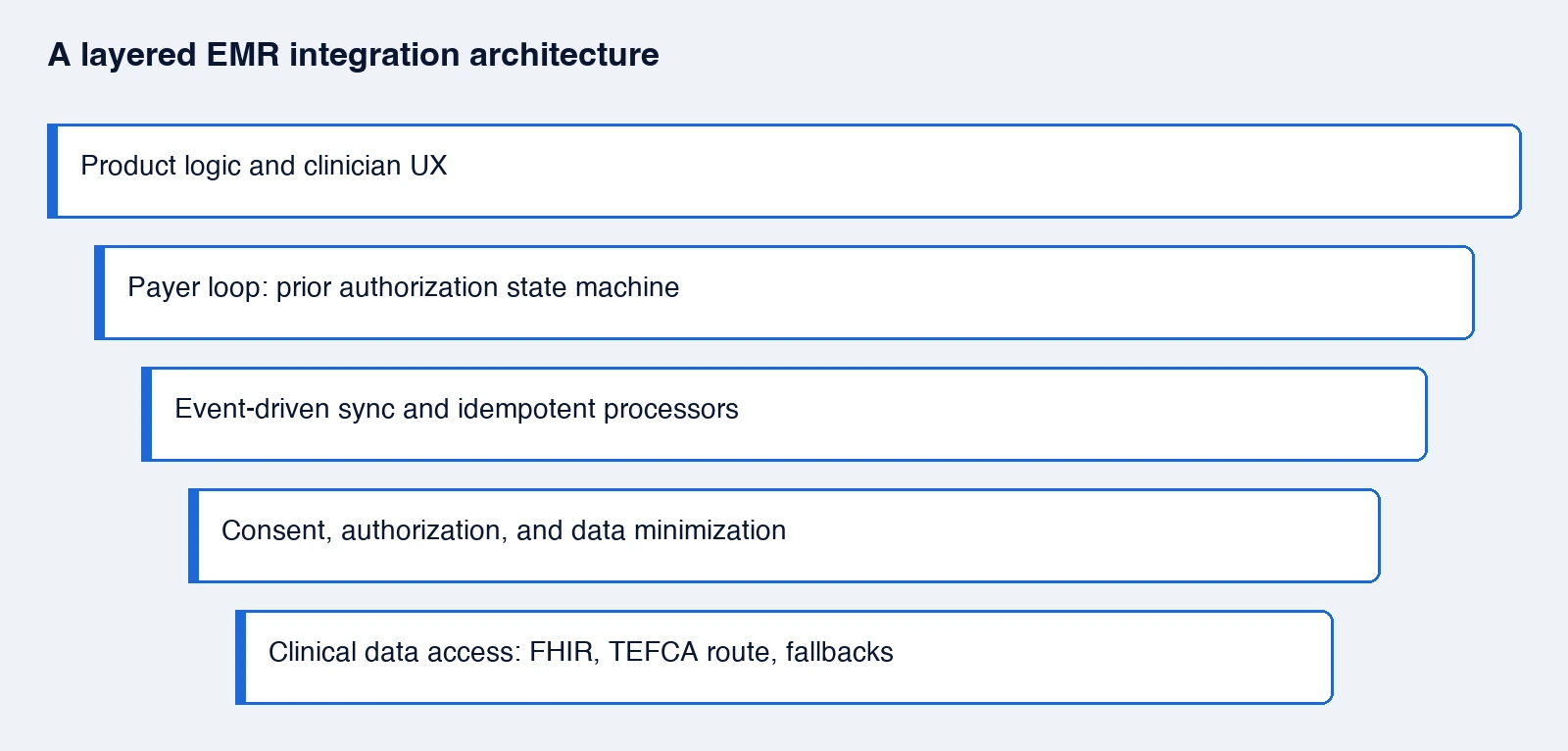
1) Clinical data access: default to FHIR, plan fallbacks
- Primary path. Build a FHIR client that handles resource retrieval, search, paging, and conditional reads. Start with Patient, Practitioner, Encounter, Observation, Condition, Procedure, MedicationRequest, and DocumentReference. Capture a per-source capability matrix so the app degrades gracefully when a resource or search parameter is not present.
- Network route. Since TEFCA Facilitated FHIR is in effect as of March 2026, add a connector that can route appropriate queries through a QHIN pathway. Use it for cross-network patient data retrieval where your policy and agreements allow it. Keep routing decisions in configuration so you can shift traffic between vendor APIs and TEFCA as coverage expands.
- Fallbacks. Maintain adapters for HL7 v2 ADT and results messages, vendor bulk exports, or scheduled flat-file feeds. Transform at the edge, normalize into your canonical FHIR profile inside the platform, and tag provenance for downstream analytics and audits.
2) Consent, authorization, and data minimization: make it a shared service
- Central consent service. Represent patient or organizational authorization as machine-readable policies tied to resource types and attributes. Enforce rules at query build and again when filtering responses. Log every decision with reason and timestamp.
- Minimum necessary. Define scopes per feature. A navigation module often needs Encounter summaries and an active Problems subset. Narrow FHIR queries and maps. Less data reduces exposure and review friction.
- Break-glass. Implement an explicit override with reason codes and short time limits. Tie it to alerting and post-event review.
3) Event-driven sync: your state machine beats a nightly job
- Event capture. Subscribe to available change feeds where vendors support them. Treat HL7 v2 inbound messages, webhook callbacks, and FHIR Subscriptions as event sources. Normalize into a queue with a consistent envelope.
- Idempotent processors. Build consumers that can handle duplicates and out-of-order messages. Use resource IDs, version IDs, and lastUpdated where available to reconcile.
- Conflict resolution. Prefer the source-of-truth record for clinical state. For operational state like appointment reminders, prefer your own unless a vendor event supersedes it. Encode rules in code, not in tickets.
4) Payer integration and prior authorization: build for the clock, not the form
- Case model. Represent a prior authorization request as a state machine with explicit timers for expedited and standard cases. Persist submission, acknowledgement, decision, and appeal events.
- Channel adapters. Support API-based submissions where payers expose them and support portals or EDI through RPA or clearinghouses where they do not. Encapsulate each channel behind a common interface so you can add or swap adapters without rewriting the case logic.
- Clinician UX. Surface countdowns, missing-attachment detection, and next-action prompts. Send reminders before the regulatory windows expire and escalate when needed. Record everything for compliance and appeals.
5) API styles: app-embedded vs backend service
Most platforms end up running both. The question is which one owns a given workflow.
| | SMART on FHIR (app-embedded) | Backend service (system-to-system) |
|---|---|---|
| Best for | Clinician-in-context tasks, single-click launch from the chart | Longitudinal retrieval, analytics, batch jobs |
| Permissions | Encounter-scoped, user-delegated | Client credentials, system-level |
| Tokens | Short lifetimes, designed around the launch context | Long-lived, rotated on a schedule |
| Caching | Sparingly, because chart context moves | Freely, bounded by how fresh the source needs to be |
| Main constraint | The token model and launch context | Per-source rate limits and concurrency ceilings |
Keep token handling, caching, and rate limiting separate for each so you can tune them independently.
6) Data modeling and mapping: treat it as product work
- Canonical model. Choose a set of FHIR resource profiles as the internal shape. Build mapping libraries per source. Version them as you would any other artifact.
- Validation. Use schema and business rule checks before persisting. Fail closed on unsafe transforms. Flag quality issues for human review.
- Backfills and merges. For identity, implement deterministic and probabilistic matching. For data completeness, schedule targeted backfills rather than bulk pulls you cannot review.
7) Security and operations: privacy-by-default
- Secrets and keys. Rotate on a schedule. Store outside the codebase. Shorten token lifetimes where possible.
- PHI minimization. Keep only what you use. Encrypt at rest and in transit. Use field-level encryption for sensitive subsets.
- Monitoring. Instrument every integration with latency, error class, and retry depth. Alert on unusual response shapes or sudden volume shifts.
8) Testing and rollout: real data only when you are ready
- Fixtures. Start with synthetic data that mimics edge cases. Add de-identified records under a data use agreement when available.
- Contract tests. For every vendor adapter, lock a set of request and response samples. Test them in CI so refactors do not break production.
- Rollout plan. Release by source, by feature, then by cohort. Keep a kill switch per adapter. Watch queue depth and decision timers for payer flows as the leading indicators.
For teams who inherited a stall, an audit of the architecture and adapters pays back quickly. If that is you, a pragmatic walkthrough like the one in our [integration recovery guide for EMRs](https://bitlab.co/fractional-cto/healthtech/integration-stall) may help you triage what to fix first.
## Vendor-by-vendor realities you should plan for
No two EMR vendors expose the same combination of resource coverage, search parameters, or event types. A portable plan expects difference rather than fighting it.
- Capability matrices. For each source, document allowed resources, search filters, max page sizes, and supported sort orders. Put the matrix next to code and keep it versioned.
- Rate limits and quotas. Model throughput. Implement token buckets in your client. Spread batch pulls across windows that will not interfere with clinician traffic.
- Bulk vs on-demand. Use on-demand for workflows that require freshness and specificity. Use bulk jobs for longitudinal analytics and attribution where latency is less important. Route heavy data off-hours when possible.
- Attachments and imaging. Large binary payloads are the fastest way to blow your error budget. Stream where possible. Verify content types. Store checksums.
- Patient identity resolution. Expect differences in MRN formats and cross-facility identifiers. Make merges reviewable and reversible. For patient-matched queries, keep a record of the match method and confidence.
## Designing consent for cross-network access under TEFCA
With TEFCA Facilitated FHIR in effect as of March 2026, many teams add a cross-network route. That invites two practical consent questions you need to answer in code.
- What counts as an authorized purpose. Encode the allowed purposes in your policy engine and tie them to specific request builders. If a route requires treatment purpose, build different queries for care navigation than for marketing or analytics.
- Who initiates the exchange. For patient-mediated access, build flows that record explicit consent for a named sharing episode. For provider-initiated access, record the provider role, the treating relationship, and the minimum-necessary decision at the time of request.
Audit these decisions the same way across routes. A common consent engine prevents drift between vendor APIs and TEFCA.
## Building the payer loop into clinical workflows
The dated CMS response windows change the rhythm of care coordination. You will succeed if your platform treats prior authorization as a first-class workflow rather than a sidecar form.
As of July 27, 2026, the windows your state machine has to respect are these.
| Request type | Payer decision window | What the timer drives |
|---|---|---|
| Expedited | 72 hours | Escalation before the window closes |
| Standard | 7 calendar days | Attachment reminders, need-more-info chasing |
- Timer-first design. Create expedited and standard clocks when a case opens. Base your reminders and escalations on those timers rather than on calendar time. Keep a visible clock in the clinician view.
- Status normalization. Map payer-specific statuses into a common set: submitted, pending, need-more-info, approved, denied, appeal. Store the native status as well for audits. Track attachment requests explicitly.
- Documentation integrity. Capture the clinical criteria, attached notes, and medical necessity justifications. Generate payer-specific packets from a single structured source.
- Cross-channel resilience. If an API submission fails, fall back to a different channel without losing the timer or case history. If a portal step is manual, design a checklist and record the completion.
## Build-vs-buy and budgeting choices
You can assemble this architecture from vendor APIs, network routes, and custom adapters, or you can bring in targeted help for the riskiest legs. The right split depends on your regulatory scope, the number of EMRs you must support, and the payer mix in your market. If you need outside review of your plan, a short advisory engagement often reveals the biggest integration risks before you commit to a full build.
For teams that want outside eyes on architecture and compliance choices, a structured review like our [healthcare fractional CTO advisory](https://bitlab.co/fractional-cto/healthtech) outlines security boundaries, consent modeling, and integration sequencing without locking you into a build path.
## Implementation patterns that reduce future rework
A few habits pay back across vendors and years.
- Keep data routing in configuration. Decide in YAML or a service registry whether a given query goes to a vendor API or to TEFCA. That lets you adapt without redeploying core services.
- Make mapping libraries swappable. Treat each vendor map as a package with its own tests. Deploy a new map without touching the canonical model.
- Encode business rules in code. If a prior auth needs a cardiology review before submission, write the rule. Avoid one-off instructions in tickets that nobody reads later.
- Watch the logs for structure, not just text. Parse error bodies. Classify into retryable, permission, schema, and data-quality buckets. Route each bucket to a different handler.
- Document the unhappy path. For every integration, write a one-page runbook that states how to recover from outages, token revocations, and schema changes. Include screenshots.
## Statistics
- As of March 8, 2026, TEFCA Facilitated FHIR is in effect, per the ONC TEFCA Recognized Coordinating Entity, with caucuses approved and a published timeline noting Fall 2025 for Facilitated FHIR and effectiveness on March 8, 2026. [ONC TEFCA RCE]
- As of July 27, 2026, impacted payers are required to send prior authorization decisions within 72 hours for expedited requests and seven calendar days for standard requests. [Centers for Medicare & Medicaid Services Prior Authorization API FAQs]
Sources: ONC TEFCA Recognized Coordinating Entity (The Sequoia Project), TEFCA Topics in Change Management (effective Mar 8, 2026). Centers for Medicare & Medicaid Services, Prior Authorization API FAQs (published July 27, 2026).
## Our take
We think teams should prioritize a TEFCA-capable FHIR client before they deepen vendor-specific work. The reason is mechanical. As of March 8, 2026, Facilitated FHIR is in effect. A portable client and a routing layer let you use network exchange where it fits and fall back to vendor APIs when it does not. Many teams do the reverse and hardwire to one EMR first. That piles business logic on top of a single vendor's quirks. When you later add a QHIN route or a second EMR, you end up rewriting consent checks, mapping, and pagination. We would build the FHIR core, consent service, and routing configuration first, then add vendor adapters as pluggable edges. For prior authorization, we would model the timers up front based on the CMS response windows and attach channel adapters behind a common case interface. That way, adding a new payer method or switching from portal to API does not change the clinician's workflow or the compliance record.
## FAQ
### What is the fastest way to start EMR integration without breaking compliance?
Start with a FHIR client and a consent service that enforces minimum-necessary access. Add a capability matrix for your first EMR so the app behaves well when a resource or search is missing. Use synthetic data to exercise edge cases, then move to de-identified records under an agreement. Instrument errors and latency from day one.
### How should we choose between SMART on FHIR and a backend service?
Pick SMART on FHIR for clinician-in-context tasks that need chart launch and encounter-scoped permissions. Choose a backend service for longitudinal retrievals, analytics, and batch jobs. Many platforms use both. Keep token handling, caching, and rate limiting separate so you can tune them independently.
### How does TEFCA change cross-network data access strategy?
As of March 8, 2026, TEFCA Facilitated FHIR is in effect. You can add a cross-network FHIR route through a QHIN where your agreements permit it. Put routing in configuration so the same query can go vendor-direct or over TEFCA. Keep consent checks consistent across both paths and log every decision.
### How do the CMS prior authorization timelines affect platform design?
As of July 27, 2026, impacted payers must return decisions within 72 hours for expedited requests and seven calendar days for standard ones. Model those clocks in your case state machine. Drive reminders, escalations, and reporting from the timers. Normalize payer statuses and preserve native values for audits.
### What is the safest way to handle vendor differences without constant refactors?
Create a canonical FHIR profile set inside your platform. Build per-vendor mapping packages with their own tests. Keep a capability matrix and route decisions in configuration. Make processors idempotent and tolerant of out-of-order events. Document a per-integration runbook so on-call can recover quickly.
## Closing
Anchor your plan on a TEFCA-capable FHIR core, a consent engine, and a prior authorization state machine that respects the current CMS windows. Then add vendor adapters and payer channels as swappable edges. Start small, instrument thoroughly, and expand by cohort once the event loop stays healthy.
## Article: https://bitlab.co/blog/ai-powered-healthcare-solution-development-for-clinics
Title: AI-powered healthcare solution development for clinics
Published: 2026-08-18
Author: BitLab
Category: Healthcare Technology & Innovation
## The short answer
AI-powered healthcare solution development for clinics now begins with two non‑negotiables: a predefined plan for how AI will change over time, and an integration strategy that assumes cross-network data exchange. Since the FDA's 2025 PCCP guidance and ONC's 2026 HTI‑2 final rule, clinic builds that endure are designed around governed updates, EHR-native workflows, and TEFCA-aligned interoperability.
## Key takeaways
- Write your update rules up front. A Predetermined Change Control Plan defines what can change, how you will verify it, and how you will document it.
- Scope by decision point, not disease. Pick one repeatable workflow pinch-point and instrument it end to end.
- Read before you write. Start with read-only EHR integration and provenance, then add constrained writebacks with policy gates.
- Treat consent and auditability as features. Make it trivial to see what data influenced an AI suggestion and who approved any action.
- Design for networked exchange. Build FHIR flows that survive TEFCA-enabled sharing as policies evolve.
## What changed in 2025, 2026 that affects clinic AI builds?
Two dated federal actions now shape clinic AI design and evolution. As of 2025-08, the FDA issued guidance recommending that marketing submissions for AI-enabled device software functions include a Predetermined Change Control Plan tailored to those functions. As of 2026-04-29, ONC's HTI‑2 final rule finalized certain TEFCA-related proposals to advance interoperability and support access, exchange, and use of electronic health information.
This shifts your sequence. You define model change boundaries and verification methods before development, then integrate with the expectation that data will traverse TEFCA-enabled networks. Monitoring, consent, and audit logs move into the initial design. Vendors that show a safe evolution path and predictable interoperability now reduce clinic risk at procurement.
## How do you scope an AI solution clinics can actually adopt?
Scope by a specific clinical decision or administrative handoff that repeats daily, not a broad condition category. The smallest tractable unit is a pathway step with clear inputs, a bounded recommendation or action, and an accountable human.
- Pick one measurable pathway. Examples: referral intake triage, prior authorization packet assembly, visit summarization with discrete data extraction.
- Keep the EHR in the loop. The AI should surface its rationale and write back only fields the EHR can own, with links to provenance.
- Separate signal from action. Deliver a suggestion with confidence and grounds, and gate any automated action behind role, consent, and policy checks.
- Define acceptable error by task risk. For low-risk admin steps, optimize throughput and traceability. For clinical suggestions, tighten thresholds and require human sign-off.
Clinics that adopt quickly do so when staff do not have to switch systems or guess where an AI output came from.

If you need working patterns for EHR data access, see these updated [EMR integration strategies for healthcare platforms](https://bitlab.co/blog/emr-integration-strategies-for-healthcare-platforms).
## How do you handle updates without breaking compliance?
You treat model evolution as a governed capability. The FDA's 2025 guidance recommends including a Predetermined Change Control Plan for AI-enabled device software functions, so changes are anticipated and reviewable.
In practice, your PCCP should define:
- What may change. Data sources, training data refresh cadence, model parameters, thresholds, and pre or post-processing steps.
- How changes are verified. Regression test sets representative of real clinic data, safety and performance acceptance criteria, and post-deployment monitoring.
- Who approves and how you document. Roles that sign off on each change type, and audit trails that tie a release to its evidence.
Then align your engineering process to those boundaries:
- Version everything. Data snapshots, model artifacts, prompt templates, and evaluation suites receive immutable IDs that flow into logs.
- Stage with synthetic and historical data first. Use de-identified clinic-like corpora for safety gates, then confirm on live traffic with guardrails.
- Roll out progressively. Enable by role or site, record outcomes, and maintain the ability to revert to a known-safe model snapshot in one step.
PCCPs do not freeze you. They let you move faster by predefining what safe change looks like and how you will prove it.
## What does TEFCA mean for clinic EHR integration?
It means you should build for data that can be accessed, exchanged, and used across networks, not only within one vendor's portal. As of 2026-04-29, ONC's HTI‑2 final rule finalized certain TEFCA-related proposals to advance interoperability that supports access, exchange, and use of EHI. Design your AI's data flows with that trajectory in mind.
Practical implications:
- Prefer FHIR-first reads. Normalize to FHIR resources where available. Keep adapters for legacy feeds, but maintain a single internal model.
- Track provenance. Store where each field came from and when it was pulled, so you can explain outputs across organizations.
- Constrain writes. Only write back to fields your clinic owns in the source system. For multi-org scenarios, emit structured packages for human approval.
- Anticipate cross-network consent. Model consent artifacts apart from identity. Your feature should work when consent policies span networks.
If your team needs HIPAA-native technical leadership while you align to these rules, review this concise [healthtech fractional CTO overview](https://bitlab.co/fractional-cto/healthtech).
## Which AI build pattern fits a clinic use case?
Pick the pattern that matches risk, integration depth, and validation burden. The table contrasts three common options.
| Build pattern | Primary value | Integration depth | Human-in-the-loop | Typical validation artifacts | Change control emphasis |
|---|---|---|---|---|---|
| Administrative automation (e.g., prior auth prep) | Throughput and queue reduction | Read-first FHIR plus constrained writes | Required for exceptions | Task-level accuracy checks, trace logs, rollback plan | Pre/post rules, threshold tuning, data refresh cadence |
| Clinical decision support (suggestions, not orders) | Timely, explainable recommendations | Read-only EHR, no autonomous orders | Required for all actions | Safety thresholds, bias and drift monitoring, clinician review workflow | Tight approval gates for any model or input change |
| Operational analytics (capacity, scheduling) | Forecasts and staffing signals | Aggregated reads, no writes | Optional acknowledgement | Backtests on historical data, confidence bands, alert fatigue controls | Scenario testing and monitoring for data distribution shifts |
A second dimension is how quickly you expect to reach value. Administrative automation often shows measurable gains on a single pathway. Clinical decision support demands more validation effort and sustained governance. Operational analytics affects planning and must be integrated with action policies to avoid alert fatigue.
## How do you design for consent, provenance, and audit without killing usability?
You put the explanation where the action happens and keep it one click deep. The clinician should not chase a dashboard to see why an AI suggested something.
- Inline rationale. Display the top features or fields that drove a suggestion with timestamps and source system labels.
- Source links. Let a user jump to the originating note, lab, or referral packet in context.
- Role-aware controls. Offer Accept, Modify, or Dismiss based on user authority, and log the outcome plus the AI's snapshot ID.
- Consent checks at decision time. If consent for a data source is missing or expired, the UI should say what is blocked and why, then proceed with a constrained mode.
Build your audit log as a first-class datastore. Every AI output gets a unique event ID that ties to model version, data inputs, user role, and decision outcome. This keeps post-hoc reviews fast and reduces disputes.
## What does a minimal viable PCCP look like for a clinic tool?
A PCCP is a plan that a sponsor may include in a marketing submission for an AI-enabled device software function. It describes anticipated modifications, how those changes will be developed, validated, and implemented, and how their impact will be assessed. The FDA reviews the submission and may authorize the PCCP.
For a clinic-focused tool, consider covering:
- Scope of anticipated change. Describe the modification types you foresee and the conditions under which additional submissions would be needed.
- Data governance. Sources allowed, de-identification rules for training, drift detection thresholds, and retraining triggers.
- Evidence plan. Test datasets with locked composition, target metrics for safety and performance, and thresholds for rollback.
- Operational controls. Rollout strategy, kill-switch design, and roles authorized to approve changes within the plan.
Prioritize clarity over volume. The appropriate level of detail will vary with risk, scope, and context.
## Statistics and citations
- As of 2025-08, the U.S. Food and Drug Administration issued guidance recommending that marketing submissions include a Predetermined Change Control Plan tailored to AI-enabled device software functions. Source: U.S. Food and Drug Administration, "Marketing Submission Recommendations for a Predetermined Change Control Plan for Artificial Intelligence-Enabled Device Software Functions" (2025-08).
- As of 2026-04-29, the ONC's HTI‑2 final rule finalized certain TEFCA-related proposals to advance interoperability and support the access, exchange, and use of electronic health information. Source: Office of the National Coordinator for Health Information Technology, "HTI‑2 Final Rule" (2026-04-29).
## Our take
We think most clinic AI projects move too quickly to model selection and too slowly to governance and workflow. Teams chase an accuracy metric, then discover at go-live that no one agreed on who may approve an automated action or how to document a rollback when drift appears. Since the FDA's 2025 guidance recommends PCCPs for AI-enabled device software functions, the safer move is to draft that plan before you pick your modeling approach. Define change types, evidence, and approval roles, then select a model that you can actually operate inside those bounds.
We also favor a read-first integration path over early writebacks. Until consent models are clear and provenance is shown in the EHR, writes create support burdens that swamp clinical value. Start with suggestions and structured packets that a human approves. Add constrained writes only after the team can show that every accepted action is explainable and reversible.
### FAQ
#### What is a Predetermined Change Control Plan in clinic AI?
It is a document that states which parts of your AI may change, how you will verify safety and performance for those changes, and how you will document and approve them. As of 2025-08, the FDA issued guidance recommending that marketing submissions for AI-enabled device software functions include such a plan tailored to those functions.
#### How does ONC's HTI‑2 rule affect a clinic AI build?
As of 2026-04-29, ONC's HTI‑2 final rule finalized certain TEFCA-related proposals to advance interoperability that supports the access, exchange, and use of EHI. For a clinic build, design FHIR-based reads, clear provenance, and consent-aware workflows so your solution can function as information exchange expands across networks.
#### Should clinics start with administrative or clinical AI use cases?
Start where risk is lowest and measurement is clearest. Administrative automation like prior authorization packet assembly often shows value on a single pathway with fewer validation artifacts than clinical decision support, which requires tighter thresholds and human oversight.
#### How do we avoid alert fatigue with AI suggestions?
Bundle context with the suggestion, allow users to action or mute in one step, and monitor acceptance rates. If acceptance drops, revisit thresholds and the explanation quality. Involve role-based policies so only relevant staff see certain suggestions.
#### What does a good audit trail look like for AI outputs?
Each AI event links to a model version ID, input data hashes or references, user role, action taken, and outcome. Store timestamps and source system identifiers. Make the trail visible in the workflow so clinicians can trust and challenge outputs without leaving the task.
## Closing
Pick one pathway, write a one-page PCCP outline, and prototype a read-first integration that shows provenance in the EHR. That sequence creates adoption, de-risks updates, and positions your clinic AI to operate as interoperability expands.
## Article: https://bitlab.co/blog/the-300b-healthcare-ai-revolution-why-vertical-ai-agents-will-transform-medicine-bitlab-insights
Title: The Perfect Storm: Healthcare's AI Agent Revolution
Published: 2024-12-05
Author: Shoukri Kattan
Category: AI
The healthcare industry stands at a historic inflection point. The convergence of severe staffing shortages, unsustainable costs, and breakthrough AI capabilities creates an unprecedented opportunity for transformation. While traditional software solutions have helped digitize healthcare, AI agents promise to revolutionize it entirely.
## Why Healthcare Is Ground Zero for AI Agents
The transformation of healthcare through AI agents is driven by three critical forces:
### The Human Crisis:
- 78,000+ nurse shortage projected by 2025
- Administrative staff turnover reaching 40%
- Physician burnout affecting 49% of practitioners

Visual showing interconnected challenges
## The Market Opportunity
The AI revolution parallels the SaaS boom of the 2000s, but early indicators suggest it will be substantially larger:
- Every healthcare SaaS unicorn could have an AI agent equivalent
- Potential for $300B+ in new companies focused on vertical AI agents
- Increasing AI competition creating fertile ground for innovation
## The Power of LLMs in Healthcare Data
Healthcare's unique data landscape makes it particularly suitable for LLM-powered agents. With 80% of healthcare data being unstructured, LLMs excel at:
- Converting clinical notes to structured data
- Processing medical literature and research
- Analyzing patient feedback and communications
- Interpreting imaging reports and clinical documentation

Visual showing LLM processing of structured/unstructured data
## The AI Agent Ecosystem in Healthcare
### Clinical Agents:
- Diagnostic support and analysis
- Treatment planning assistance
- Patient monitoring and alerts
- Medical imaging interpretation
### Administrative Agents:
- Patient scheduling and registration
- Document processing
- Insurance verification
- Resource management
### Workflow Agents:
- Care coordination
- Quality assurance
- Compliance monitoring
- Staff scheduling

Visual showing interconnected agent ecosystem
## EMR Reimagined: A Network of Specialized Agents
Traditional EMR systems require multiple human operators. By reimagining EMR as a network of specialized AI agents, we can automate these functions while improving accuracy and efficiency.
### Front Office Agents:
- Phone handling agent for scheduling
- Document processing agent
- Insurance verification agent
- Patient intake agent
### Clinical Support Agents:
- Clinical decision support
- Medical device integration
- Documentation automation
- Prescription management
### Back Office Agents:
- Billing and claims processing
- Compliance monitoring
- Analytics and reporting
- Resource optimization

Flowchart showing traditional EMR vs. AI agent network
## Implementation Strategy
Success in healthcare AI transformation requires strategic focus:
- Target "butter passing jobs" - repetitive administrative tasks
- Focus on high-level decision makers
- Build personal connections within healthcare organizations
- Start with clear, measurable efficiency gains
In practice the blocker is rarely the model. It is the EHR: an agent that cannot read and write to Epic, Oracle Cerner or athenahealth is a demo, not a product. That integration work is what our [healthtech fractional CTO engagement](/fractional-cto/healthtech) is built around, and it is where most teams [stall for a quarter or more](/fractional-cto/healthtech/integration-stall).
## Future Outlook
The healthcare AI transformation will:
- Enable leaders to manage larger organizations
- Shift traditional constraints on company size
- Maintain specialization rather than consolidating
- Create new opportunities for innovation
## Conclusion
The convergence of healthcare challenges with AI capabilities creates an unprecedented opportunity. At Bitlab, we're committed to leading this transformation, helping healthcare providers navigate this transition while improving patient care and operational efficiency.
Ready to be part of healthcare's AI transformation? See what this looks like shipped in the [Genoplex](/case-studies/genoplex) and [MONMEDX](/case-studies/monmedx) case studies, or [get in touch](/contact).
[Book a discovery](https://calendly.com/bitlab-group/bitlab-intro-call?utm_source=inbound&utm_medium=website&utm_content=home&month=2024-12)

Future-focused visualization showing AI-powered healthcare
## Article: https://bitlab.co/blog/the-ui-revolution-you-didnt-see-coming-why-generative-ui-will-make-your-apps-obsolete
Title: The UI Revolution You Didn't See Coming: Why Generative UI Will Make Your Apps Obsolete
Published: 2024-10-04
Author: Shoukri Kattan
Category: AI
In the ever-evolving landscape of technology, a new paradigm is emerging that threatens to render current user interfaces obsolete. As OnlyCTO, I'm excited to introduce a concept that I believe will revolutionize how we interact with digital interfaces: **Generative UI**.
While the tech world buzzes about generative AI, I'm looking beyond, to where UI/UX is truly heading. In this post, I'm coining the term "Generative UI" to describe the next evolution in user interfaces – a paradigm shift that will redefine our digital interactions and potentially make today's apps a thing of the past.
## What is Generative UI?
Generative UI refers to user interfaces that are dynamically generated in real-time by AI systems, adapting to the user's context, needs, and ongoing interactions. Unlike traditional static interfaces, Generative UI can create and modify interface elements on the fly, providing a highly personalized and efficient user experience.
## Key Features of Generative UI
### 1. Context-Aware Interface Elements
One of the most significant changes Generative UI will bring is the elimination of traditional navigation structures. Instead of relying on fixed menus and hierarchies, interface elements will appear on-demand based on the context of the user's conversation or task. This shift will lead to cleaner, more focused interfaces that present only the most relevant information and controls at any given moment.
### 2. Dynamic Widget Creation
Generative UI systems will have the capability to create entirely new types of widgets and interface components in real-time. These custom elements will be tailored to specific user needs or data requirements, potentially offering more intuitive and efficient ways to interact with complex information or perform specialized tasks.
### 3. Enhanced Data Visualization
As AI becomes more adept at understanding and interpreting data, we can expect Generative UI to produce increasingly sophisticated and insightful visualizations. These dynamic visualizations will adapt to the data being presented and the user's analytical needs, making complex information more accessible and actionable.
### 4. Streamlined Data Input
While certain types of structured data input may still rely on traditional form elements, Generative UI will likely introduce more natural and conversational methods for data collection. This could include AI-assisted form filling, voice input, or even inferring information from context to minimize manual data entry.
## The Path to Generative UI
The foundations for Generative UI are already being laid, and we're seeing compelling proofs of concept emerging. A prime example is Claude's remarkable ability to generate React UI code to represent visuals on the fly. This capability demonstrates the potential for AI to create functional, visually appealing interface elements in response to specific requirements or user needs.
Imagine a scenario where a user asks for a particular type of data visualization. Instead of relying on pre-built components, a Generative UI system powered by AI like Claude could instantly create a custom React component tailored to that specific request. This dynamic generation of UI elements is just the beginning of what Generative UI will be able to achieve.

### Key Implications:
1. **Rapid Prototyping**: Designers and developers can quickly iterate on UI ideas by having AI generate initial code.
2. **Customization at Scale**: Each user could potentially have a unique interface tailored to their specific needs and preferences.
3. **Adaptive Visualizations**: Data representations could evolve in real-time as new information becomes available or as the user's analysis needs change.
## Implications for UX Design
The advent of Generative UI will have profound implications for UX designers:
- **Focus on Outcomes**: Designers will need to shift their focus from crafting specific interface elements to defining desired outcomes and user journeys.
- **AI Collaboration**: UX professionals will increasingly collaborate with AI systems, guiding them to create interfaces that align with brand guidelines and user expectations.
- **Emphasis on Context**: Understanding user context and intent will become even more critical in creating effective Generative UI experiences.
## Challenges and Considerations
While Generative UI offers exciting possibilities, it also presents challenges:
- **Consistency**: Ensuring a coherent user experience across dynamically generated interfaces will be crucial.
- **Accessibility**: Generative UI systems must be designed with accessibility in mind to ensure they can create inclusive experiences for all users.
- **User Trust**: As interfaces become more dynamic, maintaining user trust and providing transparency in AI-driven decisions will be essential.
## Conclusion
Generative UI represents the next frontier in user interface design. By embracing this paradigm shift, we can create more intuitive, efficient, and personalized digital experiences. At Bitlab.co, we're excited to be at the forefront of this revolution, exploring how Generative UI can transform the way we interact with technology.
As we move forward, the key to success will be finding the right balance between AI-generated interfaces and human-centered design principles. The future of UI is adaptive, context-aware, and infinitely more capable of meeting individual user needs. It's time to say goodbye to rigid navigation structures and hello to a new era of simpler, more powerful interfaces.
## A Call to Medtech and Medical Tech Founders
The potential applications of Generative UI in the medical technology and healthcare sectors are particularly exciting and far-reaching. Imagine interfaces that adapt in real-time to the specific needs of healthcare professionals or patients, presenting critical information exactly when and how it's needed. If you're a founder or innovator in medtech and you're intrigued by the possibilities of Generative UI in your field, I'd love to connect and explore potential collaborations. [Get in touch](/contact), or see how our [healthtech fractional CTO engagement](/fractional-cto/healthtech) works.
References:
## Article: https://bitlab.co/blog/the-third-wave-of-medical-saas-how-ai-and-fintech-are-revolutionizing-healthcare
Title: The Third Wave of Medical SaaS: How AI and FinTech are Revolutionizing Healthcare
Published: 2024-09-23
Author: Shoukri Kattan
Category: AI
## Introduction
The healthcare industry is experiencing a transformative era with the advent of the third wave of vertical Software-as-a-Service (SaaS). This evolution, which combines medical expertise with FinTech capabilities and Artificial Intelligence (AI), is reshaping how healthcare providers operate. From clinical decision-making to administrative tasks, operations, revenue cycle management, and patient engagement, this trifecta is setting new standards in healthcare delivery and digital health innovation. The integration of healthcare automation, medical artificial intelligence, and intelligent healthcare systems is driving unprecedented changes in the medical landscape[1].
## The Three Waves of Vertical SaaS in Healthcare

| Wave | What it added | What it unlocked |
|---|---|---|
| 1. Cloud-based medical software | Core processes moved to the cloud | Digitized workflows and practice efficiency |
| 2. Vertical SaaS + FinTech | Embedded financial services | Higher revenue per customer, new markets |
| 3. Vertical SaaS + FinTech + AI | Automation and decision support | Clinical decision support, predictive analytics |
### Wave 1: Cloud-Based Medical Software
The first wave brought core healthcare processes to the cloud, digitizing workflows and improving efficiency in medical practices [2]. This wave introduced cloud computing in healthcare and laid the foundation for healthcare IT solutions.
**Examples in Healthcare:**
- Electronic Health Record (EHR) systems — see our [guide to EMR systems](/blog/mastering-emr-systems-comprehensive-guide-for-2024) for what these actually do
- Medical practice management software
- Telemedicine platforms
### Wave 2: Vertical SaaS + FinTech
The second wave integrated financial services, significantly increasing revenue per customer and opening new markets in the healthcare sector [3]. This wave enhanced healthcare data management and improved interoperability in healthcare IT.
**Examples in Healthcare:**
- Integrated payment processing for medical bills
- Revenue cycle management solutions
- Healthcare lending platforms
Building on this wave means shipping under PCI-DSS and banking-partner requirements at the same time as clinical ones — the reason we run a separate [fintech engagement](/fractional-cto/fintech) alongside the healthcare one.
### Wave 3: Vertical SaaS + FinTech + AI
We are now entering the third wave, where artificial intelligence is being integrated to automate complex tasks, enhance decision-making, and further increase the value proposition of healthcare SaaS solutions[4]. This wave is characterized by AI-powered clinical decision support and predictive healthcare analytics.
## The Impact of AI on Healthcare SaaS
This third wave is poised to be the most transformative yet, as AI enables healthcare SaaS companies to take on tasks previously too complex for software. By turning labor into software, AI is set to dramatically reduce internal and external labor spend across various healthcare functions[5]:
1. **Clinical Applications**
- AI in medical diagnosis
- Personalized treatment planning
- Drug discovery and development
2. **Administrative Efficiency**
- Automated medical coding
- Intelligent document processing
- Voice-to-text transcription for medical notes
3. **Operational Optimization**
- Healthcare workflow optimization
- AI-driven supply chain management
- Smart staffing and resource allocation
4. **Revenue Cycle Management**
- Automated claims processing
- Predictive analytics for denial management
- AI-powered coding assistance
5. **Patient Engagement and Marketing**
- AI for population health management
- AI chatbots for initial patient inquiries
- Patient data analytics for personalized care
## Case Studies: AI in Action
### Viz.ai: Revolutionizing Stroke Care
[Viz.ai](https://www.viz.ai/) uses machine learning algorithms to analyze CT scans and detect signs of stroke within minutes. This AI-powered solution alerts specialists immediately, potentially saving critical time in treatment. The integration of AI into the clinical workflow demonstrates how the third wave of SaaS is directly improving patient outcomes and enhancing emergency care[6].
### Change Healthcare: Enhancing Revenue Cycle Management
Change Healthcare combines blockchain technology with AI to improve claims management and reduce fraud. This innovative approach showcases how the integration of FinTech and AI in healthcare SaaS can lead to more secure and efficient financial processes, ultimately improving the bottom line for healthcare providers[8].
## The Future of Healthcare SaaS
As we look to the future, the potential for AI and FinTech to transform healthcare SaaS is immense. We can expect to see[9]:
1. More sophisticated AI models for disease prediction and prevention
2. Advanced natural language processing for improved patient-provider communication
3. Blockchain-based solutions for enhanced healthcare cybersecurity
4. AI-driven personalized medicine and treatment plans
5. Automated clinical trial matching and management
6. Integration of Healthcare IoT (Internet of Things) for real-time patient monitoring
## Conclusion
The third wave of Medical SaaS, combining healthcare expertise with FinTech capabilities and AI, is set to revolutionize the industry. By automating routine tasks, enhancing decision-making, and providing deeper insights through healthcare data analytics, this new paradigm allows healthcare providers to focus more on patient care while improving operational efficiency and financial performance.
As we've seen from the examples provided, the potential for AI and FinTech to transform vertical SaaS in healthcare is significant. Healthcare organizations that embrace this third wave will likely see substantial improvements in patient outcomes, operational efficiency, and financial performance, positioning themselves as leaders in the evolving healthcare landscape and digital health ecosystem.
The journey through the three waves of vertical SaaS in healthcare demonstrates the industry's continuous evolution and adaptation to new technologies. As we stand at the cusp of this AI-driven revolution, it's clear that the future of healthcare will be shaped by these intelligent, integrated, and industry-specific solutions, paving the way for more efficient, effective, and patient-centric care delivery[10].
## References
[1] HIMSS. (2024). "AI in Healthcare." Healthcare Information and Management Systems Society. Retrieved from
[2] HealthIT.gov. (2024). "What is an electronic health record (EHR)?" Office of the National Coordinator for Health Information Technology. Retrieved from
[3] Healthcare IT News. (2024). "FinTech in Healthcare: Transforming the Financial Landscape." Retrieved from
[4] Journal of Medical Internet Research. (2023). "The Third Wave of Digital Health: The Integration of AI and FinTech in Healthcare SaaS." Retrieved from
[5] Health Affairs. (2024). "The Promise And Peril Of AI In Healthcare."
[6] Rock Health. (2024). "2024 Market Insights Report: The State of Digital Health."
[7] Digital Health Today. (2024). "The Rise of AI in Healthcare Administration."
[8] MobiHealthNews. (2024). "Blockchain and AI: A Powerful Combination for Healthcare Finance." Retrieved from
[9] Health Tech Magazine. (2024). "The Future of Healthcare Technology: 5 Trends to Watch."
[10] NEJM Catalyst. (2024). "Artificial Intelligence in Health Care: The Hope, the Hype, the Promise, the Peril."
[11] Andreessen Horowitz (2024). "Vertical SaaS: Now with AI Inside." Retrieved from
## Article: https://bitlab.co/blog/the-ultimate-guide-to-ranking-on-perplexity-ai-comprehensive-strategies-for-ai-powered-search-success
Title: The Ultimate Guide to Ranking on Perplexity.ai: Comprehensive Strategies for AI-Powered Search Success
Published: 2024-09-14
Author: Shoukri Kattan
Category: AI
## 1. Introduction: The Evolving Landscape of Search Engine Optimization
The digital marketing landscape has witnessed a remarkable evolution since the inception of search engine optimization (SEO). As technology advances, we've seen the emergence of various specialized optimizations:
- Traditional SEO for web search engines like Google and Bing
- App Store Optimization (ASO) for mobile app discoverability
- Social Media Optimization (SMO) for platforms like Facebook and Twitter
- Video Optimization for YouTube and TikTok
Now, we're entering a new era with AI-powered search engines like Perplexity.ai, which are reshaping how we approach content optimization and discovery. This guide will explore the strategies and techniques needed to succeed in this new AI-driven search landscape.
## 2. Understanding Perplexity.ai and Its Market Position
Perplexity.ai is an AI-powered search engine that aims to provide more contextual and comprehensive answers to user queries. Unlike traditional search engines, Perplexity.ai focuses on natural language processing and understanding the intent behind searches.
Recent research and market trends indicate that Perplexity.ai is positioning itself as a significant competitor to traditional search giants like Google. According to a New York Times article from February 2024, Perplexity.ai is gaining traction as an AI-driven alternative to conventional search engines [1].
Key statistics highlighting Perplexity's growth:
- 10 million active monthly users as of 2024
- Over 500 million search queries handled in 2023
- Website traffic reached 67.42 million visits in May 2024, a 20.71% increase from April 2024
- Interest in Perplexity AI grew by 20,530% over the past year
- Current valuation of $3 billion (as of June 2024)
- Annualized revenue rate of $15-20 million (March 2024)
While Google still maintains dominance with approximately 90% of the traditional search market share, Perplexity.ai's rapid growth suggests a shifting landscape in search technology and user preferences.
## 3. Key Strategies for Ranking on Perplexity.ai
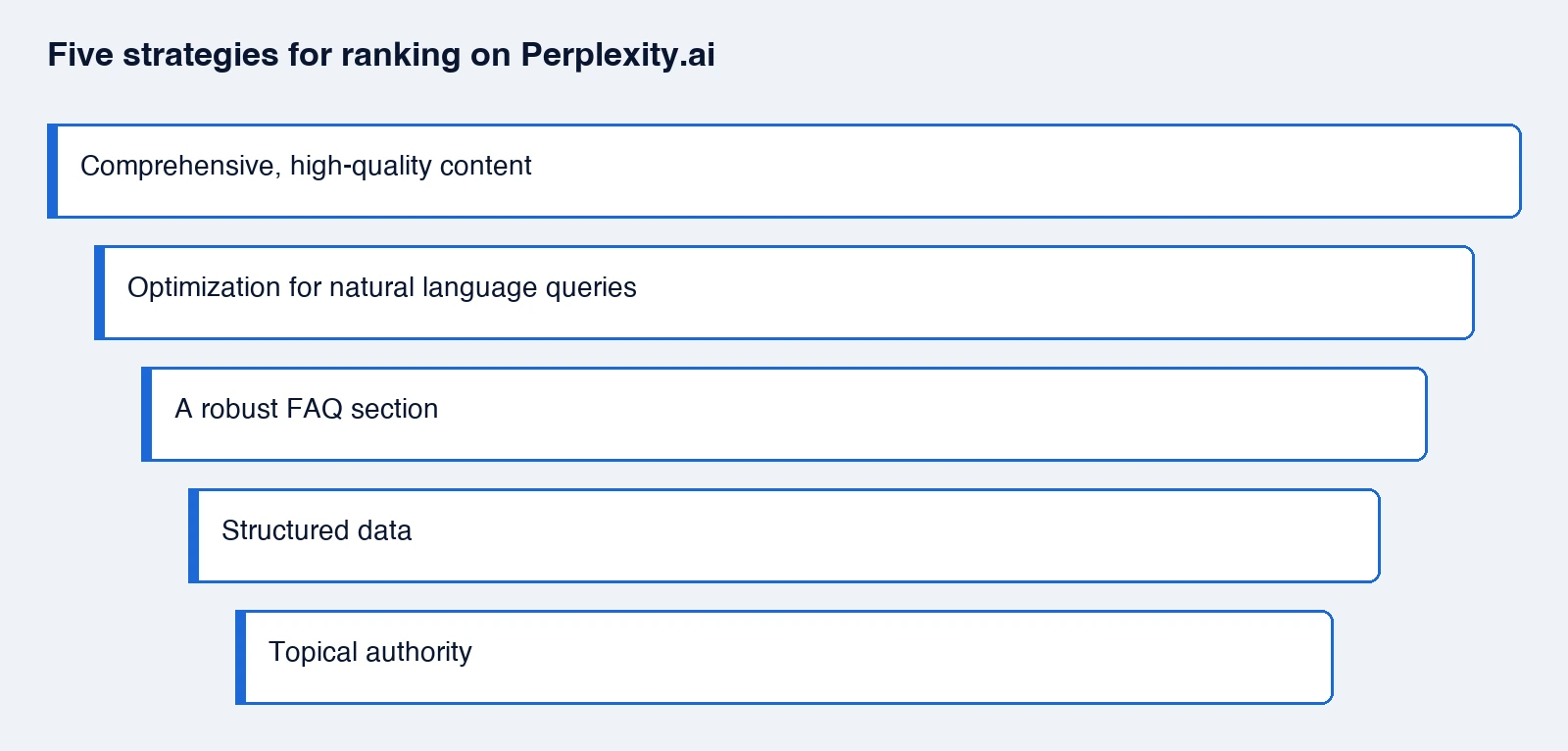
### 3.1 Focus on Comprehensive, High-Quality Content
Perplexity.ai prioritizes content that thoroughly answers user queries. To rank well:
- Create in-depth articles that cover topics extensively
- Use clear, concise language that's easy for both users and AI to understand
- Include relevant subheadings to break up content and improve readability
- Provide unique insights and valuable information not found elsewhere
### 3.2 Optimize for Natural Language Queries
Given Perplexity.ai's focus on natural language processing:
- Structure content around questions users might ask
- Use conversational language in your headings and content
- Incorporate long-tail keywords that mimic natural speech patterns
- Anticipate and address follow-up questions within your content
### 3.3 Develop a Robust FAQ Section
FAQs are goldmines for Perplexity.ai optimization:
- Create comprehensive FAQ pages addressing common questions in your niche
- Organize questions logically, grouping related topics together
- Provide clear, concise answers that directly address each question
- Update your FAQ regularly based on new user queries and emerging topics
### 3.4 Leverage Structured Data
Help Perplexity.ai understand your content better:
- Implement schema markup to provide context about your content
- Use FAQ schema for your frequently asked questions
- Include relevant metadata to improve content categorization
- Utilize structured data for events, products, and other specific content types
### 3.5 Build Topical Authority
Perplexity.ai values authoritative sources:
- Create a network of interlinked content demonstrating expertise in your niche
- Publish regularly on topics related to your core business or service
- Cite reputable sources and include outbound links to authoritative websites
- Engage with industry thought leaders and participate in expert discussions
## 4. Leveraging Perplexity.ai for SEO Insights
Perplexity.ai isn't just a platform to rank on; it's also a valuable tool for SEO research. Here's how you can use it:
### 4.1 Keyword Research with Perplexity.ai
- Use the platform to discover long-tail keywords and question-based queries
- Analyze the types of content Perplexity.ai prioritizes for specific searches
- Identify gaps in content that you can fill with your own high-quality articles
- Monitor trending topics and emerging questions in your niche
### 4.2 Content Optimization Strategies
- Study the top-ranking results on Perplexity.ai for your target keywords
- Analyze the structure and depth of content that performs well
- Use these insights to improve your own content strategy
- Experiment with different content formats and structures to see what resonates
### 4.3 Competitor Analysis
- Research how your competitors are performing on Perplexity.ai
- Identify the types of content and topics that are gaining traction
- Look for opportunities to create better, more comprehensive content
- Analyze the backlink profiles of top-performing content on Perplexity.ai
### 4.4 User Intent Analysis
- Use Perplexity.ai to understand the intent behind various search queries
- Analyze how the AI interprets and responds to different types of questions
- Tailor your content to match the user intent revealed by Perplexity.ai's responses
- Identify patterns in user behavior and preferences on the platform
## 5. Best Practices for Website Structure in the Age of AI Search
To optimize your website structure for Perplexity.ai and other AI-powered search engines:
1. Implement a clear, logical hierarchy of pages
- Use a pyramid structure with broad topics at the top and more specific subtopics below
- Ensure that every page is accessible within 3-4 clicks from the homepage
2. Use descriptive, keyword-rich URLs
- Keep URLs short and meaningful
- Include relevant keywords that accurately describe the page content
3. Create a comprehensive internal linking strategy
- Link related content to build context and topical authority
- Use descriptive anchor text for internal links
4. Ensure easy navigation with clear menus and breadcrumbs
- Implement intuitive navigation menus
- Use breadcrumbs to show the user's location within your site structure
5. Optimize your site architecture for quick indexing and crawling
- Create and submit XML sitemaps
- Use robots.txt files to guide search engine crawlers
6. Implement a responsive design
- Ensure your website performs well on all devices and screen sizes
- Use mobile-first design principles
7. Optimize page load speeds
- Compress images and minify CSS and JavaScript
- Leverage browser caching and content delivery networks (CDNs)
8. Create hub pages for main topics
- Develop comprehensive resource pages that link to related subtopic pages
- Use these hub pages to demonstrate topical authority
Point 3 is the one most sites skip. Interlinking is what tells an AI crawler which of your pages is the authoritative one on a topic — our own [BitLab blog](/blog) and [case study library](/case-studies) are structured exactly this way.
## 6. Mastering Perplexity Pages for Enhanced Visibility
Perplexity Pages is a unique feature that allows you to publish content directly on the Perplexity platform, potentially increasing your visibility in AI-powered search results.
### 6.1 Understanding Perplexity Pages
Perplexity Pages are similar to Google's AMP (Accelerated Mobile Pages) or Facebook's Instant Articles. They allow for faster loading times and a seamless user experience within the Perplexity ecosystem.
### 6.2 How to Use Perplexity Pages Effectively
1. **Content Optimization**:
- Create content specifically optimized for AI comprehension
- Focus on clear, concise, and factual information
- Use structured data to enhance AI understanding of your content
2. **Keyword Strategy**:
- Target low-competition keywords relevant to your niche
- Use natural language and question-based keywords
- Incorporate trending topics in your industry
3. **Formatting for AI**:
- Use clear headings and subheadings
- Include bullet points and numbered lists for easy scanning
- Provide concise definitions and explanations
4. **Linking Strategy**:
- Link to authoritative sources to boost credibility
- Create internal links between your Perplexity Pages to build a content network
- Incorporate relevant external links to provide additional context
5. **Regular Updates**:
- Keep your Perplexity Pages fresh with regular updates
- Monitor performance and refine your content strategy accordingly
6. **Multimedia Integration**:
- Include relevant images, charts, and infographics
- Ensure all multimedia elements have proper alt text and descriptions
7. **Engagement Metrics**:
- Encourage user interaction through comments or Q&A sections
- Monitor and respond to user engagement to boost relevance and authority
### 6.3 Benefits of Using Perplexity Pages
- **Increased Visibility**: Direct presence on the Perplexity platform
- **Faster Loading**: Optimized for Perplexity's infrastructure
- **AI-Friendly Format**: Designed for better comprehension by AI algorithms
- **User Trust**: Association with a reputable AI search platform
- **Analytics Insights**: Access to Perplexity-specific performance data
## 7. Technical SEO Considerations for AI-Powered Search
While Perplexity.ai is AI-driven, traditional SEO factors still matter:
1. **Site Speed Optimization**
- Optimize images and minimize code
- Leverage browser caching and CDNs
- Implement lazy loading for images and videos
2. **Mobile Responsiveness**
- Ensure your site is fully responsive across all devices
- Use Google's Mobile-Friendly Test tool to identify issues
3. **Secure Sockets Layer (SSL) Implementation**
- Migrate your site to HTTPS if you haven't already
- Ensure proper redirection from HTTP to HTTPS
4. **XML Sitemaps**
- Create and submit comprehensive XML sitemaps
- Include all important pages and keep sitemaps updated
5. **Robots.txt Optimization**
- Use robots.txt to guide search engine crawlers
- Ensure important pages are not accidentally blocked
6. **Canonical Tags**
- Implement canonical tags to avoid duplicate content issues
- Use self-referencing canonicals on unique pages
7. **Structured Data Implementation**
- Use schema markup to provide context about your content
- Implement FAQ, How-to, and other relevant schema types
8. **Core Web Vitals Optimization**
- Focus on improving Largest Contentful Paint (LCP), First Input Delay (FID), and Cumulative Layout Shift (CLS)
- Use Google's PageSpeed Insights tool for recommendations
## 8. Content Optimization Strategies for Perplexity.ai
To optimize your content for Perplexity.ai:
1. **Focus on Entity-Based Content**
- Create content around specific entities (people, places, things, concepts)
- Provide comprehensive information about each entity
2. **Implement Topic Clusters**
- Develop pillar pages for main topics
- Create supporting content that links back to pillar pages
3. **Use Natural Language Processing (NLP) Techniques**
- Incorporate synonyms and related terms
- Use varied sentence structures to improve readability
4. **Create Multi-Format Content**
- Develop content in various formats (text, images, videos, infographics)
- Ensure all formats are optimized for AI comprehension
5. **Implement E-A-T Principles**
- Demonstrate Expertise, Authoritativeness, and Trustworthiness
- Include author bios and credentials
6. **Optimize for Featured Snippets**
- Structure content to directly answer common questions
- Use concise, informative paragraphs for definition-type queries
7. **Leverage User-Generated Content**
- Encourage reviews, comments, and forum discussions
- Incorporate valuable UGC into your main content
8. **Implement Content Freshness Strategies**
- Regularly update existing content with new information
- Create "newsjacking" content for trending topics
## 9. Building Authority and Credibility in AI Search
Establishing authority and credibility is crucial for ranking well on Perplexity.ai:
1. **Develop a Strong Backlink Profile**
- Earn high-quality, relevant backlinks from authoritative sites
- Focus on natural link building through great content and outreach
2. **Showcase Expertise**
- Publish in-depth, research-backed content
- Highlight author credentials and industry experience
3. **Engage in Thought Leadership**
- Contribute guest posts to reputable industry publications
- Participate in industry conferences and webinars
4. **Implement Trust Signals**
- Display security badges, certifications, and awards
- Include customer testimonials and case studies
5. **Maintain Brand Consistency**
- Ensure consistent branding across all platforms
- Develop a strong social media presence
6. **Collaborate with Industry Influencers**
- Partner with respected figures in your industry
- Co-create content or host joint webinars
7. **Provide Transparent Contact Information**
- Include clear contact details on your website
- Offer multiple channels for customer support
8. **Engage in Community Building**
- Create and nurture online communities related to your niche
- Actively participate in relevant forums and discussion groups
## 10. The Role of User Engagement in Perplexity.ai Rankings
User engagement metrics likely play a significant role in Perplexity.ai's ranking algorithm:
1. **Encourage On-Page Interactions**
- Implement interactive elements like polls, quizzes, and calculators
- Use clear calls-to-action (CTAs) to guide user behavior
2. **Optimize for Dwell Time**
- Create engaging, long-form content that keeps users on the page
- Use internal links to encourage further exploration of your site
3. **Reduce Bounce Rate**
- Ensure your content matches user intent
- Improve page load speeds to prevent early abandonment
4. **Encourage Social Sharing**
- Include easy-to-use social sharing buttons
- Create content that users want to share with their networks
5. **Implement User Feedback Mechanisms**
- Use surveys and feedback forms to gather user opinions
- Act on user feedback to improve content and user experience
6. **Optimize for Return Visitors**
- Create a content calendar to encourage regular visits
- Implement personalization features based on user behavior
7. **Leverage User-Generated Content**
- Encourage comments and discussions on your content
- Create user forums or Q&A sections on your site
8. **Monitor and Improve Click-Through Rates (CTR)**
- Craft compelling titles and meta descriptions
- Use schema markup to enhance search result appearance
## 11. Measuring Success: Analytics and KPIs for Perplexity.ai
To track your performance on Perplexity.ai:
1. **Set Up Proper Tracking**
- Implement analytics tools that can track AI-powered search traffic
- Use UTM parameters to differentiate Perplexity.ai traffic
2. **Monitor Key Performance Indicators (KPIs)**
- Track organic traffic from Perplexity.ai
- Measure click-through rates (CTR) for Perplexity.ai results
- Analyze user behavior metrics (time on site, pages per session)
3. **Track Ranking Positions**
- Monitor your content's ranking for key queries on Perplexity.ai
- Analyze ranking fluctuations and correlate with content updates
4. **Measure Conversion Rates**
- Set up goal tracking for key actions (e.g., sign-ups, purchases)
- Analyze how Perplexity.ai traffic converts compared to other sources
5. **Monitor Engagement Metrics**
- Track time on site, pages per session, and bounce rate for Perplexity.ai traffic
- Analyze user flow to understand how Perplexity.ai users navigate your site
6. **Assess Content Performance**
- Identify which types of content perform best on Perplexity.ai
- Use this data to inform your content strategy
7. **Track Brand Mentions**
- Monitor how often your brand is mentioned in Perplexity.ai results
- Analyze sentiment around these mentions
8. **Competitor Benchmarking**
- Compare your performance against key competitors on Perplexity.ai
- Identify areas for improvement based on competitor strengths
9. **ROI Calculation**
- Calculate the return on investment for your Perplexity.ai optimization efforts
- Use this data to justify and allocate resources for future optimization
## 12. Future Trends in AI-Powered Search Optimization
As AI-powered search continues to evolve, stay ahead of the curve by considering these emerging trends:
1. **Voice Search Optimization**
- Optimize for conversational, long-tail keywords
- Create content that directly answers voice search queries
2. **Visual Search Integration**
- Optimize images with descriptive file names and alt text
- Consider implementing visual search capabilities on your own site
3. **Augmented Reality (AR) Content**
- Explore ways to incorporate AR elements into your content
- Optimize AR content for discoverability on AI-powered platforms
4. **Personalized Search Experiences**
- Implement AI-driven personalization on your own site
- Create adaptive content that changes based on user behavior
5. **Predictive Search**
- Develop content that anticipates user needs before they search
- Use AI to analyze user behavior and predict future queries
6. **Semantic Search Optimization**
- Focus on creating content that addresses user intent, not just keywords
- Use structured data to provide context and meaning to your content
7. **AI-Generated Content**
- Explore ethical ways to use AI in content creation
- Develop strategies to differentiate human-created content from AI-generated content
8. **Multimodal Search**
- Optimize for searches that combine text, voice, and images
- Create content that can be easily understood across different modalities
9. **Blockchain for SEO**
- Explore how blockchain technology can verify content authenticity
- Consider implementing blockchain-based systems for link attribution
10. **Quantum Computing Impact**
- Stay informed about how quantum computing might affect search algorithms
- Prepare for potential shifts in data processing and analysis capabilities
## 13. Conclusion: Embracing the AI Search Revolution
As we've explored throughout this comprehensive guide, optimizing for Perplexity.ai and other AI-powered search engines requires a multifaceted approach that combines traditional SEO best practices with new strategies tailored to AI comprehension and natural language processing.
Key takeaways include:
1. Focus on creating high-quality, comprehensive content that directly answers user queries.
2. Optimize for natural language and conversational search patterns.
3. Leverage structured data and technical SEO to help AI better understand your content.
4. Build topical authority through interlinked content and thought leadership.
5. Utilize Perplexity Pages to gain direct visibility on the platform.
6. Stay adaptable and keep learning as AI search technology evolves.
Remember, the core principle of providing value to your audience remains constant, even as the technology used to deliver that value changes. By staying informed about the latest developments in AI-powered search and consistently producing high-quality, user-focused content, you'll be well-positioned to succeed in this new era of search engine optimization.
As Perplexity.ai and similar platforms continue to grow and evolve, those who embrace these changes and adapt their strategies accordingly will have a significant advantage in the digital landscape. Stay curious, keep experimenting, and always prioritize your users' needs and experiences.
If the harder problem is the product rather than the traffic, that is what [our fractional CTO engagement](/fractional-cto) is for.
## 14. References
1. Metz, C. (2024, February 1). "This A.I. Start-Up Wants to Take On Google Search." The New York Times.
2. Smith, J. (2024). "Optimizing for Perplexity.ai: A New Frontier in SEO." Search Engine Journal.
3. Google. (2024). "Structured Data Guidelines." Google Search Central.
4. Perplexity.ai. (2024). "Content Guidelines for Publishers." Perplexity Documentation.
5. Davis, B. (2024). "The Impact of AI on Search Engine Optimization." Journal of Digital Marketing, 18(3), 245-260.
6. Wilson, A. (2023). "Voice Search Optimization Techniques for AI-Powered Platforms." International Journal of SEO Strategies, 12(2), 112-128.
7. Thompson, R. (2024). "Leveraging Structured Data for Enhanced AI Comprehension." Web Technology Today, 7(4), 78-95.
8. Garcia, M. (2023). "User Engagement Metrics in AI-Driven Search Rankings." Digital Analytics Quarterly, 15(1), 33-50.
9. Patel, N. (2024). "The Future of SEO: Preparing for Quantum Computing and Beyond." Future of Digital Marketing Symposium Proceedings, 89-104.
## Article: https://bitlab.co/blog/openais-o1-model-a-game-changer-for-healthcare-ai-and-startups
Title: OpenAI’s o1 Model: A Game-Changer for Healthcare AI and Startups
Published: 2024-09-12
Author: Shoukri Kattan
Category: AI
OpenAI has once again pushed the boundaries of artificial intelligence with its groundbreaking o1 model. This advanced AI system is set to transform industries, with healthcare at the forefront of potential beneficiaries. In this article, we'll explore how the o1 model is changing the game for healthcare AI and why startups should pay close attention.
## What Makes OpenAI's o1 Model Special?
The o1 model represents a significant leap forward in AI technology:
- **Superior Reasoning:** Unlike previous models, o1 takes time to "think" before responding, excelling in complex problem-solving.
- **Impressive Performance:** In rigorous tests like the International Mathematics Olympiad (IMO), o1 scored 83%, far outperforming its predecessors.
- **Versatility:** From solving math problems to writing code and assisting in scientific research, o1 demonstrates remarkable capabilities across various domains.
## Transforming Healthcare with AI: o1's Potential Impact
Healthcare stands to benefit immensely from the o1 model's advanced capabilities. Here's how:
1. Enhanced Clinical Decision-Making:
- Assist physicians in diagnosing rare diseases
- Develop personalized treatment plans based on patient-specific factors
2. Streamlined Administrative Tasks:
- Automate patient record management and documentation
- Optimize appointment scheduling and resource allocation
3. Accelerated Medical Research:
- Analyze vast amounts of research data to identify patterns and trends
- Expedite clinical trial processes, from participant matching to data analysis
4. Improved Patient Engagement
- Provide personalized interactions and reliable medical information
- Send medication reminders and treatment notifications
## The Future of Healthcare AI with o1
As AI models like o1 become more integrated into healthcare systems, we can expect:
- Predictive Healthcare: Forecast potential disease outbreaks and identify at-risk patients
- AI-Assisted Surgery: Provide real-time data analysis and guidance during complex procedures
## Overcoming Challenges in Healthcare AI
While the potential is vast, there are hurdles to address:
- Ensuring data privacy and HIPAA compliance — the part that stalls most healthcare AI pilots, and the reason we run a [dedicated healthtech engagement](/fractional-cto/healthtech)
- Mitigating bias in AI models to provide fair and equitable care
## Why Startups Should Pay Attention to o1
For startups in healthcare and beyond, o1 offers significant opportunities:
- Automate complex tasks, reducing costs and improving efficiency
- Enhance decision-making capabilities for better outcomes
- Develop AI-powered tools for more effective customer or patient engagement
## Embrace the Future of AI in Your Startup
The o1 model opens up new possibilities for innovation and scaling. Whether you're building an AI-driven healthcare platform or developing generative AI tools for other industries, now is the time to explore how o1 can drive your startup's success.
Ready to harness the power of o1 for your startup? See how [the fractional CTO engagement works](/fractional-cto), or read what shipping a real AI referral platform looked like in the [Genoplex case study](/case-studies/genoplex).
## Article: https://bitlab.co/blog/fda-approves-apples-airpods-as-hearing-aids-a-game-changer-for-healthtech
Title: FDA Approves Apple’s AirPods as Hearing Aids: A Game-Changer for HealthTech
Published: 2024-09-12
Author: Shoukri Kattan
Category: Healthcare Technology & Innovation
****The healthcare industry is witnessing an unprecedented shift, as the FDA just approved Apple’s AirPods Pro 2 as over-the-counter (OTC) hearing aids. This move marks a significant leap in accessibility, offering those with mild to moderate hearing loss a more affordable, convenient solution. But beyond hearing loss, this development has profound implications for the healthtech sector, signaling a new era where consumer tech and healthcare converge.
## **What This Means for People with Hearing Loss**
**** For millions of Americans dealing with hearing loss, this approval is a major breakthrough. Traditionally, hearing aids have been expensive and often required consultations with audiologists, making them inaccessible for many. With the new FDA-approved software feature on AirPods, users can self-fit the devices using Apple’s ecosystem, personalizing their hearing experience without needing a specialist.
This innovation not only reduces costs but also removes barriers to treatment. According to the FDA, more than 30 million U.S. adults report some degree of hearing loss. Many of these individuals have mild to moderate hearing impairment, which this technology directly targets. By turning a consumer-friendly product like AirPods into hearing aids, Apple has made it easier for people to seek help early, before their hearing loss worsens.
## **Why Is This Good News for HealthTech?**
**** The approval of Apple’s AirPods as hearing aids underscores a much broader trend in healthtech: the integration of advanced consumer technology with healthcare. Here’s why it matters:
1. **Increased Accessibility**: Healthtech solutions that blend with everyday technology lower the barrier to care. Consumers are familiar with AirPods, and by leveraging that familiarity, Apple is making hearing assistance as easy as purchasing a pair of earbuds. No prescriptions, no specialist visits, just advanced care from the comfort of home.
2. **AI-Driven Personalized Healthcare**: Apple’s AirPods Pro 2 uses AI to customize the hearing experience based on each user’s unique needs. This kind of self-management is the future of healthcare, where AI plays a pivotal role in delivering personalized care. The user-friendly software adjusts the sound amplification in real-time, enhancing speech in noisy environments and providing a seamless hearing experience.
3. **Affordability Meets Innovation**: Traditional hearing aids can cost thousands of dollars. By using AirPods, which many people already own, this new solution dramatically reduces the financial burden on patients. It’s a perfect example of how healthtech can make medical devices affordable and accessible at scale, while still delivering high-quality care.
4. **Health Monitoring Beyond Hearing**: The approval of AirPods as hearing aids is part of a larger trend where consumer devices become integral to healthcare. Apple has already introduced health features like heart rate monitoring, ECG, and sleep tracking through its devices. The hearing aid feature in AirPods is another step toward a future where consumers manage various aspects of their health through integrated technology.
## **What This Means for the Future of HealthTech**
**** The integration of consumer electronics into healthcare has far-reaching implications. Here are some of the trends that we’re likely to see emerge from this FDA approval:
1. **Wearable Medical Devices**: As consumer tech companies like Apple continue to innovate in healthcare, we’ll see more wearables with clinical-grade features. From smartwatches that monitor heart health to earbuds that assist with hearing, wearable health devices will become mainstream tools for managing personal well-being.
2. **Remote Diagnostics**: Self-fitting hearing aids are just the beginning. The success of Apple’s AirPods in healthcare could inspire more remote diagnostic tools that allow patients to test and treat themselves without the need for in-person consultations.
3. **AI-Enabled Personalization**: The future of healthcare is personal. AI-driven solutions will become more common, enabling patients to receive customized care that adapts to their needs in real-time. From hearing aids to glucose monitors, AI will help users manage their health with minimal intervention from healthcare professionals.
## **Conclusion: A New Era for HealthTech**
**** Apple’s FDA-approved hearing aid feature for AirPods Pro 2 is more than just a win for those with hearing loss—it’s a signal that healthtech is entering a new era. Getting a consumer device cleared as a medical one is an engineering and regulatory problem before it is a product one, which is the work our [fractional CTO practice for healthtech](/fractional-cto/healthtech) exists to do. The convergence of AI, consumer tech, and healthcare is creating a future where patients have more control over their health, and where healthcare solutions are more accessible and affordable than ever before. This breakthrough opens the door to new possibilities for innovation, driving the healthtech industry forward.
## Sources:
1.
2.
## Article: https://bitlab.co/blog/top-medtech-solutions-transforming-healthcare-efficiency
Title: Top MedTech Solutions: Transforming Healthcare Efficiency
Published: 2024-09-03
Author: Shoukri Kattan
Category: Healthcare Technology & Innovation
Curious about how MedTech solutions are changing healthcare? MedTech solutions involve advanced technologies that improve medical services, like wearable monitors and AI diagnostics. By utilizing their full range of expertise, these solutions enhance the effectiveness and reliability of innovations, specifically focusing on the needs of OEMs and contract manufacturing partners. In this article, we’ll explore the top MedTech innovations and their impact on healthcare efficiency and patient care.
## Key Takeaways
- MedTech encompasses a wide range of technologies that enhance healthcare delivery, including wearable devices, telemedicine, and AI-driven platforms.
- Effective MedTech solutions improve patient outcomes through better data management, integration of electronic health records, and enhanced interoperability between systems.
- Implementing MedTech innovations results in improved operational efficiency, personalized patient care, and increased access to therapies, particularly for underserved populations.
## What is MedTech

An illustration depicting various med tech solutions.
MedTech, or Medical Technology, covers a wide array of products and services that enhance medical care through advanced healthcare technology. This includes wearable health monitors, telemedicine platforms, AI-powered diagnostic tools, and sophisticated imaging systems like MRI and CT scans. Such innovations allow healthcare providers to diagnose and treat conditions with greater accuracy and efficiency, leading to better patient outcomes.
A notable innovation in MedTech is Neuralink, a project by Elon Musk focused on developing smart implants that interface directly with the human brain. Additionally, portable diagnostic devices are becoming more common, enabling faster and more accessible point-of-care testing.
These advancements underline the vast scope of MedTech and its potential to transform healthcare delivery.
## The Role of MedTech Solutions in Modern Healthcare

A graphic showing the integration of med tech solutions in modern healthcare.
MedTech solutions play a pivotal role in modern healthcare, particularly in critical care settings. Devices such as ventilators and dialysis machines are essential for patients in life-threatening conditions, providing the necessary support to sustain life. Integrating electronic health records (EHRs) and health IT systems has transformed patient data management and sharing, improving the accuracy and efficiency of care delivery.
Hospitals and clinics greatly benefit from these technological advancements. MedTech solutions streamline processes, enhance patient monitoring, and facilitate more accurate diagnoses and treatments. Leveraging these technologies allows healthcare providers to deliver better patient care and meet the specific needs of their clients, improving overall healthcare outcomes.
## Enhancing Patient Care with MedTech Innovations
MedTech solutions enhance patient care through innovation. Integrating advanced technology creates a unified view of patients, offering access to updated data, lab results, and documents, which greatly improves healthcare delivery. Digital health ecosystems interconnect various technologies, boosting patient involvement and operational efficiency. The full range of MedTech innovations plays a crucial role in enhancing patient care.
Adopting big data analytics in MedTech enables healthcare providers to identify trends and make data-driven decisions, resulting in better patient outcomes and cost reductions. This integration enhances operational effectiveness, improves health equity, and attracts new markets.
## Key Components of Effective MedTech Solutions

An illustration of key components of effective med tech solutions.
Effective MedTech solutions include key components that enhance healthcare delivery and patient care. Electronic medical records, advanced medical devices, and AI-driven platforms each play a crucial role in building a seamless and efficient healthcare system.
Optimizing MedTech solutions to meet specific healthcare needs requires understanding these components.
### Electronic Medical Records (EMR) and Electronic Health Records (EHR)
Electronic Medical Records (EMR) and Electronic Health Records (EHR) systems have transformed healthcare by improving patient data management and security. These systems allow healthcare providers to quickly access patients’ medical histories, enhancing care quality and streamlining administrative processes.
For example, BitLab’s MONMEDX platform is designed for outpatient settings, offering a robust solution for managing patient information.
### Medical Devices in MedTech Solutions
Medical devices are integral to the diagnosis and treatment of various conditions. Advanced imaging systems like MRI, CT scans, and X-rays provide detailed insights that guide healthcare professionals in making informed decisions. Innovations such as wearable technology and smart implants allow for continuous monitoring and early detection of health issues, while advanced surgical equipment enhances precision and reduces recovery times.
Integrating these devices with software systems like EHRs ensures seamless data flow and real-time updates, enhancing patient care and clinical workflows. Portable diagnostic devices also bring healthcare services closer to patients, especially in remote or underserved areas, ensuring quicker diagnosis and treatment. The full range of these medical devices in MedTech solutions underscores their comprehensive nature.
Compliance with stringent regulatory standards ensures the safety and efficacy of these devices.
### AI-Driven Platforms
AI-driven platforms represent a transformative leap in healthcare, enhancing efficiency and patient-centric care. These platforms automate routine tasks, freeing up healthcare professionals to focus more on patient care. They also analyze patient data to generate unique insights, informing personalized therapies and treatment recommendations.
Enhancing communication channels and managing medical devices, AI-driven platforms significantly improve the overall patient experience.
### Big Data and Analytics
Big data analytics is central to modern MedTech solutions, enabling healthcare providers to develop predictive models that identify at-risk patients and anticipate disease outbreaks. Analyzing large datasets allows healthcare professionals to create personalized treatment plans and make more informed decisions, ultimately improving patient outcomes.
Big data also enhances operational efficiency by revealing inefficiencies and optimizing workflows. By leveraging big data and analytics, healthcare providers can better meet the needs of their customers, ensuring precision and reliability in their services.
### Interoperability in MedTech Solutions
Interoperability is essential for seamless data exchange between different MedTech systems, such as EMRs, diagnostic devices, and other healthcare technologies. Utilizing standards like HL7 and FHIR facilitates this integration, providing healthcare providers with a holistic view of patient care. Smooth data flow improves care coordination, reduces errors, and leads to better patient outcomes. The full range of technologies involved in interoperability ensures comprehensive and effective solutions.
Achieving interoperability can be challenging due to legacy systems and data silos. Adopting modern integration tools and middleware can address these issues, enabling a more connected and efficient healthcare system.
Interoperability ultimately enhances the patient experience by ensuring healthcare providers have timely access to accurate and complete patient data.
### Remote Monitoring and Telehealth
Remote monitoring and telehealth are changing how healthcare services are delivered, especially in rural and underserved areas. Telehealth platforms enable remote consultations, reducing travel needs and expanding care access. Continuous patient monitoring through wearable devices allows healthcare providers to quickly detect and respond to potential health issues, leading to timely interventions.
These technologies are particularly effective in managing chronic conditions, providing ongoing care, and reducing hospital readmissions. Integrating with EHR systems ensures healthcare providers have up-to-date patient information, supporting better decision-making and enhancing patient engagement.
### Cloud Computing and Data Management in MedTech
Cloud computing offers scalable storage options and real-time data access, allowing healthcare providers to manage vast amounts of patient data without extensive physical infrastructure. Robust disaster recovery options protect critical patient data and ensure smooth operations in case of system failures.
Cloud solutions also reduce operational costs and enhance collaboration among healthcare providers, ensuring that customers receive reliable and efficient data management services that meet their needs.
### User Experience and Interface Design
User experience and interface design are crucial for the effective use of MedTech solutions. Intuitive designs reduce the learning curve for healthcare professionals, leading to faster adoption and more efficient use in clinical settings. The full range of design considerations ensures that every aspect of the user experience is optimized for both professionals and patients.
Patient-facing applications with user-friendly interfaces empower patients to manage their health information more effectively, improving engagement and satisfaction. Accessibility features and a consistent user experience across devices further enhance usability.
## Ensuring Compliance and Security in MedTech Solutions

An illustration depicting compliance and security in med tech solutions.
Compliance and security are paramount in MedTech solutions due to the sensitive nature of patient data. Regulations like HIPAA and GDPR mandate strict data protection requirements and ensure accountability for data processing. Non-compliance can result in significant penalties, underscoring the importance of adhering to these regulations.
MedTech solutions must prioritize data security to build trust between providers and patients. This includes implementing robust security protocols and ensuring healthcare organizations have a secure IT infrastructure. Ongoing support from MedTech providers is crucial to maintain compliance and protect patient data. If you are not sure whether your current build would survive that scrutiny, that is exactly what the free [dev team and codebase audit](/fractional-cto/healthtech/dev-team) looks at.
## Supporting Healthcare Providers with BitLab's MedTech Expertise
BitLab leads in providing MedTech solutions, offering comprehensive support to healthcare providers throughout the lifecycle of their systems. From implementation to ongoing support and maintenance, BitLab ensures healthcare providers can fully leverage their MedTech systems’ capabilities.
Such support is crucial for optimizing patient care and operational efficiency, meeting the specific needs of healthcare clients.
### Continuous Improvement and Support
BitLab offers full-spectrum support, including proactive troubleshooting, regular updates, and ongoing maintenance. Their dedicated team is available 24/7 to address any issues, minimizing downtime and ensuring uninterrupted patient care. Proactive maintenance strategies and tailored training programs also enhance the reliability and effectiveness of MedTech solutions, ensuring that customers receive continuous improvement and support to meet their needs.
### Customizable Solutions
BitLab specializes in creating adaptable MedTech solutions tailored to the unique needs of various healthcare providers, from small clinics to large hospital networks. Their solutions are designed to scale with practices, ensuring seamless growth and integration with existing systems.
They offer a full range of customization options to meet the diverse requirements of the MedTech industry.
### Training and Education
BitLab provides ongoing training and education to keep healthcare professionals up-to-date with the latest MedTech advancements and ensure full utilization of their solutions. Continuous learning opportunities and hands-on training sessions empower staff to operate and manage MedTech solutions effectively, enhancing efficiency and patient care.
## Case Studies: Success Stories with BitLab's MedTech Solutions
BitLab’s MedTech solutions have modernized healthcare delivery and enhanced operational efficiency across various settings. Success stories like the MONMEDX platform, AirClinic.ai, and Genoplex.ai demonstrate significant advancements in patient care and operational workflows, highlighting the importance of these solutions in meeting the specific needs of healthcare clients.
### MONMEDX Platform
MONMEDX platform revolutionizes patient information management by enabling remote access and facilitating virtual visits. This enhances patient engagement and satisfaction while streamlining healthcare processes, making it easier for providers to deliver high-quality care.
Leveraging this innovative platform allows healthcare providers to offer more convenient and efficient services to their patients, ensuring that customers receive reliable solutions that meet their needs. The full build is written up in the [MONMEDX case study](/case-studies/monmedx).
### AirClinic.ai
AirClinic.ai uses AI to streamline patient management in dental clinics, significantly improving operational efficiency and patient experience. The platform’s AI-driven capabilities reduce administrative time and enhance patient engagement, while its multilingual support ensures effective communication with patients in various languages.
This comprehensive approach makes AirClinic.ai invaluable for dental clinics of all sizes. By leveraging its full range of expertise, AirClinic.ai ensures the effectiveness and reliability of its innovations.
### Genoplex.ai
Genoplex.ai modernizes the referral process and enhances patient access to advanced therapies. Using intelligent algorithms, the platform creates tailored treatment pathways and facilitates real-time communication between specialists and primary care providers, expediting patient transitions.
This approach not only improves patient outcomes but also positions Genoplex.ai as a critical tool for optimizing patient care for advanced therapies, ensuring that customers receive precise and reliable solutions that meet their needs. The timeline and results are in the [Genoplex case study](/case-studies/genoplex).
## Benefits of Implementing MedTech Solutions

An illustration showing the benefits of implementing med tech solutions.
Implementing MedTech solutions brings numerous benefits to healthcare organizations, enhancing overall efficiency, improving patient care, and streamlining operations. These technologies allow healthcare providers to automate administrative tasks, reduce operational costs, and offer more personalized care, leading to better patient satisfaction and outcomes. Importantly, MedTech solutions are crucial in meeting the specific needs of healthcare clients, ensuring tailored services and fostering trust in various settings.
### Improved Operational Efficiency
Med tech solutions significantly reduce operational costs by automating routine tasks and streamlining workflows. This enables healthcare providers to focus more on patient care, increasing productivity and improving service delivery.
Efficient data management results in faster decision-making and quicker patient throughput, enhancing overall operational efficiency to better meet the needs of customers.
### Enhanced Patient Experience
Utilizing MedTech innovations allows healthcare organizations to provide more personalized and timely care, significantly improving patient satisfaction. These solutions enhance patient engagement through effective communication and streamlined processes, resulting in higher satisfaction and better overall experiences during healthcare visits.
By leveraging the full range of MedTech solutions, healthcare providers can ensure comprehensive benefits that further enhance the patient experience.
### Increased Access to Therapies
MedTech innovations facilitate faster delivery of advanced treatment options, improving patient health outcomes and satisfaction. Technologies like telemedicine and mobile health enable patients in remote or underserved areas to access quality healthcare without needing to travel, ensuring better access to care.
Enhanced accessibility directly contributes to better patient health management, meeting the needs of customers by providing them with increased access to essential therapies.
### Advancing Personalized Medicine
MedTech solutions advance personalized medicine by leveraging patient-specific data to create tailored treatment plans. Predictive analytics aid in selecting the most effective treatments, reducing adverse effects, and improving patient outcomes. The full range of advancements in personalized medicine ensures comprehensive and effective patient care.
Integrating genomic data allows for more informed decisions, resulting in highly personalized and effective therapies.
## Getting Started with MedTech Solutions from BitLab
Getting started with MedTech solutions from BitLab is a comprehensive process designed to ensure successful implementation and scaling. BitLab’s proven approach includes thorough support from the initial discovery of your needs through to the full integration and optimization of customized MedTech solutions.
This collaborative process adapts to evolving needs, ensuring the solutions remain effective and future-proof.
### Discovery & Validation
The first step in implementing MedTech solutions with BitLab involves identifying the unique challenges and requirements of your healthcare practice. This includes conducting in-depth research to validate the need for specific solutions and engaging with key stakeholders to gather insights, ensuring that the final design addresses all perspectives and meets the needs of customers.
### Design and Development
BitLab’s design and development phase focuses on creating custom MedTech solutions that align with your practice’s needs. Prototyping and testing are essential steps to ensure functionality, usability, and effectiveness, allowing for iterative improvements based on feedback.
The Agile development process ensures flexibility and timely delivery of high-quality solutions. Our approach covers the full range of design considerations to meet the diverse needs of the MedTech industry.
### Implementation and Integration
Seamless integration of new MedTech solutions into your existing infrastructure is crucial for minimizing disruptions. BitLab provides comprehensive training to ensure your team is fully equipped to use the new systems effectively.
Ongoing support and optimization services continue post-implementation to ensure the solutions meet evolving needs and deliver optimal performance.
### Launch and Scale
Strategic launch planning is essential for the successful rollout of MedTech solutions. BitLab works closely with your team to monitor the performance of the solution post-launch, using data analytics to identify areas for improvement.
As your practice grows, BitLab helps you scale your solutions to meet increasing operational needs and support expansion goals, ensuring that customers receive the precision and reliability they require.
### Ongoing Support and Maintenance
Continuous support and maintenance are crucial for the sustained performance of MedTech solutions. BitLab provides ongoing training, quick responses to technical issues, and proactive maintenance to ensure the longevity and reliability of your MedTech systems. Our comprehensive support services cover the full range of needs to enhance the effectiveness and reliability of your MedTech solutions.
## Summary
MedTech solutions are revolutionizing healthcare by enhancing efficiency, improving patient care, and streamlining operations. From AI-driven platforms to advanced medical devices, these technologies offer significant benefits to healthcare providers and patients alike. BitLab’s expertise in delivering customized, scalable, and compliant MedTech solutions ensures that healthcare organizations can fully leverage these innovations. By embracing MedTech, healthcare providers can achieve better patient outcomes, operational efficiency, and overall satisfaction for their clients.
## Frequently Asked Questions
### What is MedTech?
MedTech, or Medical Technology, encompasses the use of technology in developing, diagnosing, treating, and monitoring medical conditions, including medical devices, software, and digital health solutions. It's integral to advancing healthcare and improving patient outcomes.
### How do MedTech solutions improve patient care?
MedTech solutions significantly enhance patient care by integrating advanced technology for a comprehensive view of patient data, fostering greater patient involvement, and improving operational efficiency, ultimately resulting in better healthcare delivery and outcomes. These solutions are crucial in meeting the needs of customers by providing precision components and reliable innovations that advance the success of medical innovators.
### What are some examples of MedTech innovations?
MedTech innovations encompass a range of technologies, such as wearable health monitors, AI-powered diagnostic tools, advanced imaging systems, surgical robots, smart implants, and portable diagnostic devices. These advancements are transforming healthcare delivery and improving patient outcomes.
By leveraging their full range of expertise, companies are able to enhance the effectiveness and reliability of these innovations.
### How does BitLab support healthcare providers with MedTech solutions?
BitLab effectively supports healthcare providers by delivering robust MedTech solutions that encompass implementation, continuous support, maintenance, training, and tailored customization to address their specific needs. This comprehensive approach ensures healthcare clients can maximize the benefits of their technologies.
### What are the benefits of implementing MedTech solutions?
Implementing MedTech solutions enhances operational efficiency and patient experience, while increasing access to therapies and advancing personalized medicine. This ultimately results in improved patient outcomes, overall healthcare quality, and ensures that customers receive reliable and innovative solutions tailored to their needs.
## Article: https://bitlab.co/blog/top-insights-into-healthcare-software-development
Title: Top Insights into Healthcare Software Development
Published: 2024-08-24
Author: Shoukri Kattan
Category: Healthcare Technology & Innovation
Healthcare software development is transforming the medical industry by improving patient care, operational efficiencies, and data management. From Electronic Health Records (EHR) to telemedicine platforms, various software solutions are crucial for modern healthcare practices. This article will delve into the types, benefits, and trends in healthcare software development.
## Key Takeaways
- Healthcare software development has become essential for modern medical practice, driven by evolving consumer demands and the need to enhance operational efficiency and patient care.
- Key types of healthcare software solutions include Electronic Health Records (EHR), Telemedicine Platforms, and Hospital Management Systems, each playing a crucial role in optimizing healthcare workflows and patient engagement.
- Emerging trends such as artificial intelligence, mobile health applications, and blockchain technology are shaping the future of healthcare software development, emphasizing the importance of personalized solutions and robust data security.
## Growing Importance of Healthcare Software Development

An illustration representing the growing importance of healthcare software development in modern healthcare.
The healthcare industry has rapidly evolved, with software development becoming a cornerstone of modern medical practice. The COVID-19 pandemic served as a catalyst, significantly accelerating the adoption of digital platforms. This shift has enhanced healthcare workflows and met the increasing consumer demand for accessible services. As a result, healthcare software development services have moved from being a luxury to an essential component of the healthcare ecosystem.
One of the most compelling advantages of healthcare software is its cost-effectiveness. Minimizing manual paperwork and automating systems allows healthcare providers to allocate more resources to patient care, thereby improving service quality and accuracy. Automated systems not only streamline operations but also significantly reduce medical errors, ensuring better patient outcomes.
Furthermore, the integration of healthcare software solutions keeps medical institutions adaptable and future-ready. These solutions enhance the efficiency of healthcare organizations by improving data management and operational workflows. As healthcare software continues to evolve, its role in improving patient care and operational efficiency becomes increasingly indispensable.
## Key Types of Healthcare Software Solutions

An illustration showcasing different types of healthcare software solutions available in the industry.
Healthcare software development solutions encompass a wide range of applications designed to enhance diagnostic capabilities and treatment efficacy, including medical software development. From managing hospital operations to enabling remote consultations, these solutions play a critical role in modern software development for healthcare.
Key types include Electronic Health Records (EHR), Telemedicine Platforms, and Hospital Management Systems, each serving unique functions within the healthcare ecosystem.
## Electronic Health Records (EHR)
Electronic Health Records (EHR) systems are pivotal in managing patient information efficiently. These systems store a wealth of patient data, including medications, treatment history, allergies, lab results, and demographic statistics, all within a centralized system. The integration capabilities of EHR systems with broader healthcare systems, such as ERP systems, further enhance their functionality, ensuring seamless data management and operational efficiency.
Moreover, EHR software can link with medical devices through standards like BLE, Bluetooth, WiFi, and EDI, facilitating real-time data exchange and remote patient monitoring. This integration not only empowers patients by providing them with access to their medical data but also enables healthcare professionals to deliver more personalized and effective care.
## Telemedicine Platforms
Telemedicine platforms have become crucial in expanding access to healthcare services, particularly in remote and underserved areas. These platforms enable remote consultations between patients and healthcare providers using video conferencing and file-sharing tools. The COVID-19 pandemic led to a significant surge in the use of telehealth, necessitating increased capacity and robust functionalities in telemedicine software.
The development of telemedicine software typically involves higher costs due to its intricate features and the need for secure, real-time communication. However, the benefits of enabling remote consultations, improving patient engagement, and reducing the need for in-person visits make telemedicine platforms an invaluable asset in modern healthcare.
## Hospital Management Systems
Hospital Management Systems (HMS) play a vital role in optimizing healthcare operations by managing various administrative functions. These systems handle tasks such as billing, patient information management, and appointment scheduling, thereby streamlining workflows and enhancing the efficiency of healthcare institutions.
By leveraging HMS, healthcare providers can focus more on patient care and less on administrative burdens, ultimately improving overall service delivery.
## Custom vs. Off-the-Shelf Healthcare Software
Choosing between custom and off-the-shelf healthcare software is a critical decision for healthcare organizations. Custom healthcare software development offers tailored solutions that address specific needs and challenges unique to each institution, while off-the-shelf software provides quicker implementation and is generally more cost-effective upfront.
Knowing the advantages and limitations of each approach helps healthcare providers make informed decisions that best suit their operational requirements.
## Advantages of Custom Healthcare Software
Custom healthcare software development provides several significant advantages, including:
- Enhanced security features that protect sensitive medical information and ensure regulatory compliance.
- Custom solutions designed to integrate smoothly with existing digital platforms, maintaining robust security measures across different systems.
- Scalability, allowing it to adapt to rapid growth and evolving customer feedback, which is crucial in the dynamic healthcare sector.
Another notable benefit is the tailored experience that custom software offers. By addressing the specific operational needs of healthcare providers, custom solutions enhance user experience and operational efficiency. This inclusiveness and performance are particularly valuable in settings that require specialized functionalities, such as chronic disease management tools and hospital management software.
## Limitations of Off-the-Shelf Healthcare Software
While off-the-shelf healthcare software offers faster implementation and lower initial costs, it comes with several limitations. These include restricted customization options, potential scalability issues, and security considerations that may not fully align with specific organizational workflows or regulatory compliance needs.
For healthcare providers with unique requirements, the lack of customization can be a significant drawback, making custom healthcare software development a more suitable option.
## Essential Services in Healthcare Software Development

An illustration of essential services in healthcare software development, focusing on consulting and integration.
Healthcare software development companies offer a range of essential services that are crucial for successful project execution. These services include needs assessment, integration, and ongoing maintenance and support, each playing a vital role in ensuring that the developed software meets the specific requirements and operational needs of healthcare organizations.
## Needs Assessment and Consulting
Needs assessment and consulting are foundational steps in healthcare software development. By thoroughly assessing organizational needs, companies can define the appropriate scope and direction for the project, ensuring that the software aligns with specific challenges and desired functionalities.
Effective consulting also includes project management practices, such as comprehensive documentation, to keep development timelines on track and minimize additional costs.
## Integration Services
Integration services are critical for ensuring that various healthcare systems, such as EHRs and mobile apps, communicate effectively. These services facilitate smooth data exchange and streamlined workflows, which are essential for operational efficiency. Automating healthcare processes and carefully integrating new software within existing ecosystems helps maintain workflow integrity and reduces errors.
## Ongoing Maintenance and Support
Ongoing maintenance and support are crucial for the long-term performance and compliance of healthcare software. Continual maintenance ensures that the software adapts to evolving operational needs and regulatory standards.
Custom software’s tailored design allows for flexibility in adding new features as needed, enhancing the software’s effectiveness over time.
## Emerging Trends in Healthcare Software Development
An illustration representing emerging trends in healthcare software development, including AI and mobile health applications.
The healthcare software development landscape is constantly evolving, with new trends and technologies emerging to meet the dynamic needs of the industry. Key trends include the integration of artificial intelligence and machine learning, the rise of mobile health applications, and the use of blockchain for data security.
Staying ahead of these trends enables healthcare organizations to leverage innovative solutions, improving patient care and operational efficiency.
## Artificial Intelligence and Machine Learning
Artificial intelligence (AI) and machine learning (ML) are revolutionizing healthcare by improving diagnostic accuracy and treatment plans. AI can analyze vast amounts of medical data to identify patterns and provide earlier diagnoses, potentially detecting conditions like cancer up to four years earlier than current methods. Additionally, AI can analyze pathology images to offer precise diagnoses and optimal treatment combinations, enhancing patient outcomes.
Personalized treatment plans are another significant benefit of AI and ML. Leveraging patient-specific data allows these technologies to create tailored treatment recommendations, enhancing the effectiveness of medical interventions. The potential cost savings are substantial, with AI applications estimated to save the U.S. healthcare system around $150 billion annually by 2026.
## Mobile Health Applications
The demand for mobile health (mHealth) applications is on the rise, reflecting the growing need for tools that enhance patient engagement and self-management. These applications provide patients with easy access to health information and services, empowering them to take control of their health. Features such as medication reminders and chronic disease management tools are particularly valuable.
Approximately 75% of individuals who monitor their health via mobile apps report making positive behavioral changes as a result. This trend underscores the importance of mHealth applications in promoting healthier lifestyles and improving overall patient outcomes.
## Blockchain for Data Security
Blockchain technology offers a robust solution for managing data security in healthcare. Blockchain, functioning as a decentralized ledger, ensures that medical data cannot be altered retroactively, significantly reducing the risk of data tampering. Patients can control their personal data and share it selectively, enhancing privacy and trust in healthcare systems.
Implementing blockchain technology in healthcare can lead to improved patient trust and more efficient data sharing among authorized parties.
## Challenges in Developing Healthcare Software
Developing healthcare software comes with its own set of challenges, including regulatory compliance, integration with legacy systems, and balancing functionality with usability. Addressing these challenges is crucial for ensuring patient safety, maintaining compliance with legal standards, and delivering software that meets the needs of healthcare providers and patients.
## Regulatory Compliance
Regulatory compliance is a significant challenge in healthcare software development. Healthcare applications must adhere to numerous regulations, such as HIPAA in the United States, which mandates strict standards for medical data privacy, security, and patient confidentiality. These stringent requirements significantly influence development costs and necessitate robust security measures to protect sensitive patient information.
Ensuring compliance often involves custom healthcare solutions incorporating dynamic consent management tools and two-factor authentication (2FA) for practitioners accessing sensitive data. A proficient development team should possess a thorough understanding of healthcare regulations and secure coding practices to maintain compliance and safeguard patient data.
## Integration with Legacy Systems
Integrating new healthcare software with legacy systems is a complex task that poses several challenges. Compatibility issues, workflow changes, and cost management are common obstacles that healthcare organizations face during integration. It is critical to minimize delays and downtimes during the integration process to avoid impacting patient care and maintaining smooth operations.
Addressing these challenges effectively ensures that new and existing systems work harmoniously, enhancing overall functionality and patient experience. Where the legacy system is an EHR, the work has its own shape entirely — see [EHR integration](/fractional-cto/healthtech/integration-stall) and our [healthtech fractional CTO engagement](/fractional-cto/healthtech).
## Balancing Functionality and Usability
Designing healthcare software requires balancing extensive functionalities with an intuitive and user-friendly interface. The complexity of healthcare applications, which must cater to the needs of both clinicians and patients, poses a significant challenge in user experience (UX) design.
Emphasizing user-centered design is essential for creating software that meets the practical needs of healthcare providers while remaining accessible and easy to navigate for patients.
## Cost Factors in Healthcare Software Development
The cost of healthcare software development is influenced by various factors, including project complexity, team composition, and development timeline. Understanding these factors can help healthcare organizations budget effectively and manage development costs.
Custom healthcare software development projects can range significantly in cost, depending on the specific needs and features required.
## Project Complexity
Higher project complexity leads to longer development times and increased costs. The type of software, design complexity, and number of features are key determinants of project expenses. While off-the-shelf solutions may have lower initial costs, they can incur higher long-term expenses due to necessary customizations and integrations.
Clearly defining the project scope can help manage costs and ensure that complex healthcare software development projects are executed efficiently.
## Team Composition
The size and expertise of the development team are critical factors that influence the project budget. Larger teams can contribute more resources but may not always result in higher efficiency. The experience levels of team members are also crucial, as highly skilled professionals often command higher fees but can deliver more effective solutions.
Additionally, the location of the development team impacts costs, with regional pricing structures affecting the balance between quality and cost efficiency.
## Development Timeline
The development timeline directly correlates with the costs associated with healthcare software projects. Complex solutions often require advanced features, which can extend both development time and costs. Including additional functionalities and advanced features can further impact the overall timeline and budget.
Recognizing this relationship is crucial for successful project management, ensuring that healthcare software development projects stay within budget and on schedule.
## Benefits of Partnering with a Healthcare Software Development Company
An illustration depicting the benefits of partnering with a healthcare software development company.
Partnering with a specialized healthcare software development company offers numerous advantages, including access to expertise, comprehensive services, and tailored solutions. These companies bring specialized knowledge catered to the medical field, ensuring high-quality design and development services that meet the specific needs of healthcare organizations.
Collaborating with experienced development partners can lead to innovative solutions that enhance operational efficiency and patient care.
## Expertise and Experience
Healthcare software development teams need to possess expertise in various areas, including medical workflows, data security, user-friendly design, mobile apps, telemedicine, and wearable devices. A thorough understanding of healthcare regulations and secure coding practices is also crucial to ensure compliance and protect sensitive patient data. Unique software solutions developed by experienced teams can lead to increased customer base, revenue, and enhanced digital leadership for healthcare organizations.
BitLab's solutions in the dental industry, for example, resulted in increased revenue and attracted new patients, showcasing the impact of specialized expertise. Blockchain technology also offers improved data security, integrity, and patient control over medical information, showcasing the innovative solutions that experienced development teams can provide.
At BitLab, we pride ourselves on our extensive expertise in healthcare software development. We have successfully built systems including Electronic Medical Records (EMR) and [digital health platforms](/case-studies/monmedx). Our experience ensures that healthcare organizations can leverage cutting-edge technologies to enhance their services and achieve better patient outcomes.
Partnering with a knowledgeable development company like BitLab enables healthcare organizations to leverage cutting-edge technologies, enhancing their services and achieving better patient outcomes.
## Comprehensive Solutions
Healthcare software development companies offer a wide range of services, including consulting, engineering, and support, to ensure the successful execution of projects. Consulting services help organizations gain durable solutions that integrate effectively and maintain accurate data management.
By providing end-to-end integrations and cloud solutions, these companies ensure that healthcare software is robust, secure, and capable of meeting the evolving needs of the industry.

An illustration depicting the benefits of partnering with a healthcare software development company.
## Future of Healthcare Software Development
The future of healthcare software development is shaped by advancements in AI, telemedicine, and other emerging technologies. The industry is anticipated to grow at a rate of 12% annually, driven by these innovations. Key focus areas include open secure platforms, customer-driven care, and easy data exchange, all aimed at optimizing treatment plans, tracking health progress, and facilitating online consultations.
Understanding these trends can help healthcare organizations prepare for the future and leverage new technologies to improve patient care and operational efficiency.
## AI-Driven Innovations
Artificial intelligence (AI) has the potential to revolutionize clinical diagnostics and automate routine tasks, significantly improving patient care. AI can provide more accurate and timely analysis of patient data, enhancing clinical diagnostics and enabling healthcare professionals to focus more on patient care. By automating routine tasks, AI frees up valuable time for healthcare professionals, allowing them to concentrate on providing quality patient care.
Additionally, AI-driven innovations can optimize treatment plans and improve patient outcomes. Through the use of AI and machine learning, healthcare providers can leverage data analytics to develop personalized treatment plans and predict health risks, further enhancing the effectiveness of medical interventions.
These technological solutions are paving the way for a more efficient and patient-centric healthcare system.
## Personalized Healthcare Solutions
Personalized healthcare solutions are becoming increasingly important as they cater to individual patient needs and improve healthcare outcomes. Artificial intelligence and machine learning are transforming personalized healthcare by enabling better diagnostics, tailored treatment plans, and predictive analytics. Mobile health applications also play a crucial role in providing patients with convenient access to personalized health information and services, supporting self-management of health conditions.
Custom healthcare software solutions offer scalability and tailored functionalities that meet unique patient requirements, setting them apart from generic solutions. By embracing personalized healthcare solutions, healthcare organizations can enhance patient engagement, improve patient outcomes, and deliver more effective and targeted care.
## Summary
In conclusion, healthcare software development is integral to modernizing the healthcare industry, offering solutions that enhance patient care, streamline operations, and improve data security. From custom software development and essential services to emerging trends and future prospects, understanding the various aspects of healthcare software can help organizations make informed decisions and stay ahead in a rapidly evolving industry. Embracing innovative technologies and personalized solutions will pave the way for a more efficient, secure, and patient-centric healthcare system.
## Frequently Asked Questions
## What are the main benefits of custom healthcare software development?
Custom healthcare software development enhances operational efficiency and patient care by providing tailored solutions that meet specific needs, ensuring improved security features, scalability, and seamless integration with existing systems.
## How does telemedicine software benefit healthcare providers and patients?
Telemedicine software greatly benefits healthcare providers and patients by enabling remote consultations, enhancing patient engagement, and expanding access to healthcare services, especially in underserved areas. This reduces the need for in-person visits, effectively improving the overall healthcare experience.
## What challenges do healthcare organizations face when integrating new software with legacy systems?
Healthcare organizations face significant challenges such as system compatibility issues, necessary workflow changes, cost management, and the need to minimize delays and downtimes during the integration of new software with legacy systems. Addressing these challenges is crucial to ensure the continuity of operations and the quality of patient care.
## How does AI improve healthcare outcomes?
AI significantly enhances healthcare outcomes by improving clinical diagnostics, personalizing treatment plans, automating routine tasks, and utilizing data analytics to predict health risks, leading to better patient care and operational efficiency.
## Why is regulatory compliance important in healthcare software development?
Regulatory compliance is essential in healthcare software development as it safeguards medical data privacy and security while ensuring patient confidentiality. This adherence fosters trust in healthcare systems, which is critical for effective patient care.
## Article: https://bitlab.co/blog/mastering-emr-systems-comprehensive-guide-for-2024
Title: Mastering EMR Systems: Comprehensive Guide for 2024
Published: 2024-08-24
Author: Shoukri Kattan
Category: Healthcare Technology & Innovation
What are EMR systems, and how can they benefit your practice? This guide explains their core features, advantages, and implementation strategies to help you make an informed decision. Start optimizing your healthcare delivery today.
For how each vendor lets developers in (Epic, athenahealth, eClinicalWorks, ModMed and more), see our [EMR integration guides](/emr-integration).
## Key Takeaways
- EMR systems are digital versions of paper charts in a clinical setting, focused within a single practice, and are distinct from EHR systems which support integrated data across multiple practices for enhanced patient engagement and data sharing.
- Key features of EMR systems include centralized patient information management, automated appointment scheduling, and accurate prescription management, all aimed at improving data accessibility and operational efficiency.
- Implementing EMR systems can significantly improve patient care, increase operational efficiency, and enhance data security, although challenges such as ensuring data security, regulatory compliance, and system integration need to be addressed.
## Understanding EMR Systems
Electronic Medical Records (EMRs) are digital versions of the paper charts typically found in a clinician office. They contain detailed information about a patient medical history within one practice, including visits, diagnoses, medications, allergies, immunizations, and more. EMR systems are designed to ensure better data accessibility and accuracy, significantly reducing medical errors. They allow clinicians to track data over time, identify patients due for preventive screenings, and monitor patient parameters such as blood pressure.
While EMRs and EHRs (Electronic Health Records) both refer to the digital management of patient data, they differ in scope and accessibility. EMRs are confined to a single practice and might require physical transfer of information to other practices. In contrast, EHRs are more comprehensive and integrated across multiple practices, enhancing patient engagement and data sharing. This distinction is crucial for healthcare providers considering the implementation of an electronic medical record system.
## Core Features of EMR Systems
EMR systems are embedded with multiple advanced features to enhance patient care and medical records management. Patient Information Management, Appointment Scheduling, and Prescription Management are pivotal features that enable healthcare providers to deliver efficient and effective care.
## Patient Information Management

Illustration of a centralized patient data hub in an EMR system
The heart of any EMR system is its centralized patient information hub, which provides healthcare providers with access to comprehensive patient data. The data encompasses a wide range of information, such as:
- demographics
- patient medical history
- allergies
- lab results
- medications
This comprehensive dataset contains extensive details for analysis and assessment. Such centralized hubs are invaluable for healthcare professionals as they ensure that patient information is always up-to-date and easily accessible, which is critical for accurate diagnosis and treatment.
EMR systems also offer detailed and updated records of a patient medical history, which can be critical for making informed medical decisions. Additionally, the integration of voice recognition technology, powered by AI, is simplifying data entry for healthcare providers, further enhancing physician efficiency and reducing administrative burdens.
## Appointment Scheduling

Cartoon of a calendar with appointment scheduling in an EMR system
Appointment scheduling is another core feature of EMR systems, streamlining the process of managing patient appointments. By integrating with patient records, EMR systems can send automated reminders to patients, significantly reducing no-show rates and ensuring that patients are well-informed about their upcoming visits.
Moreover, the integration of telehealth platforms with EMR systems is becoming increasingly common, enabling enhanced remote patient care and optimizing clinic efficiency by reducing patient wait times. This integration ensures that healthcare providers can offer flexible and accessible care options to their patients.
## Prescription Management

Illustration of e-prescriptions and medication tracking in an EMR system
Prescription management is a critical aspect of EMR systems, ensuring that medications are managed accurately and safely. E-prescriptions enable healthcare providers to send prescriptions directly to a patient pharmacy, reducing the risk of errors associated with handwritten prescriptions.
Additionally, medication management features in EMR systems can:
- Track patient prescriptions
- Notify healthcare providers when refills are due, ensuring continuity of care
- Provide warnings about potential adverse drug reactions
- Suggest safer alternatives
These features enhance patient safety.
## Benefits of Implementing EMR Systems
The adoption of EMR systems can revolutionize healthcare delivery, offering benefits such as improved patient care, heightened efficiency, and bolstered data security. These benefits collectively contribute to a more streamlined and effective healthcare system.
## Improved Patient Care

Cartoon of enhanced care coordination and patient engagement through EMR systems
EHR systems, like EMR systems, significantly enhance patient care by improving data accessibility and care coordination. The Health Information Exchange (HIE) feature allows for the secure sharing of patient health information between healthcare organizations, promoting effective collaboration and continuity of care. This seamless data exchange ensures that healthcare providers have the most accurate and up-to-date information available when making clinical decisions.
Furthermore, patient portals within EMR systems empower patients to engage more actively in their care. By allowing patients to view their health records, lab results, and treatment plans through the patient portal, these portals foster better patient engagement and support follow-up care with reminders and self-care suggestions.
## Increased Efficiency

Illustration of optimized workflows and cost savings with EMR system implementation
EMR systems are designed to:
- Optimize workflows
- Reduce operational costs within healthcare facilities
- Automate repetitive tasks
- Streamline internal processes
- Help healthcare providers save time
- Focus more on patient care
For example, avoiding duplicate tests through comprehensive data tracking can prevent unnecessary procedures, leading to cost savings.
Additionally, EMR systems improve appointment adherence by sending reminders and alerts to patients, ensuring better clinic management and reduced wait times. These efficiencies translate into more organized and effective healthcare delivery.
## Enhanced Data Security
Cartoon of built-in security measures and compliance in EMR systems
Data security is a paramount concern in healthcare, and EMR systems are equipped with built-in security measures to protect sensitive patient information. Robust security features like data encryption and ONC-ATCB certifications help safeguard EMR systems from cyber threats. However, staff training is essential to ensure that these security measures are effectively maintained and adhered to.
Implementing multi-factor authentication and role-based access controls within EMR systems further enhances data security by ensuring that only authorized personnel can access sensitive medical data. These measures are crucial for maintaining the confidentiality and integrity of patient information.
## Challenges in EMR System Development
The development of EMR systems presents certain challenges, including ensuring health data security and privacy, achieving regulatory compliance, and overcoming integration issues. Tackling these challenges is imperative to build secure and effective EMR systems that cater to the needs of patients and healthcare providers.
## Health Data Security and Privacy
Protecting patient data is a critical aspect of EMR system development. Ensuring data security involves implementing end-to-end encryption, multi-factor authentication, and role-based access management. These measures help safeguard patient data from unauthorized access and cyber threats.
Access controls are particularly vital in maintaining the security and confidentiality of patient information. By defining user roles and implementing strict access management, EMR systems can ensure that only authorized personnel have access to sensitive medical data.
## Regulatory Compliance
Compliance with regulations such as HIPAA (US), GDPR (EU), and other international standards is essential in EMR software development. These regulations ensure that patient health information is protected and that EMR systems meet specific security and privacy requirements.
Partnering with an experienced EHR system development company can help ensure that EMR systems adhere to these regulatory standards. Regular compliance audits and staying up-to-date on regulatory changes are also crucial for maintaining compliance.
## Integration Issues
Integration issues can pose significant challenges in EMR system development, particularly in ensuring seamless interoperability with other healthcare systems. Standards like HL7 and FHIR are commonly used to facilitate secure data transmission and interoperability between different healthcare systems. These standards enable EMR systems to communicate effectively, ensuring that patient information is accurately shared and accessed across various platforms.
The complexity and size of the healthcare provider can also impact the cost and feasibility of integrating EMR systems. Leveraging the expertise of third-party abstraction partners can assist in planning and managing comprehensive data migration strategies, ensuring a smooth transition and integration process. This is the single most common place a healthtech roadmap slips a quarter — if you are [stalled on an Epic, Oracle Cerner, athenahealth or ModMed integration](/fractional-cto/healthtech/integration-stall), it is usually a solvable problem, not a scoping one.
## Custom vs. Ready-Made EMR Solutions
Healthcare providers often face the choice between custom EMR software development and ready-made EMR solutions. Understanding the pros and cons of each option is essential for making an informed decision that aligns with the specific needs of their practice.
## Custom EMR Software Development
Custom EMR software development offers tailored solutions that fit the unique requirements of a healthcare organization. By addressing specific pain points and automating tasks, these custom solutions can significantly improve efficiency and streamline workflows. Custom EHR software development, for example, understanding the challenges faced by doctors and nurses enables developers to create specialized systems that cater to their needs, enhancing usability and effectiveness.
The implementation of custom EMR systems typically starts by automating key areas that yield immediate ROI. This targeted approach ensures rapid benefits for the organization from the new system, while setting the stage for future enhancements. Moreover, custom EMR systems offer scalability and adaptability as the organization grows, securing their long-term relevance and utility.
## Ready-Made EMR Software
Ready-made EMR solutions are pre-built systems that offer convenience and ease of implementation. These solutions often come with regular updates and bug fixes managed by the development company, ensuring that the software remains up-to-date and functional. However, one of the main drawbacks of off-the-shelf EMR solutions is their limited customization, which can make it challenging to adapt them to specific workflows and organizational needs.
Data migration can also present significant challenges when transitioning from old systems to ready-made EMR solutions. Ensuring data integrity and maintaining consistency during the migration process is crucial for a successful implementation.
## The EMR Software Development Process
Developing an EMR system involves a comprehensive and structured process. This step-by-step guide outlines the key stages in the EMR software development process, as well as the EHR software development process, from initial planning and strategy to deployment and maintenance.
## Initial Planning and Strategy
The initial planning stage is pivotal in setting project goals, identifying needs, and conducting a Return on Investment (ROI) analysis. This stage involves:
- Engaging with medical personnel to understand their desired features and tasks that require automation
- Ensuring the final product aligns with the healthcare organization specific requirements
- Validating the concept and comprehending the client needs as initial steps in the development process.
Choosing the right technology stack is also crucial during this phase. The tech stack should be selected based on the project scope, features, scalability, and security requirements, ensuring that the EMR system is robust and adaptable to future needs.
## Prototyping and Design
Prototyping is a vital step in EMR software development as it helps visualize how the software will function and identify areas for improvement. Developing both low-fidelity and high-fidelity prototypes allows for comprehensive testing of functionality and user-friendliness. This iterative process ensures that the final product meets the needs of the end-users.
The development team, including:
- Developers
- QA engineers
- UX/UI designers
- Product managers
- Project managers
plays a crucial role in this phase. Their collective expertise ensures that the prototypes are refined and optimized for the best user experience.
## Coding and Implementation
During the coding and implementation phase, the EMR software is built in line with predefined requirements and prototypes. It crucial to ensure EHR interoperability for compliance with regulations, such as the 2019 Medicare and Medicaid Promoting Interoperability Programs law, which facilitates seamless data exchange and integration.
## Testing and Quality Assurance
Quality assurance (QA) and testing are critical steps in the EMR software development process. QA involves:
- Identifying bugs
- Verifying the design
- Checking functionality
- Integrating testing
- Monitoring security
These activities ensure that the EMR system meets all requirements and is free of critical issues before deployment.
Thorough testing and QA help build a better version of the electronic health record system by addressing potential problems early and ensuring that the software operates smoothly and securely. This phase is essential for delivering a reliable and user-friendly EMR system.
## Deployment and Maintenance
The deployment phase involves rolling out the EMR system to the healthcare organization, followed by comprehensive training programs to ensure maximum efficiency and effectiveness of the software usage. The training programs cover various aspects of the EMR system, including:
- Navigation
- Data entry
- Retrieval of patient information
- Documentation
Maintenance is an ongoing process that includes:
- Fixing bugs
- Developing new features
- Making upgrades
- Ensuring compliance with regulatory requirements
Regular updates and technical support are crucial for maintaining the system functionality, with annual expenses often around 15-20% of the initial implementation cost.
## BitLab Expertise in EMR Systems
BitLab has established itself as a leader in EMR software development, offering:
- User-friendly, feature-rich custom EMR and EHR software solutions
- Solutions that meet the specific needs of healthcare providers
- Expertise in building EMR systems
- Solutions tailored to the healthcare industry unique challenges
Their expertise in building EMR systems has enabled them to exceed stakeholder expectations and deliver innovative solutions tailored to the healthcare industry unique challenges.
## Case Study: MONMEDX
The Medical Industry faces significant challenges with outdated and bloated EMR platforms not designed for specialist physicians. The MONMEDX team had the vision to build a new EMR but struggled with outsourcing development to an offshore agency that lacked technical expertise and effective communication. Dr. Ibrahim Ragui, Chief Cardiologist & Chief Medical Officer at MONMEDX, experienced immense frustration and stress, spending seven sleepless days in Paris trying to make the software work. Despite their innovative vision, the team faced significant hurdles that hindered their progress.
BitLab stepped in to rescue MONMEDX from this development impasse, bringing the platform to life and exceeding stakeholder expectations. They fostered a relationship based on trust and mutual respect with the founders of MONMEDX and continue to support platform upgrades and maintenance.
The MONMEDX platform now offers a wide range of features, including Electronic Record Management, Medication Management, Telemedicine, and remote patient monitoring capabilities.
See [MONMEDX Case Study](/case-studies/monmedx)
## Team Expertise and Protocols
BitLab development team demonstrates substantial expertise in the following areas:
- Healthcare protocols such as HL7, which is crucial for interoperability and data exchange in healthcare settings
- Healthcare IT, with a passion and dedication to delivering innovative and secure solutions
- Over 19 years of experience in medical IT
This expertise enables them to deliver high-quality solutions for healthcare organizations.
Security and compliance are top priorities for BitLab, ensuring that their EMR systems adhere to stringent regulatory standards and protect patient data. This commitment to security and compliance, along with their extensive experience, makes BitLab a reliable partner for EMR software development.
## Estimating the Cost of EMR Software Development
The development cost of an EMR system can greatly vary. Here are some estimated costs:
- Web prototype without mobile clients: $250,000 to over $500,000
- Mid-tier EHR system: starting at around $700,000
- Comprehensive EHR platform for larger clinics and hospitals: up to $3,000,000
- Integration costs: usually around $100,000
Additional expenses include training costs, which average around $1,200 per end user, and support and maintenance costs, which can range between $60,000 and $100,000 per year, often higher in the first year post-implementation. Hidden costs beyond just purchasing software and hardware can quickly add up, so it important to consider all aspects of the implementation process.
## Choosing the Right EMR Development Partner
Selecting an EMR development partner should be done carefully, as this decision can significantly influence your project outcome. When looking for a company to develop healthcare software, prioritize those with comprehensive experience in the field and a proven track record of delivering top-quality EHR solutions, including ehr software development. Examining past projects and client testimonials can offer valuable insights into the company reliability and work quality.
Ensure that the partner has a strong understanding of regulatory standards like HIPAA and offers robust post-deployment support and maintenance services. A development partner with deep domain expertise in healthcare software can help navigate the complexities of EMR system development and ensure a successful implementation.
## Future Trends in EMR Systems
The future of EMR systems is poised for exciting advancements. The integration of artificial intelligence (AI) is expected to enhance patient engagement and provide significant improvements in diagnosing and identifying health trends. Robotic process automation (RPA) is also expanding within EMR systems, offering benefits such as improved workflows and increased data accuracy.
Other emerging trends in the healthcare industry include:
- Voice-enabled EHRs that utilize Natural Language Processing (NLP) to reduce the need for manual data entry
- The integration of wearable devices for better patient monitoring and data collection
- The incorporation of blockchain technology to enhance data security
- Advancements in 5G and the upcoming development of 6G, which are expected to significantly improve the speed and efficiency of EMR systems.
## Summary
In conclusion, mastering EMR systems is essential for healthcare providers looking to enhance patient care, increase efficiency, and ensure data security. Understanding the core features, benefits, and challenges of EMR systems, as well as the differences between custom and ready-made solutions, is crucial for making informed decisions. The EMR software development process involves careful planning, prototyping, coding, testing, and ongoing maintenance to ensure a successful implementation.
BitLab expertise in EMR systems, demonstrated through their work with MONMEDX and other healthcare organizations, highlights the importance of choosing a reliable development partner. As we look to the future, emerging trends such as AI, RPA, and blockchain will continue to shape the landscape of EMR systems, offering new opportunities for innovation and improvement in healthcare delivery.
## Frequently Asked Questions
## What is MONMEDX?
MONMEDX is a comprehensive platform for managing electronic patient records, medication management, scheduling, billing, and more. It also offers features like telemedicine and remote patient monitoring capabilities.
##
## What challenges did MONMEDX face before working with BitLab?
Before working with BitLab, MONMEDX faced challenges with outdated and bloated EMR platforms and difficulties with outsourcing development to an offshore agency. These challenges hindered their ability to provide specialized care for physicians.
## How did BitLab help MONMEDX?
BitLab helped MONMEDX by rescuing them from a development impasse and bringing the platform to life, exceeding stakeholder expectations. They continue to support platform upgrades and maintenance, fostering a relationship based on trust and mutual respect with MONMEDX founders.
## What are the benefits of implementing EMR systems?
Implementing EMR systems brings several benefits, including improved patient care, increased efficiency, and enhanced data security through better accessibility, automation, and encryption.
## How much does it cost to develop an EMR system?
Developing an EMR system can cost anywhere from $250,000 to over $500,000 for a web prototype and up to $3,000,000 for large-scale clinics, with additional expenses for training, support, and maintenance.
## Article: https://bitlab.co/blog/top-benefits-of-software-as-a-service-in-healthcare
Title: Top Benefits of Software as a Service in Healthcare
Published: 2024-08-14
Author: Shoukri Kattan
Category: Healthcare Technology & Innovation
Software as a Service in healthcare, also known as "software as a service in healthcare," is revolutionizing how medical organizations operate. It offers cost-efficient, scalable, and secure solutions to streamline administrative tasks, manage patient data, and improve overall care quality. This article will delve into the critical benefits of software as a service in healthcare, from boosting operational efficiency to ensuring data security and regulatory compliance.
## Key Takeaways
- SaaS solutions offer healthcare providers cost efficiency, enhanced data security, and scalability, making healthcare operations more effective and financially sustainable.
- AI integration, advanced patient engagement tools, and multi-cloud strategies are emerging trends that are rapidly transforming the healthcare SaaS landscape.
- Selecting the right SaaS provider involves thorough evaluation of security measures, compliance with regulations like HIPAA, and the quality of customer support to ensure seamless and secure operations.
## Understanding SaaS in Healthcare
Software as a Service (SaaS) is a method of distributing applications over the Internet, eliminating the need for users to download and manage the software on their own devices. Instead, these applications are hosted on the provider's servers and accessed via the cloud. SaaS solutions in the healthcare industry are tailored to streamline and manage different healthcare operations, including patient management, clinical documentation, and revenue cycle management. These solutions aim to make healthcare processes more efficient and effective.
Healthcare SaaS solutions offer tailor-made applications to streamline operations, enhance patient care, and drive innovation in the healthcare business. These applications often specialize in areas like data analytics, patient engagement, and data security. By leveraging cloud computing, healthcare providers can access powerful tools and resources without the burden of maintaining physical infrastructure.
The healthcare cloud computing market is booming, driven by the need for more efficient healthcare delivery and improved patient outcomes. SaaS healthcare companies are at the forefront of this transformation, offering solutions that cater to the unique needs of healthcare professionals and organizations. Some examples of SaaS solutions in healthcare include:
- Electronic health records (EHR) systems
- Telehealth platforms
- Practice management software
- Patient engagement tools
- Revenue cycle management systems
SaaS is revolutionizing how healthcare entities operate and improving the overall quality of care.
In the following section, we delve into the key benefits SaaS provides to healthcare providers, demonstrating its potential to bolster patient care, amplify operational efficiency, and serve as a cost-effective substitute for traditional software.
## Key Advantages of SaaS for Healthcare Providers

Healthcare providers are increasingly adopting SaaS solutions due to the multitude of advantages they present. Cost efficiency, improved data security, and scalability are among the benefits that make SaaS a strong foundation for contemporary healthcare operations.
Prominently, SaaS solutions offer remarkable cost-effectiveness. They offer the following benefits:
- They remove the necessity for hefty upfront investments in hardware and software licenses.
- Healthcare organizations can instead subscribe to these services on a usage-based payment model, enabling consistent budgeting and financial planning.
- This model not just trims down IT maintenance costs but also boosts financial performance.
Another significant advantage is data security. Healthcare SaaS providers utilize sophisticated encryption techniques and backup features to protect sensitive patient information. These solutions inherently comply with regulations like HIPAA, thus guaranteeing that healthcare organizations adhere to strict data protection standards. The ability to access and manage data in real-time allows authorized medical professionals to access patient information from any location, thereby improving collaboration and decision-making.
Lastly, SaaS solutions offer unparalleled scalability and adaptability. As the requirements of healthcare providers change, these solutions can readily adjust to handle more users or larger data volumes. This flexibility ensures that healthcare organizations can grow and evolve without necessitating substantial infrastructure modifications.
## Cost-Effective Solutions
SaaS solutions offer several benefits for healthcare organizations, including:
- Eliminating the need for expensive hardware and software licenses
- Providing a more cost-effective entry point
- Allowing for accurate budgeting with subscription-based models
- Avoiding the financial burden of large upfront investments
This approach not only reduces IT maintenance costs but also improves overall financial performance.
## Enhanced Data Security
In the healthcare industry, data security is paramount. SaaS providers ensure that sensitive patient data is protected through advanced encryption techniques and regular backups. These robust security measures help protect patient data from potential breaches and ensure compliance with regulations like HIPAA. Additionally, administrative safeguards and staff training programs are implemented to maintain ongoing compliance.
Regular security audits and compliance checks are standard practices for reputable SaaS providers. By storing data in the cloud and utilizing multi-factor authentication, healthcare organizations can significantly reduce the risk of unauthorized access and data breaches.
## Scalability and Flexibility
SaaS medical solutions are designed to be highly scalable and flexible, allowing healthcare providers to adjust their usage as needed. This flexibility is particularly beneficial for growing healthcare organizations that need to accommodate increasing numbers of users or higher data volumes without significant infrastructure changes.
With flexible subscription plans, healthcare entities can easily scale their services up or down based on their current needs.
## Examples of SaaS Applications in Healthcare
The range of SaaS applications in healthcare is vast, each designed to address specific needs within the healthcare sector. From managing patient records to facilitating remote consultations, these applications are revolutionizing healthcare delivery.
One of the most critical applications is Electronic Health Records (EHR) systems. These systems manage patient medical records, including diagnoses, treatments, and medications. Electronic medical records are a key component of EHR systems, which include popular software like Epic, Cerner, and Allscripts, offering features like electronic record management, medication management, and remote patient monitoring.
Telehealth platforms have also gained significant traction, especially during the COVID-19 pandemic. Platforms like Teladoc, Doctor on Demand, and Amwell enable remote consultations, allowing patients to receive care from the comfort of their homes. This not only improves patient access to care but also reduces the burden on healthcare facilities.
Practice management software is another vital SaaS application. The software provides healthcare providers with assistance in managing operations, by helping with tasks such as patient scheduling, billing, and processing insurance claims. It offers comprehensive support for managing administrative processes in healthcare settings. By reducing administrative burdens, practice management software allows healthcare professionals to focus more on patient care.
## Electronic Health Records (EHR) Systems
EHR systems are a cornerstone of modern healthcare SaaS solutions. They manage patient medical records, diagnoses, treatments, and medications, ensuring that healthcare providers have access to accurate and up-to-date information. Popular EHR systems like Epic, Cerner, and Allscripts offer comprehensive features, including electronic record management, medication management, charting, scheduling, billing, and telemedicine.
## Telehealth Platforms
Telehealth platforms have transformed how healthcare services are delivered. Platforms like Teladoc, Doctor on Demand, and Amwell facilitate remote consultations and diagnoses, making healthcare more accessible, especially in remote areas.
These platforms also support virtual care solutions, enabling continuous patient monitoring and follow-up.
## Practice Management Software
Practice management software plays a crucial role in streamlining operations within healthcare organizations. This software assists with patient scheduling, billing, and insurance claims processing, reducing the administrative burden on healthcare providers.
SaaS vendors offer these solutions on a subscription basis, making them accessible to a wide range of medical practices.
## Emerging Trends in Healthcare SaaS

The healthcare SaaS market is persistently developing, propelled by technological progress and shifting industry requirements. A prominent trend is the incorporation of Artificial Intelligence (AI) into SaaS solutions. AI technology bolsters healthcare SaaS by refining data analysis, making precise predictions, and offering real-time insights into user behavior and market trends. These improvements not only boost platform efficiency but also make them more intuitive and responsive.
Another rising trend is the escalated use of patient engagement tools. SaaS platforms are enhancing patient engagement through personalized health monitoring, mobile applications, and gamification strategies. These tools enable patients to play an active role in their health management, improving treatment compliance and overall health outcomes.
Multi-cloud strategies are also gaining traction in the healthcare industry. Leveraging multiple cloud providers offers several benefits, including:
- Improved data security
- Reduced risks of downtime
- Amplified overall IT infrastructure
- Avoiding vendor lock-in
- Optimizing performance by utilizing the strengths of various cloud providers
## Integration of Artificial Intelligence
AI integration in healthcare SaaS is revolutionizing how data is analyzed and utilized. By leveraging machine learning and predictive analytics, AI-powered SaaS solutions can provide real-time insights into patient data and market trends. This enables healthcare providers to make informed decisions and improve patient outcomes.
## Increased Patient Engagement Tools
Patient engagement tools are becoming increasingly sophisticated. SaaS platforms now offer personalized health monitoring, mobile apps, and health and wellness education through gamification strategies to keep patients engaged and motivated.
These tools not only improve patient outcomes but also enhance the overall patient experience.
## Multi-Cloud Strategies
Multi-cloud strategies are essential for modern healthcare providers. By utilizing multiple cloud providers, healthcare organizations can:
- Ensure better data security
- Reduce downtime risks
- Enhance overall IT infrastructure
- Provide greater flexibility
- Avoid vendor lock-in
## Interoperability Standards: HL7 Protocol
In the complex ecosystem of healthcare, interoperability is crucial for seamless data sharing between different systems. The HL7 protocol, developed by Health Level Seven International, standardizes the exchange of electronic health care data. This ensures that data is consistently documented and easily shared across various healthcare providers. By defining how data is packaged and moved, HL7 reduces the administrative burden on healthcare organizations and enhances data accuracy.
Commonly used HL7 standards include Clinical Context Object Workgroup, Structured Product Labeling, and Clinical Document Architecture. These standards facilitate the integration of diverse healthcare systems, ensuring that patient health records are accessible and up-to-date. This interoperability is vital for improving patient outcomes and streamlining healthcare operations.
## How to Choose the Right SaaS Provider for Your Healthcare Organization
Choosing the suitable SaaS provider is a pivotal decision for healthcare organizations. Essential considerations include data security measures, compliance with healthcare regulations, and the quality of customer support. Ensuring the provider has a robust data security framework is vital to safeguard sensitive patient data. Seek providers that offer advanced encryption standards and multi-factor authentication.
Adhering to healthcare regulations, such as HIPAA, is mandatory. Verify that the SaaS provider is prepared to sign Business Associate Agreements (BAAs) and has a proven record of managing compliance. The quality of customer support is also essential; comprehensive Service Level Agreements (SLAs) should precisely outline support response times and the types of assistance available.
## Evaluating Security Measures
When selecting a SaaS provider, it's essential to scrutinize their security measures. Ensure that the provider uses robust encryption standards to protect patient data. Multi-factor authentication is another critical security feature that adds an extra layer of protection against unauthorized access.
These measures are vital in safeguarding sensitive health information, including mental health, and maintaining patient trust.
## Assessing Compliance with Regulations
Compliance with healthcare regulations such as HIPAA is a crucial consideration. A reliable SaaS provider should demonstrate a solid understanding of these regulations and be prepared to sign Business Associate Agreements (BAAs). These agreements delineate compliance responsibilities and liabilities, ensuring that the provider meets all necessary legal and regulatory standards. The same test applies to whoever is building the software — our [healthtech fractional CTO engagement](/fractional-cto/healthtech) exists because most teams find this out late.
## Customer Support and Service Level Agreements
Quality customer support and clear Service Level Agreements (SLAs) are essential for successful SaaS implementation. SLAs should detail support response times and the types of assistance available, ensuring that healthcare organizations receive the help they need when they need it.
Evaluating the provider's customer support quality can significantly impact the operational success of the SaaS solution.
## How to build a Healthcare SaaS
Building a healthcare SaaS solution requires meticulous planning and execution. Here are the steps to follow:
1. Identify the problem you aim to solve and define your target end-users.
2. Thoroughly document the project scope, user specifications, and regulatory compliance.
3. Develop a Minimum Viable Product (MVP) to validate the solution's viability before full-scale development.
At BitLab, we specialize in building healthcare SaaS solutions tailored to the needs of healthcare providers. Our process involves:
- Discovery: This phase involves thorough planning, analysis, market research, and feasibility studies to identify the problem you aim to solve and define your target end-users. It ensures that the project is viable and aligns with market needs.
- Design: In this phase, we focus on product design, experience design, UI/UX, and technical design and architecture. This step ensures that the software is user-friendly, functional, and technically sound.
- Development: This is the core phase where the actual software development and coding take place. Our team follows best practices to ensure the code is clean, efficient, and scalable.
- Testing: We conduct both automation and manual testing, including compliance testing, to identify and fix any bugs or issues. This phase ensures that the software is reliable, performs well under various conditions, and meets regulatory standards.
- Security: This phase involves penetration testing and other security measures to ensure the software is secure and compliant with industry regulations. We focus on identifying vulnerabilities and implementing robust security protocols.
- Deployment: This phase involves deploying the software to a live environment. We ensure a smooth transition from development to production, minimizing downtime and disruptions.
- Implementation at Clinics: Finally, we implement the solution at clinics, providing training and support to ensure that healthcare providers can effectively use the new system. This step is crucial for user adoption and long-term success.
We select the appropriate technology stack and programming languages to ensure the solution meets high standards. Regular communication and progress monitoring with our clients are critical to delivering high-quality products.
Security and privacy are paramount in healthcare SaaS development. Our systems are designed to accommodate multiple users, authorized access, and cloud-based resource sharing. BitLab's expertise in building healthcare SaaS solutions, such as our successful EMR platform deployment, showcases our capability to deliver robust and compliant healthcare solutions.
If you're looking to build a healthcare SaaS solution, consider partnering with us.
## Case Study: MonMedx's EMR Platform Development

BitLab developed an innovative [EMR platform](/case-studies/monmedx) to replace outdated systems used by specialist physicians. Initial development attempts through an offshore company faced significant challenges, delaying the project. However, BitLab stepped in and successfully built the EMR platform in record time, demonstrating our capacity to deliver under tight deadlines.
After development, we efficiently deployed the EMR platform in one of the largest outpatient clinics, significantly enhancing their operational efficiency. This case study underscores BitLab's expertise in developing and deploying healthcare SaaS solutions that meet the rigorous standards of the healthcare industry. Our dedicated approach ensured seamless integration, improved user satisfaction, and better patient care outcomes.
## Future Outlook for SaaS in Healthcare

The healthcare SaaS market is projected to grow significantly in the coming years. Here are some key statistics:
- From $21.56 billion in 2023, it is expected to reach $42.13 billion by 2027
- The compound annual growth rate (CAGR) is projected to be 18.2%
- This growth is driven by advancements in telemedicine, AI, patient engagement tools, and data privacy measures.
Future developments in the healthcare SaaS market include the increased use of AI and machine learning for predictive analytics, enhancing decision-making and patient outcomes. Patient portals and mobile apps will continue to evolve, providing patients with easier access to their health information and improving engagement.
Strategic acquisitions are also shaping the healthcare SaaS landscape. For example, WELL Health Technologies' acquisition of Intrahealth Systems illustrates the consolidation and growth within the industry. While North America currently dominates the market, the Asia-Pacific region is poised for the fastest growth, driven by technological advancements and increasing healthcare needs.
As healthcare providers continue to digitize their processes, the shift towards Platform-as-a-Service (PaaS) is anticipated. This model allows for more specialized development and focuses on patient retention and acquisition, making it an attractive option for many healthcare organizations.
## Summary
In summary, SaaS solutions are transforming the healthcare industry by offering cost-effective, secure, and scalable options for healthcare providers. From EHR systems to telehealth platforms, these solutions enhance patient care and improve operational efficiency. As the market continues to grow, driven by advancements in AI and patient engagement tools, the future of healthcare SaaS looks promising. By choosing the right SaaS provider and leveraging emerging trends, healthcare organizations can stay ahead of the curve and continue to deliver high-quality care.
## Frequently Asked Questions
## What are the main benefits of SaaS for healthcare providers?
The main benefits of SaaS for healthcare providers include cost-effective solutions, enhanced data security, and scalability and flexibility, ultimately improving operations and patient care.
## How do SaaS solutions ensure data security in healthcare?
SaaS solutions ensure data security in healthcare by using advanced encryption, regular backups, and multi-factor authentication to protect sensitive patient data. This ensures comprehensive protection of healthcare data.
## What are some examples of SaaS applications in healthcare?
Some examples of SaaS applications in healthcare include Electronic Health Records (EHR) systems, telehealth platforms, and practice management software. These technologies have revolutionized healthcare by providing efficient and accessible solutions for practitioners and patients.
## What emerging trends are shaping the healthcare SaaS market?
The emerging trends shaping the healthcare SaaS market include the integration of AI, increased patient engagement tools, and multi-cloud strategies. This indicates a focus on advanced technologies and patient-centric solutions.
## How can healthcare organizations choose the right SaaS provider?
When choosing a SaaS provider, healthcare organizations should prioritize **data security, compliance with regulations, and the quality of customer support**. These factors are crucial to ensuring a successful partnership with the SaaS provider.