Clinical AI assistant platform design and deployment

Clinical AI assistant platform design and deployment means building an auditable, EHR-aware assistant with explicit safety gates, change control, and traceability so it can evolve without breaking care or compliance. Since 2025, the bar moved from demos to deployable systems with documented update plans and explainable outputs.
Key takeaways
- Design with a Predetermined Change Control Plan from day one or plan to rebuild it later.
- An AI bill of materials plus a rationale store turns model prompts and tools into audit evidence.
- Read-first, evented integration buys safety and trust before any writeback.
- Deterministic safety policies around non-deterministic models make critical actions shippable.
- Deployment choice (edge, VPC, vendor cloud) determines latency and PHI residency constraints more than the model itself.
What changed for clinical AI assistants since 2025?
The FDA's August 2025 guidance on Predetermined Change Control Plans clarified how AI-enabled device software functions can be iteratively modified while preserving a reasonable assurance of safety and effectiveness. In April 2026, NIST described trustworthy AI patterns for critical infrastructure that include AI bills of materials and traceable, auditable rationales.
Together, these updates shifted platform design from model-first experiments to governance-first systems. Teams now win by documenting what can change, how they will verify it, and how a reviewer can trace assistant recommendations back to specific datasets, prompts, and tools. That pushes key platform concerns, version control, test harnesses, rollback paths, and evidence storage, into the core architecture rather than the last mile.
The minimum viable architecture of a clinical assistant
A clinical AI assistant needs a defensible path from input to action that can be replayed and inspected. The stack is smaller than it looks, but every layer must be explicit.
Start with EHR-safe ingestion that normalizes patient context and provenance. Wrap a reasoning engine with policy and tools that encode clinical and organizational rules. Store the rationale and components as first-class artifacts. Put deployment behind change control with gates that match what you promised in your update plan.
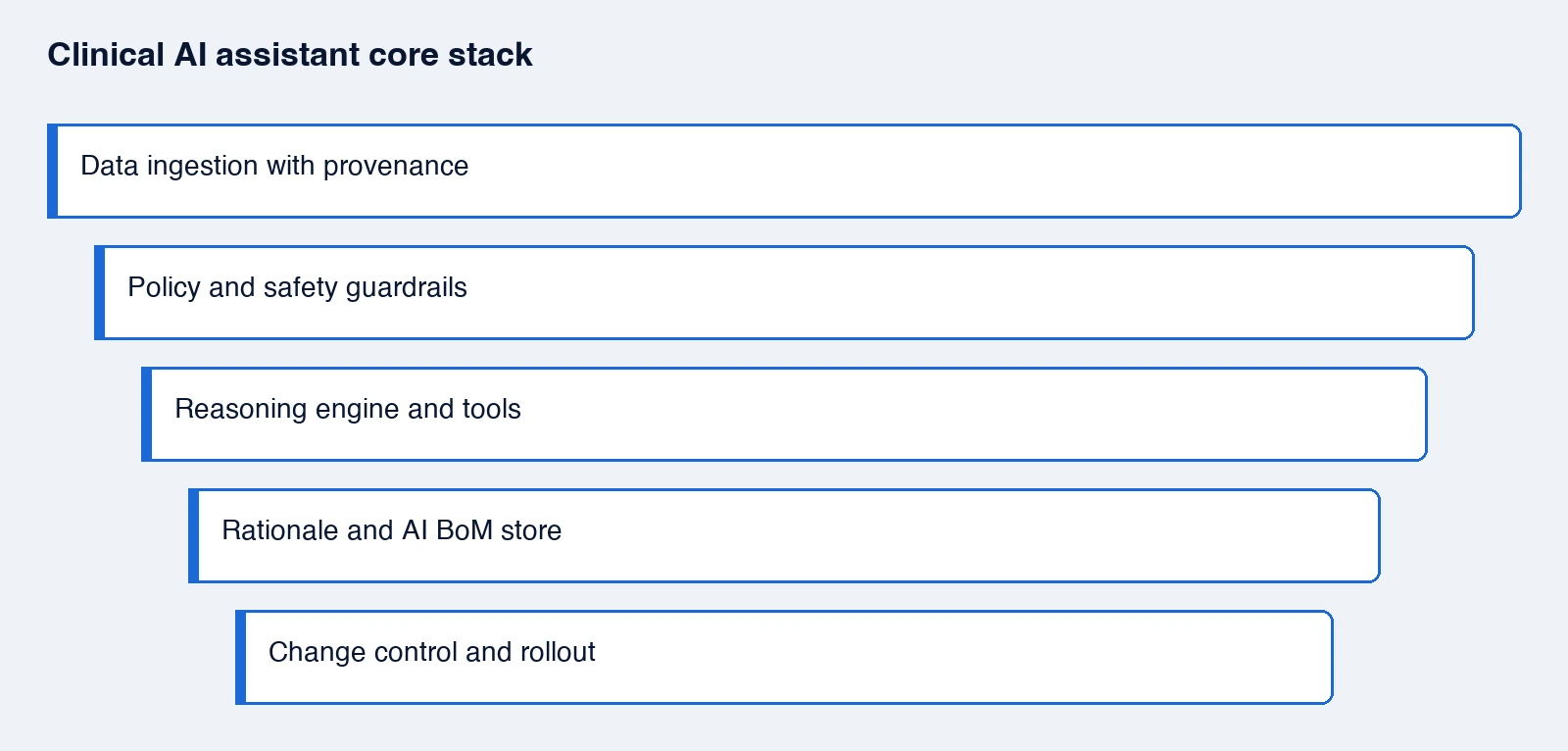
- Data ingestion with provenance. Parse EHR and ancillary sources into typed facts with timestamps, encounter linkage, and the facility that authorized access. Provenance is part of the safety case, not a logging afterthought.
- Policy and safety guardrails. Encode clinician-in-the-loop rules, scope of practice, forbidden actions, timeouts, and consent constraints as deterministic policies that sit between the model and any external effect.
- Reasoning engine and tools. Use the model for synthesis and planning, but push structured operations into tools with typed inputs and explicit preconditions. Critical flows become a sequence of checked tool calls instead of free-form generation.
- Rationale and AI bill of materials (BoM). Persist prompts, tool specs, policy versions, datasets, and model build hashes alongside the assistant's step-by-step reasoning trace. This supports post-hoc review and change impact analysis.
- Change control and rollout. Gate any update behind automatic tests, offline replay on curated cases, canaries, and rollback. Align these gates to the updates you said you would make and how you would verify them.
Deployment models: where should the assistant run?
Choose deployment to match PHI residency, latency, and integration posture. The model provider is only one input. Data gravity and control planes usually decide.
| Deployment model | PHI residency control | Latency to EHR tools | Update and rollback path | Typical use |
|---|---|---|---|---|
| On-device or facility edge | Maximum, stays on site | Lowest if tools local | Ops-heavy, slower fleet updates | Imaging rooms, OR, poor connectivity sites |
| Customer VPC/cloud | High, tenant-isolated | Low to moderate via private links | Strong infra-as-code and canaries | Multi-site providers, payers, HIEs |
| Vendor-hosted SaaS | Shared controls by vendor | Variable, depends on connectors | Fastest, vendor-managed | Startups in pilot, non-critical assistants |
Two implications follow. If you must honor strict data residency or site-level consent, edge or customer VPC keeps the control plane close to the data. If you need to learn fast with minimal infra, vendor SaaS is viable for read-only assistants where writebacks are mediated through the EHR's own API scopes.
Sequencing EHR integration for assistants
Assistants that last start with reads, then add events, then tightly-scoped writes. The order matters because every step teaches your safety system how to fail safely.

- Read-only patient context. Start with demographics, meds, problems, vitals, notes. Validate normalization and screen for missing or stale data. Build prompts and plans against real but harmless context.
- Evented reads with provenance. Subscribe to new labs, admissions, signed notes. Trigger assistant plans from deterministic events and store full provenance. Prove that your assistant does not act on unauthenticated or draft data.
- Tool-gated writeback. Only after the assistant has been trialed with reads, add writes through tools that require typed inputs and policy checks. For example, draft a message or a plan that must be explicitly accepted, or write a task to the EHR's inbox rather than changing a clinical record.
- Clinician acceptance gates. Keep a visible accept, edit, or reject step with attribution. The acceptance decision is both a safety brake and a feedback signal for later updates.
A practical caution: teams often try bulk exports early to accelerate training. That helps data prep, but it hides the real-time edge cases your policies must handle. If you cannot safely handle an evented lab result with missing units today, a weekly export will not fix it. Handle events first, then scale.
Designing safety so non-determinism never reaches the patient
Large models are non-deterministic. Clinical actions cannot be. The fix is not to avoid models but to contain them.
Use the model for interpretation and planning, not execution. Actions become tools with typed schemas, preconditions, and postconditions. The assistant proposes a plan. Policies validate scope, time windows, consent, and data sufficiency. Only then do tools execute, often producing drafts rather than final writes. For high-risk flows, require human acceptance or a second signal, such as a structured rule firing or an EHR-side CDS hook confirming context.
This pattern also aligns with update governance. When you change prompts, you re-run offline cases and check that plan shapes remain within policy. When you add or alter tools, you run contract tests on the tool boundary. When you revise policies, you inspect that previously permitted actions remain permitted where intended. Each class of change has a verification method and a rollback path.
Change control you can actually ship
A Predetermined Change Control Plan only works if it maps to your build and release system. Treat the plan as code.
- Classify changes. Prompts and retrieval changes are one class, model swaps another, tool specifications a third, safety policies a fourth. Each class has its own tests and evidentiary artifacts.
- Build offline replay. Maintain curated cases with ground-truth outcomes. Re-run these on every proposed change and persist deltas to your rationale store.
- Canaries and dark launches. Expose the new assistant to a small cohort or run it in shadow mode. Compare proposed actions and human acceptances against the current baseline.
- Rollback that is real. Rollbacks must restore prompts, model build, tools, and policies as a unit. If your storage or feature flags cannot do this atomically, your change plan is a wish, not a control.
As these practices mature, you can state exactly which updates you will make automatically, which require additional review, and which are out of scope. That specificity is what turns an approval barrier into a deployable cadence.
Build versus buy: models matter less than interfaces and tests
You will change models over the life of the assistant. That makes the model interface, the tool schema, and the test harness more valuable than any single model choice.
- Prefer a stable reasoning interface. Whether you call an internal model or a vendor API, wrap it behind a function that takes structured context and returns structured plans with citations to the inputs used.
- Test plans, not probabilities. Because models differ in tokenization, temperature, or batching, assertion-based plan tests are more robust than numeric thresholds on logit scores.
- Store the evidence. Persist which inputs, prompts, tools, and policy versions produced each action proposal. Without this, you cannot explain a regression or justify a rollback.
For many teams, starting with a vendor-hosted inference endpoint speeds iteration for read-only use cases. When writebacks and residency show up, you can migrate the reasoning layer behind the same interface to your VPC or edge without rewriting the assistant.
Where EHR integration usually fails and how to avoid it
The hardest problems are not API quotas. They are consent, time, and trust.
- Consent modeling. Codify who can authorize what, at which sites, and for how long. Assistants fail when they assume a patient or facility-wide consent that does not exist. A consent check is a policy, not a pop-up.
- Temporal scope. Assistants that pull any available data from any encounter generate misleading advice. Constrain by encounter, by treating team, or by time window, and justify every expansion in the rationale store.
- Human factors. If an assistant hides drafts deep in an inbox or times out during charting, no one will accept its output. Bring proposed actions to where clinicians already work, with one-step accept or edit.
For clinics evaluating integration partners or architectures, a read-first pilot can be shipped in weeks when you use certified APIs and vendor marketplaces. Writebacks take longer because scope and acceptance flows must be negotiated and tested on-site. BitLab supports both with a HIPAA-native approach through its healthtech fractional CTO offering and publishes details on connection options in its EMR and EHR integration services guide.
The table stakes for platform operations
Operations are now part of the product. If a reviewer cannot reconstruct a decision, a clinician cannot trust it in practice.
- Observability for reasoning. Log token budgets, tool latencies, policy denials, and acceptance rates. Alert on drift in plan shapes, not just CPU.
- PHI-aware analytics. Separate telemetry from patient data or aggregate it within the residency boundary. Analysts must see patterns without pulling raw notes off site.
- Incident response. Treat a policy misfire like a production incident. Halt actions, roll back, and publish a post-incident record into the rationale store.
These are not add-ons. They determine whether the assistant stays on after the pilot and whether it can expand to new sites with minimal rework.
Statistics and recent guidance
- In August 2025, the U.S. Food and Drug Administration issued guidance titled "Marketing Submission Recommendations for a Predetermined Change Control Plan for Artificial Intelligence-Enabled Device Software Functions." The guidance states its recommendations are intended to support iterative improvement through modifications to AI-enabled devices while continuing to provide a reasonable assurance of device safety and effectiveness. Source: FDA (2025-08).
- On April 7, 2026, the National Institute of Standards and Technology published a concept note for the AI Risk Management Framework that describes AI-enhanced deterministic diagnostic assistants which utilize AI bills of materials to provide traceable, auditable rationales for recommendations. Source: NIST (2026-04-07).
Our take
We think most teams over-invest in model choice and under-invest in policy, tools, and evidence. The FDA's August 2025 guidance makes change explicit: you will keep modifying your assistant. If you do not separate reasoning from action with deterministic tools and policies, each model or prompt update becomes a new safety problem to re-argue. We also think deferring a rationale store is a mistake. The NIST April 2026 concept note points to AI bills of materials and auditable rationales for trustworthy operation in critical settings, and that lines up with what clinicians ask when something looks wrong: what did the assistant see, how did it decide, and can I replay it? Our bias is to start with read-only, evented integrations, then add tool-gated writes with human acceptance. That sequence keeps errors observable and recoverable. Teams that reverse it usually end up pausing rollouts to rebuild policy and test harnesses under pressure.
FAQ
What is a Predetermined Change Control Plan for clinical AI?
It is a documented plan describing which parts of your AI-enabled device software function you will modify, how you will verify those changes, and how you will maintain safety and effectiveness when you deploy them. Since August 2025, the FDA has issued recommendations specific to these plans, which shifts design work toward explicit tests, rollback paths, and evidence capture.
Do I need a model-specific validation for every update?
Validate the behavior class you changed. Prompt or retrieval changes get replay tests and plan-shape assertions. Tool changes require contract tests on inputs and postconditions. Policy changes need allow and deny case tests. If you swap a model, re-run the full curated suite. Tie each class of change to its gate and rollback so you do not retest the universe for a small prompt edit.
How should a clinical assistant write back to an EHR safely?
Use tool-gated writes with typed inputs, explicit preconditions, and a visible human acceptance step for high-impact actions. Start with drafts or tasks rather than direct record changes. Constrain scope by encounter or time, and store the full rationale and provenance so any reviewer can reconstruct why a write was proposed and accepted.
Where should the assistant run for HIPAA compliance?
Pick the deployment model that matches your data residency and integration needs. Facility edge or a customer VPC gives stronger PHI residency control and predictable latency to local systems. Vendor-hosted SaaS can be acceptable for read-only assistants during pilots. The decision turns on PHI flow, not the model alone.
How long does it take to pilot a clinical assistant?
A read-only pilot is often gated by integration access, curated test cases, and clinician workflow fit. When you use certified APIs and keep actions read-only, you can stand up a pilot quickly. Writebacks add time due to scope, policy review, and on-site testing. The fastest path is read-first with evented triggers, then gated writes.
Next step: sketch your assistant's policy layer, tool boundaries, and rationale store before you choose a model. If those three are crisp, deployment and model swaps become execution details rather than redesigns.
The audit is free. Another quarter of guessing is not.
Book the Free 48-Hour Audit