EMR integration strategies for healthcare platforms

The short answer
EMR integration strategies now hinge on three moves: design FHIR-first while planning non-FHIR fallbacks, route cross-network retrievals through TEFCA Facilitated FHIR where it fits your data-sharing agreements, and embed payer-facing prior authorization loops that meet the current CMS decision timelines. Wrap this in consent-aware access controls and event-driven synchronization.
For how each vendor lets developers in (Epic, athenahealth, eClinicalWorks, ModMed and more), see our EMR integration guides.
What changed since 2024 and how it reshapes your plan
Two dated shifts now govern roadmaps.
-
TEFCA Facilitated FHIR took effect on March 8, 2026. That introduced a standardized path to exchange clinical data across networks through Qualified Health Information Networks. The consequence is practical: you can add a network-based FHIR route and reduce bespoke, bilateral builds for certain cross-organization queries.
-
CMS stated on July 27, 2026 that impacted payers must send prior authorization decisions to providers within 72 hours for expedited requests and seven calendar days for standard requests. This does not guarantee a plug-in endpoint inside every EMR. It does put a clock on your care coordination loop and changes how you design status tracking, reminders, and escalation.
Together these updates change sequencing. Teams that once led with static document exchange now need to plan for cross-network FHIR retrieval and payer decision-state handling early, or they refactor the care workflow engine mid-project. The right strategy meets those dated realities first, then fills in vendor-specific depth where needed.
A practical integration blueprint for 2026
Aim for a layered architecture. Keep clinical data access, payer workflows, and product logic separate so you can evolve each without breaking the rest.
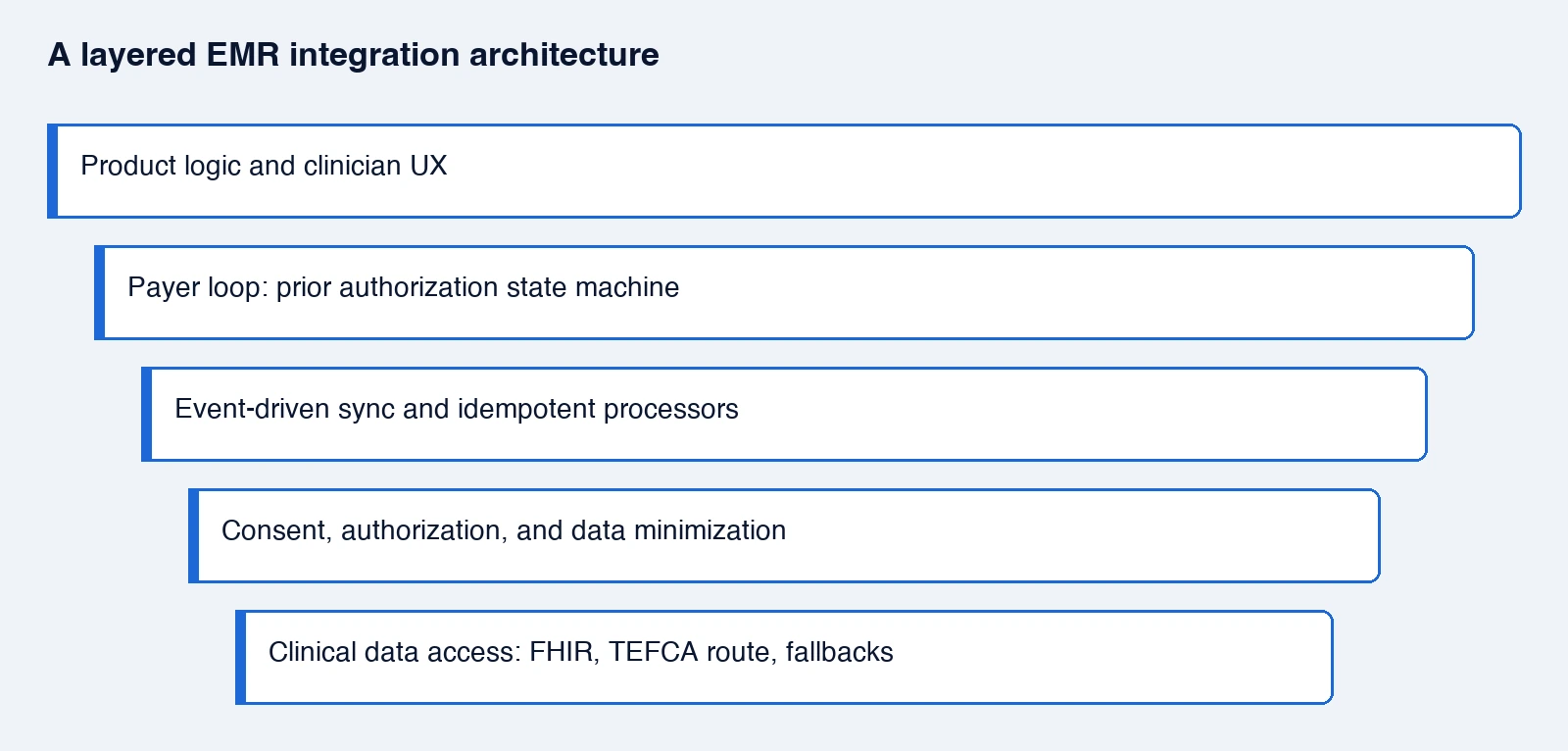
- Clinical data access: default to FHIR, plan fallbacks
-
Primary path. Build a FHIR client that handles resource retrieval, search, paging, and conditional reads. Start with Patient, Practitioner, Encounter, Observation, Condition, Procedure, MedicationRequest, and DocumentReference. Capture a per-source capability matrix so the app degrades gracefully when a resource or search parameter is not present.
-
Network route. Since TEFCA Facilitated FHIR is in effect as of March 2026, add a connector that can route appropriate queries through a QHIN pathway. Use it for cross-network patient data retrieval where your policy and agreements allow it. Keep routing decisions in configuration so you can shift traffic between vendor APIs and TEFCA as coverage expands.
-
Fallbacks. Maintain adapters for HL7 v2 ADT and results messages, vendor bulk exports, or scheduled flat-file feeds. Transform at the edge, normalize into your canonical FHIR profile inside the platform, and tag provenance for downstream analytics and audits.
- Consent, authorization, and data minimization: make it a shared service
-
Central consent service. Represent patient or organizational authorization as machine-readable policies tied to resource types and attributes. Enforce rules at query build and again when filtering responses. Log every decision with reason and timestamp.
-
Minimum necessary. Define scopes per feature. A navigation module often needs Encounter summaries and an active Problems subset. Narrow FHIR queries and maps. Less data reduces exposure and review friction.
-
Break-glass. Implement an explicit override with reason codes and short time limits. Tie it to alerting and post-event review.
- Event-driven sync: your state machine beats a nightly job
-
Event capture. Subscribe to available change feeds where vendors support them. Treat HL7 v2 inbound messages, webhook callbacks, and FHIR Subscriptions as event sources. Normalize into a queue with a consistent envelope.
-
Idempotent processors. Build consumers that can handle duplicates and out-of-order messages. Use resource IDs, version IDs, and lastUpdated where available to reconcile.
-
Conflict resolution. Prefer the source-of-truth record for clinical state. For operational state like appointment reminders, prefer your own unless a vendor event supersedes it. Encode rules in code, not in tickets.
- Payer integration and prior authorization: build for the clock, not the form
-
Case model. Represent a prior authorization request as a state machine with explicit timers for expedited and standard cases. Persist submission, acknowledgement, decision, and appeal events.
-
Channel adapters. Support API-based submissions where payers expose them and support portals or EDI through RPA or clearinghouses where they do not. Encapsulate each channel behind a common interface so you can add or swap adapters without rewriting the case logic.
-
Clinician UX. Surface countdowns, missing-attachment detection, and next-action prompts. Send reminders before the regulatory windows expire and escalate when needed. Record everything for compliance and appeals.
- API styles: app-embedded vs backend service
Most platforms end up running both. The question is which one owns a given workflow.
| SMART on FHIR (app-embedded) | Backend service (system-to-system) | |
|---|---|---|
| Best for | Clinician-in-context tasks, single-click launch from the chart | Longitudinal retrieval, analytics, batch jobs |
| Permissions | Encounter-scoped, user-delegated | Client credentials, system-level |
| Tokens | Short lifetimes, designed around the launch context | Long-lived, rotated on a schedule |
| Caching | Sparingly, because chart context moves | Freely, bounded by how fresh the source needs to be |
| Main constraint | The token model and launch context | Per-source rate limits and concurrency ceilings |
Keep token handling, caching, and rate limiting separate for each so you can tune them independently.
- Data modeling and mapping: treat it as product work
-
Canonical model. Choose a set of FHIR resource profiles as the internal shape. Build mapping libraries per source. Version them as you would any other artifact.
-
Validation. Use schema and business rule checks before persisting. Fail closed on unsafe transforms. Flag quality issues for human review.
-
Backfills and merges. For identity, implement deterministic and probabilistic matching. For data completeness, schedule targeted backfills rather than bulk pulls you cannot review.
- Security and operations: privacy-by-default
-
Secrets and keys. Rotate on a schedule. Store outside the codebase. Shorten token lifetimes where possible.
-
PHI minimization. Keep only what you use. Encrypt at rest and in transit. Use field-level encryption for sensitive subsets.
-
Monitoring. Instrument every integration with latency, error class, and retry depth. Alert on unusual response shapes or sudden volume shifts.
- Testing and rollout: real data only when you are ready
-
Fixtures. Start with synthetic data that mimics edge cases. Add de-identified records under a data use agreement when available.
-
Contract tests. For every vendor adapter, lock a set of request and response samples. Test them in CI so refactors do not break production.
-
Rollout plan. Release by source, by feature, then by cohort. Keep a kill switch per adapter. Watch queue depth and decision timers for payer flows as the leading indicators.
For teams who inherited a stall, an audit of the architecture and adapters pays back quickly. If that is you, a pragmatic walkthrough like the one in our integration recovery guide for EMRs may help you triage what to fix first.
Vendor-by-vendor realities you should plan for
No two EMR vendors expose the same combination of resource coverage, search parameters, or event types. A portable plan expects difference rather than fighting it.
-
Capability matrices. For each source, document allowed resources, search filters, max page sizes, and supported sort orders. Put the matrix next to code and keep it versioned.
-
Rate limits and quotas. Model throughput. Implement token buckets in your client. Spread batch pulls across windows that will not interfere with clinician traffic.
-
Bulk vs on-demand. Use on-demand for workflows that require freshness and specificity. Use bulk jobs for longitudinal analytics and attribution where latency is less important. Route heavy data off-hours when possible.
-
Attachments and imaging. Large binary payloads are the fastest way to blow your error budget. Stream where possible. Verify content types. Store checksums.
-
Patient identity resolution. Expect differences in MRN formats and cross-facility identifiers. Make merges reviewable and reversible. For patient-matched queries, keep a record of the match method and confidence.
Designing consent for cross-network access under TEFCA
With TEFCA Facilitated FHIR in effect as of March 2026, many teams add a cross-network route. That invites two practical consent questions you need to answer in code.
-
What counts as an authorized purpose. Encode the allowed purposes in your policy engine and tie them to specific request builders. If a route requires treatment purpose, build different queries for care navigation than for marketing or analytics.
-
Who initiates the exchange. For patient-mediated access, build flows that record explicit consent for a named sharing episode. For provider-initiated access, record the provider role, the treating relationship, and the minimum-necessary decision at the time of request.
Audit these decisions the same way across routes. A common consent engine prevents drift between vendor APIs and TEFCA.
Building the payer loop into clinical workflows
The dated CMS response windows change the rhythm of care coordination. You will succeed if your platform treats prior authorization as a first-class workflow rather than a sidecar form.
As of July 27, 2026, the windows your state machine has to respect are these.
| Request type | Payer decision window | What the timer drives |
|---|---|---|
| Expedited | 72 hours | Escalation before the window closes |
| Standard | 7 calendar days | Attachment reminders, need-more-info chasing |
-
Timer-first design. Create expedited and standard clocks when a case opens. Base your reminders and escalations on those timers rather than on calendar time. Keep a visible clock in the clinician view.
-
Status normalization. Map payer-specific statuses into a common set: submitted, pending, need-more-info, approved, denied, appeal. Store the native status as well for audits. Track attachment requests explicitly.
-
Documentation integrity. Capture the clinical criteria, attached notes, and medical necessity justifications. Generate payer-specific packets from a single structured source.
-
Cross-channel resilience. If an API submission fails, fall back to a different channel without losing the timer or case history. If a portal step is manual, design a checklist and record the completion.
Build-vs-buy and budgeting choices
You can assemble this architecture from vendor APIs, network routes, and custom adapters, or you can bring in targeted help for the riskiest legs. The right split depends on your regulatory scope, the number of EMRs you must support, and the payer mix in your market. If you need outside review of your plan, a short advisory engagement often reveals the biggest integration risks before you commit to a full build.
For teams that want outside eyes on architecture and compliance choices, a structured review like our healthcare fractional CTO advisory outlines security boundaries, consent modeling, and integration sequencing without locking you into a build path.
Implementation patterns that reduce future rework
A few habits pay back across vendors and years.
-
Keep data routing in configuration. Decide in YAML or a service registry whether a given query goes to a vendor API or to TEFCA. That lets you adapt without redeploying core services.
-
Make mapping libraries swappable. Treat each vendor map as a package with its own tests. Deploy a new map without touching the canonical model.
-
Encode business rules in code. If a prior auth needs a cardiology review before submission, write the rule. Avoid one-off instructions in tickets that nobody reads later.
-
Watch the logs for structure, not just text. Parse error bodies. Classify into retryable, permission, schema, and data-quality buckets. Route each bucket to a different handler.
-
Document the unhappy path. For every integration, write a one-page runbook that states how to recover from outages, token revocations, and schema changes. Include screenshots.
Statistics
-
As of March 8, 2026, TEFCA Facilitated FHIR is in effect, per the ONC TEFCA Recognized Coordinating Entity, with caucuses approved and a published timeline noting Fall 2025 for Facilitated FHIR and effectiveness on March 8, 2026. [ONC TEFCA RCE]
-
As of July 27, 2026, impacted payers are required to send prior authorization decisions within 72 hours for expedited requests and seven calendar days for standard requests. [Centers for Medicare & Medicaid Services Prior Authorization API FAQs]
Sources: ONC TEFCA Recognized Coordinating Entity (The Sequoia Project), TEFCA Topics in Change Management (effective Mar 8, 2026). Centers for Medicare & Medicaid Services, Prior Authorization API FAQs (published July 27, 2026).
Our take
We think teams should prioritize a TEFCA-capable FHIR client before they deepen vendor-specific work. The reason is mechanical. As of March 8, 2026, Facilitated FHIR is in effect. A portable client and a routing layer let you use network exchange where it fits and fall back to vendor APIs when it does not. Many teams do the reverse and hardwire to one EMR first. That piles business logic on top of a single vendor's quirks. When you later add a QHIN route or a second EMR, you end up rewriting consent checks, mapping, and pagination. We would build the FHIR core, consent service, and routing configuration first, then add vendor adapters as pluggable edges. For prior authorization, we would model the timers up front based on the CMS response windows and attach channel adapters behind a common case interface. That way, adding a new payer method or switching from portal to API does not change the clinician's workflow or the compliance record.
FAQ
What is the fastest way to start EMR integration without breaking compliance?
Start with a FHIR client and a consent service that enforces minimum-necessary access. Add a capability matrix for your first EMR so the app behaves well when a resource or search is missing. Use synthetic data to exercise edge cases, then move to de-identified records under an agreement. Instrument errors and latency from day one.
How should we choose between SMART on FHIR and a backend service?
Pick SMART on FHIR for clinician-in-context tasks that need chart launch and encounter-scoped permissions. Choose a backend service for longitudinal retrievals, analytics, and batch jobs. Many platforms use both. Keep token handling, caching, and rate limiting separate so you can tune them independently.
How does TEFCA change cross-network data access strategy?
As of March 8, 2026, TEFCA Facilitated FHIR is in effect. You can add a cross-network FHIR route through a QHIN where your agreements permit it. Put routing in configuration so the same query can go vendor-direct or over TEFCA. Keep consent checks consistent across both paths and log every decision.
How do the CMS prior authorization timelines affect platform design?
As of July 27, 2026, impacted payers must return decisions within 72 hours for expedited requests and seven calendar days for standard ones. Model those clocks in your case state machine. Drive reminders, escalations, and reporting from the timers. Normalize payer statuses and preserve native values for audits.
What is the safest way to handle vendor differences without constant refactors?
Create a canonical FHIR profile set inside your platform. Build per-vendor mapping packages with their own tests. Keep a capability matrix and route decisions in configuration. Make processors idempotent and tolerant of out-of-order events. Document a per-integration runbook so on-call can recover quickly.
Closing
Anchor your plan on a TEFCA-capable FHIR core, a consent engine, and a prior authorization state machine that respects the current CMS windows. Then add vendor adapters and payer channels as swappable edges. Start small, instrument thoroughly, and expand by cohort once the event loop stays healthy.
The audit is free. Another quarter of guessing is not.
Book the Free 48-Hour Audit